










Introduction to Colorwork Cup Cozy Crochet Patterns
If you have ever admired the intricate, textured look of knitted colorwork but found yourself more comfortable holding a crochet hook than a pair of needles, then the knit-look crochet cup cozy pattern is about to become your new favorite project. This ingenious technique uses specific crochet stitches to mimic the appearance of traditional knitting, resulting in a finished piece that most people would never guess was crocheted. The colorwork cup cozy combines two beloved crafting elements — the visual appeal of stranded colorwork and the accessibility of crochet — into one small, satisfying, and genuinely useful project.
Cup cozies have long been a staple of the handmade gift world, and for good reason. They are quick to complete, require minimal yarn, and serve a practical purpose by insulating your hands from a hot beverage while also keeping your drink warmer for longer. When you add colorwork to the mix, however, a simple cup sleeve transforms into a miniature canvas for geometric patterns, classic Fair Isle motifs, or even seasonal designs. The knit-look texture elevates the final product far beyond what most people expect from a crocheted item.
This article will walk you through everything you need to know about creating your own simple colorwork cup cozy using knit-look crochet techniques. Whether you are a complete beginner curious about colorwork for the first time or an experienced crocheter looking to add a new skill to your repertoire, the following sections will give you the materials knowledge, stitch guidance, pattern instructions, and finishing tips to produce a beautiful, professional-looking coffee sleeve you will be proud to use or gift to someone special.
Why Knit-Look Crochet Is the Perfect Technique for Beginners
The genius of knit-look crochet lies in the use of a stitch called the waistcoat stitch, sometimes also referred to as the knit stitch or center single crochet. Unlike traditional single crochet, which inserts the hook under both loops of the stitch below, the waistcoat stitch inserts the hook directly into the vertical legs of the stitch, producing a column of interlocked V-shapes that is nearly indistinguishable from stockinette knitting. The result is a tighter, more structured fabric with a smooth, even surface that showcases colorwork motifs with exceptional clarity.
Beginners often find that knit-look crochet is less intimidating than actual knitting because you are still working with just one hook and one active loop at a time. There is no risk of dropping stitches off a needle, no purling required, and no need to manage multiple live stitches simultaneously. The technique does require a slightly looser tension than standard crochet to maintain flexibility in the fabric, but with a little practice, this adjustment becomes second nature and the results are consistently impressive even for those who have only recently picked up a crochet hook.
For a cup cozy specifically, the waistcoat stitch is ideal because the small scale of the project means you will see results quickly and can correct any tension issues without having invested hours of work. A standard coffee cup sleeve requires only about sixty to eighty stitches around and eight to ten rows in height, making it one of the fastest and most forgiving projects you can choose when learning a new technique. You will have a functional, beautiful item to show for your effort within a single crafting session.
Materials and Tools You Will Need
Choosing the right yarn is the single most important decision you will make when embarking on a colorwork cup cozy project. Because the waistcoat stitch produces a denser, tighter fabric than standard crochet, you want a yarn that has good stitch definition — meaning the individual plies are clearly visible and the yarn does not bloom or fuzz excessively after working. Smooth, tightly plied yarns in wool, cotton, or acrylic blends tend to perform best. Many crafters favor a fingering-weight or sport-weight yarn for cup cozies, as these create a fabric with the right thickness and drape for a coffee sleeve without adding unnecessary bulk.
For colorwork, you will need a minimum of two yarn colors: a main color (MC) and a contrast color (CC). Classic combinations include deep jewel tones paired with cream or off-white, navy and red for a nautical feel, or earthy terracotta and sage green for a more contemporary aesthetic. The key is to choose colors with sufficient contrast so that the colorwork motif reads clearly against the background. Holding the two skeins up side by side in natural light is a reliable way to assess whether the contrast level will be satisfying in the finished piece.
In terms of tools, you will need a crochet hook that is one to two sizes larger than the yarn label recommends, since the waistcoat stitch naturally tightens the fabric. A 4.0mm or 4.5mm hook is a common starting point for sport-weight yarn, but always work a small gauge swatch before beginning the pattern to ensure your finished cozy will fit a standard coffee cup. Additional supplies include a yarn needle for weaving in ends, scissors, and stitch markers to indicate the beginning of each round. A row counter app on your phone or a physical counter can also be helpful when tracking color changes.
- Main yarn color (MC): Approximately 30–40 yards of sport or fingering weight yarn
- Contrast yarn color (CC): Approximately 15–20 yards of the same weight yarn
- Crochet hook: One to two sizes larger than yarn label suggests (typically 4.0–4.5mm)
- Yarn needle: For weaving in ends and seaming if working flat
- Stitch markers: To mark the beginning of rounds and pattern repeats
- Scissors: Sharp embroidery or craft scissors for clean cuts
- Measuring tape: For checking gauge and cup circumference

Understanding Colorwork Basics in Crochet
Colorwork in crochet refers to any technique that involves working with two or more yarn colors within the same project to create a pattern or motif. The most common methods include intarsia, tapestry crochet, and stranded colorwork, each with its own approach to managing multiple yarns and carrying the non-working color across the fabric. For a cup cozy using the waistcoat stitch, stranded colorwork and tapestry crochet are both excellent choices, with tapestry crochet being slightly easier for absolute beginners because the non-working yarn is carried inside the stitches rather than floating loosely across the back of the work.
In tapestry crochet, you hold both yarn colors in your non-dominant hand throughout the work and simply pick up whichever color is called for in the pattern at each stitch, while the other color is crocheted over and encased within the body of the stitches. This technique eliminates the need to weave in many ends and creates a neat, padded fabric that is slightly stiffer than standard crochet — a quality that actually works in the cup cozy’s favor, as it helps the sleeve maintain its cylindrical shape around the cup. The encased yarn also adds a small but noticeable layer of insulation.
Reading a colorwork chart is a skill that may feel unfamiliar at first but becomes intuitive very quickly. Charts are grids where each square represents one stitch and each row of squares represents one row or round of crochet. Filled squares in two different colors indicate which yarn to use at each stitch. For the knit-look waistcoat stitch, you will typically work in continuous rounds without turning, reading the chart from right to left on every round. Simple geometric patterns such as diamonds, chevrons, stripes, or small repeating motifs are the most beginner-friendly chart styles and produce striking visual results even with just two colors.
Carrying Yarn and Managing Tension During Colorwork
One of the most common challenges new colorwork crocheters face is maintaining consistent tension while managing two strands of yarn simultaneously. The carried yarn — the color not currently in use — should be held at a neutral tension: not so tight that it puckers the fabric and not so loose that it causes the stitches above it to become baggy or uneven. A helpful trick is to periodically spread the stitches on your hook across the full width of the hook shaft before crocheting over the carried yarn, which naturally keeps the carried strand at the right tension without requiring you to consciously measure it each time.
Another common issue is color bleeding or unevenness at color change points within a round. To keep transitions crisp, always complete the last yarn-over of the old color stitch with the new color. This means that when you are about to switch from your main color to your contrast color, you will insert the hook into the next stitch, pull up a loop with the main color, and then use the contrast color to complete the yarn-over that closes the stitch. This single adjustment makes an enormous difference in the cleanliness of the color change and ensures your motifs have sharp, defined edges.
Managing yarn tangles is also something worth planning for before you begin. When working in the round with two colors, the yarns will naturally twist around each other after several rounds. Many crafters wind their working yarn into small palm-sized butterflies or use yarn bobbins to reduce the weight and tangle potential of each strand. Pausing every four to six rounds to unwind any twists takes only a few seconds and prevents the frustrating mess that can result from ignoring this issue. Some crafters also like to keep their two yarn balls in separate small bowls or bags to prevent them from rolling together on the floor.
Step-by-Step Pattern Instructions for the Cup Cozy
Before casting on, take a moment to measure the cup you intend to make the cozy for. A standard tall paper coffee cup has a circumference of approximately eleven inches at the center, though this can vary between brands and sizes. Work a gauge swatch of ten waistcoat stitches and ten rows in your chosen yarn and hook size, then measure the swatch and calculate how many stitches you will need to reach the desired circumference. Most standard cozies work out to approximately sixty-four to seventy-two stitches in the round using sport-weight yarn, but your specific gauge will determine the exact number for a well-fitting sleeve.
To begin, create a foundation chain using your main color that equals the number of stitches in your stitch count, then join with a slip stitch to form a ring, being careful not to twist the chain. Work one round of standard single crochet into each chain stitch, then join with a slip stitch to the first stitch. This foundation round establishes the base of your waistcoat stitches. From round two onward, insert your hook into the vertical legs of each stitch rather than under the top loops, and complete each stitch as a standard single crochet. Place a stitch marker at the beginning of each round to track your progress.
Introduce the contrast color in round three or four, depending on your chosen pattern. A simple and visually effective beginner colorwork motif is a two-row stripe of contrast color every four rows of main color, which creates a clean horizontal band pattern. For a more complex design, a five-stitch diamond repeat across the round produces a classic Scandinavian-inspired look that photographs beautifully. Continue working in the round, following your chosen colorwork chart and switching colors as indicated, until the cozy reaches the desired height of approximately three to three and a half inches. Finish with one round of slip stitches in the main color for a neat edge, then fasten off and weave in all ends securely.
Adding a Button Band or Slip-On Finish
Cup cozies can be finished as seamless slip-on sleeves or as flat strips that button around the cup, and each option has its advantages. The seamless sleeve is faster to make and has a cleaner exterior appearance, making it ideal for gifting. The button-band version, worked flat and then seamed or buttoned together, allows for easy size adjustment and makes it simpler to remove the cozy from the cup for washing without requiring you to slide it over the cup’s contents. For a colorwork cozy, the seamless construction generally showcases the pattern more elegantly since there is no interruption from a button band.
If you prefer the button closure option, work your cozy as a flat rectangle instead of in the round. Cast on your stitch count as a foundation chain, then work back and forth in rows using the waistcoat stitch. Note that when working flat, you must turn the work at the end of each row, which means reading alternate rows of your colorwork chart from left to right rather than right to left. Add two or three buttonhole rows at one short end of the rectangle by creating small chain loops at regular intervals in the final few rows, then sew two or three corresponding buttons onto the opposite short end. The result is an adjustable, removable cozy that works across different cup sizes.
To add a small decorative element without the complexity of a full button band, consider adding a single crocheted flower, a small bow made from a length of ribbon, or an embroidered monogram to the finished cozy. These additions can be worked separately and then sewn onto the cozy with a yarn needle, allowing you to customize each one individually. A set of cozies in coordinating colorwork patterns but with personalized decorative initials makes an exceptionally thoughtful handmade gift for coffee-loving friends and family members, and the entire set can be completed in a single weekend of relaxed crafting.
Caring for Your Finished Cup Cozy and Troubleshooting Common Issues
Once your cup cozy is complete, proper care will ensure it maintains its shape, color vibrancy, and structural integrity through repeated use and washing. The care instructions depend almost entirely on the fiber content of the yarn you chose. Pure wool cozies should be hand-washed in cool water with a gentle wool wash, then pressed flat and left to air dry away from direct sunlight or heat sources. Acrylic and cotton blends are generally machine washable on a gentle cycle, though it is still advisable to place them in a mesh laundry bag to prevent snagging. Always check the yarn label before washing and test a small swatch if you are uncertain about a particular fiber’s behavior when wet.
One of the most common issues crafters encounter with finished colorwork cozies is puckering or drawing in at the color change points. This is almost always a tension issue that can be prevented by consciously loosening the carried yarn strand as described earlier, but if your finished cozy does pucker slightly, a gentle wet blocking session can often correct the problem. Soak the cozy in lukewarm water for ten to fifteen minutes, then press out the excess water gently without wringing, and use rust-proof pins or blocking wires to stretch the cozy to its correct dimensions on a foam blocking mat. Allow it to dry completely in this pinned position and the stitches will relax and even out beautifully.
Another frequent challenge is the cozy turning out too small or too large for the intended cup. If the cozy is too tight, try working the same pattern with a hook one size larger and re-checking your gauge before beginning the full project. If it is too loose and slides around on the cup, try blocking the finished cozy over the cup itself while it is still slightly damp, which allows the fabric to take on the exact shape of the cup as it dries. A small line of non-slip fabric paint or silicone applied to the interior of the cozy can also help it grip the cup surface and stay in place during everyday use.
Pattern Variations and Creative Customizations
Once you have mastered the basic colorwork cup cozy pattern, the creative possibilities expand enormously. Try incorporating a third color for a more complex stranded colorwork look reminiscent of traditional Norwegian or Icelandic textile designs. You can also experiment with different colorwork motifs beyond simple stripes and diamonds — snowflakes, hearts, tiny trees, and geometric stars all translate beautifully to the small scale of a cup cozy and can be charted on graph paper or designed using free online chart-making tools before you begin crocheting.
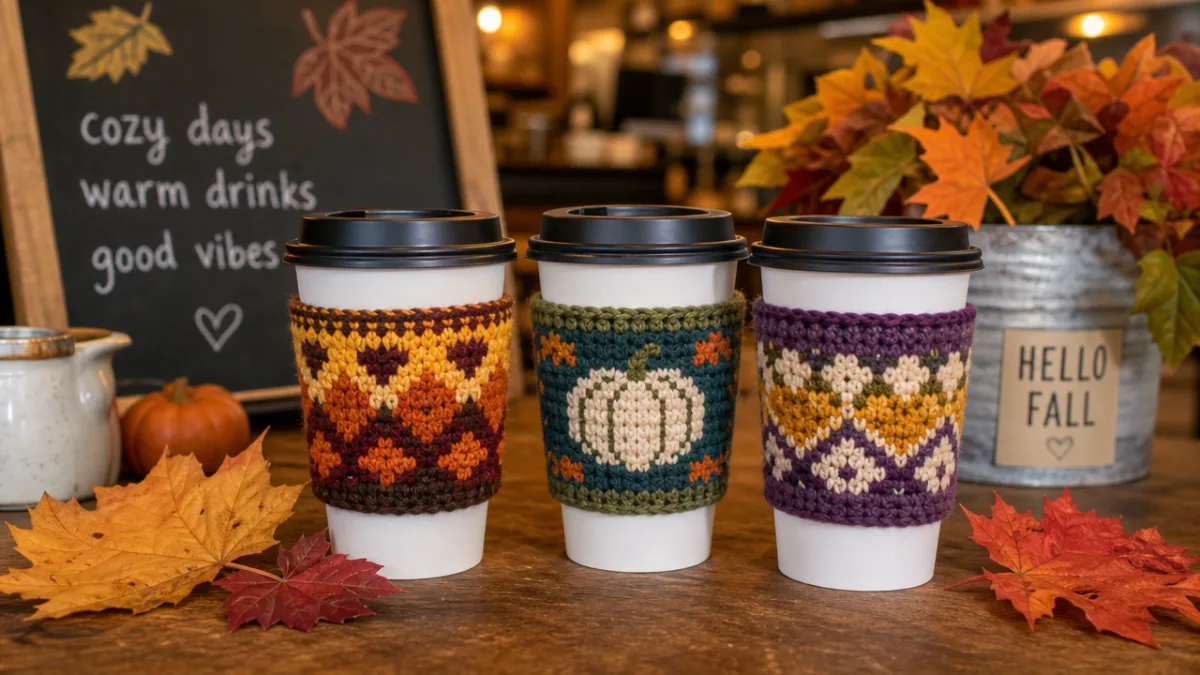
Seasonal variations are among the most popular cup cozy customizations. An autumn cozy might feature a harvest palette of burnt orange, golden yellow, and deep brown with a simple leaf motif repeated around the band. A winter holiday version could incorporate classic red and white with a snowflake or reindeer silhouette. Spring and summer cozies look wonderful in pastel colorways with simple floral or striped designs. By keeping your materials list minimal — just two small balls of yarn and a hook — you can build a collection of seasonal cozies that rotate throughout the year without requiring a significant investment of money or time.
Finally, consider scaling up the cup cozy pattern to create matching Accessories. The same waistcoat stitch colorwork technique can be applied to travel mug cozies, French press cozies, teapot cozies, and even small plant pot covers. A coordinated set of kitchen and dining accessories worked in the same colorwork motif and color palette makes a stunning handmade gift set and demonstrates just how versatile and adaptable this deceptively simple knit-look crochet technique truly is. The cup cozy is not just a beginner project — it is an introduction to a whole world of colorwork possibilities waiting to be explored one stitch at a time.








What do you think?
It is nice to know your opinion. Leave a comment.