










How to Make a DIY Nature Journal for Kids: A Complete Guide to Outdoor Discovery
Why Nature Journaling Is the Perfect Activity for Children
Nature journaling is one of those rare activities that blends creativity, science, and outdoor exploration into a single, deeply enriching experience for children. Unlike screen-based entertainment, a nature journal invites kids to slow down, observe carefully, and engage their senses in ways that a smartphone or tablet simply cannot replicate. The practice has been embraced by educators, child psychologists, and naturalists for generations because it cultivates curiosity in a completely organic and self-directed way.
When a child sits beside a creek to sketch a frog or presses a fallen maple leaf into the pages of a homemade book, they are doing something profoundly important: they are building a relationship with the natural world. That relationship, formed during childhood, tends to last a lifetime. Studies in environmental education consistently show that children who spend time observing and recording nature are more likely to grow into adults who care deeply about conservation and environmental stewardship. A simple journal is the beginning of that long journey.
Beyond environmental awareness, nature journaling supports a wide range of developmental skills. Fine motor skills improve as children practice drawing and writing. Observational thinking sharpens as they learn to notice details like the veining on a leaf or the pattern of clouds. Patience grows as they wait for a butterfly to land. And emotional regulation flourishes in the calm, restorative environment of the outdoors. This one activity quietly builds the whole child in ways parents and teachers often find remarkable and deeply satisfying to witness.
Gathering Your Supplies: What You Need to Get Started
One of the most wonderful things about making a DIY nature journal is that it requires very few materials and almost no budget. The goal is not to create a polished product from an art supply store but to put together something personal, tactile, and meaningful that a child feels genuine ownership over. When kids help assemble their own journal, they are far more motivated to actually use it, filling its pages with observations, drawings, and discoveries gathered from backyards, parks, and woodland trails.
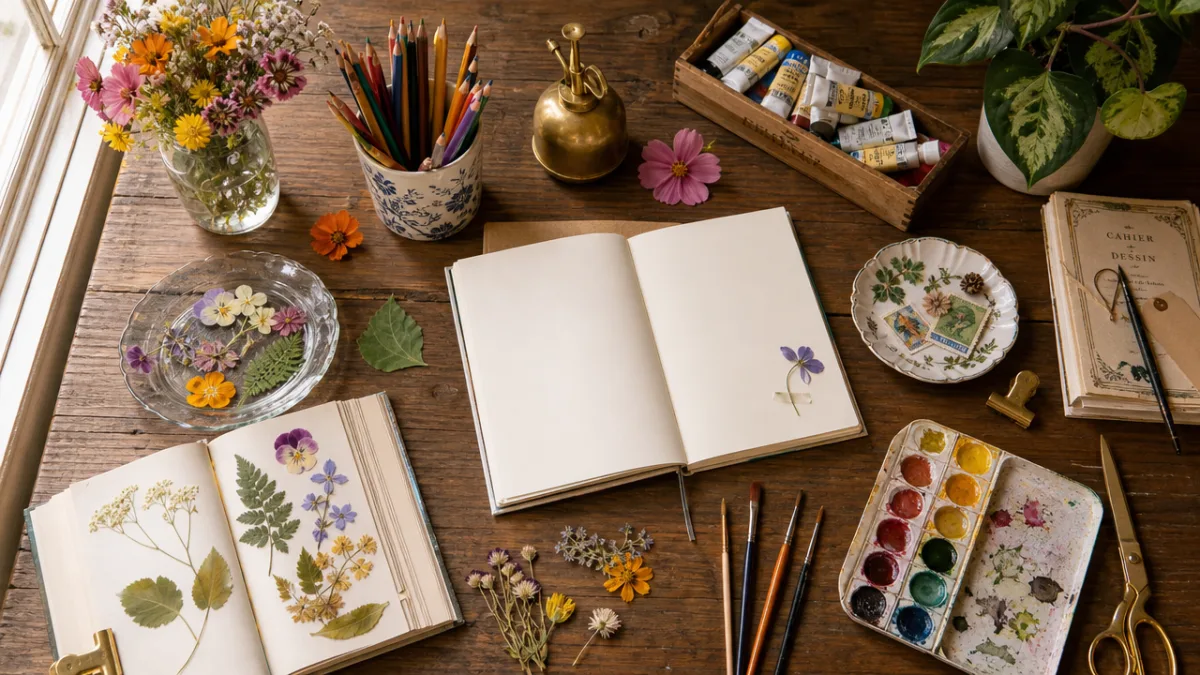
For the journal itself, you will need a handful of basic supplies that most families already have at home. A stack of plain white printer paper or watercolor paper works beautifully as the interior pages. Thicker cardstock, a piece of cardboard from a cereal box, or even a repurposed hardcover book cover can serve as the exterior. Twine, yarn, ribbon, or binder rings can hold everything together. A hole punch is essential, and a ruler helps keep things tidy if your child enjoys a more structured look to their pages.
For decorating and personalizing the journal cover, consider gathering natural materials in advance: pressed flowers, dried leaves, small pieces of bark rubbings, or stamps made from cut vegetables like potatoes or halved apples. Inside the journal, stock a small pouch or pocket with colored pencils, a watercolor set, a magnifying glass, a ruler for measuring specimens, and a glue stick for affixing found materials like feathers, seeds, or petals. The richer and more inviting you make the supply kit, the more enthusiasm your child will bring to every journaling session.
- Plain white printer paper or watercolor paper for interior pages
- Cardstock, cardboard, or repurposed book covers for the exterior
- Hole punch, twine, yarn, binder rings, or ribbon for binding
- Colored pencils, watercolors, and fine-tip markers for illustration
- Magnifying glass, ruler, and small envelopes or pockets for specimens
- Glue stick and tape for affixing pressed flowers, leaves, or feathers
- Rubber stamps or sponges for decorating the cover and page borders
Step-by-Step Instructions for Building the Journal
Creating the Interior Pages
Start by deciding how many pages your journal will have. For younger children aged four to seven, a journal of ten to fifteen pages feels manageable and not overwhelming. Older children aged eight and up can handle twenty to thirty pages or more, especially if they plan to use the journal across an entire season. Cut or fold your paper to the desired size — a half-sheet format measuring approximately 5.5 by 8.5 inches is ideal because it fits easily in a backpack or jacket pocket during outdoor adventures and is small enough not to feel intimidating.
Once you have your pages cut to size, stack them neatly and use a hole punch to create evenly spaced holes along the left margin. Two holes work for a simple ribbon binding, while three holes allow for a traditional binder-ring or Japanese stab-stitch binding, which is more durable and opens flat on a table. If your child is old enough, involve them in this punching step — children often find the satisfying click of the hole punch enormously enjoyable, and participation at every stage increases their sense of pride in the finished product.
Before binding the pages, consider adding a few special page types throughout the journal to guide observation. You might include a printed or hand-drawn template for sketching a specimen, a lined page for writing observations and questions, a grid page for measuring and comparing leaves or seeds, and a blank double-page spread for free drawing. Alternating these page types keeps the journal interesting and gives children a variety of ways to record what they find, regardless of whether they prefer drawing, writing, or measuring.
Constructing and Decorating the Cover
The cover is where personalization truly comes to life, and it deserves plenty of time and creative energy. Cut your cardstock or cardboard to match the size of your interior pages, adding a small margin on three sides so it slightly overhangs the pages and protects them. You can leave the cardboard raw for a naturalistic, earthy look, or cover it with kraft paper, fabric, or painted paper. Let your child choose the color scheme or theme — some kids gravitate toward botanical illustrations while others prefer animals, weather patterns, or a single beloved habitat like the beach or forest floor.
Nature-printed covers are especially beautiful and surprisingly easy to achieve. Gather a selection of interesting leaves with prominent veins — maple, oak, fern, and ginkgo all print wonderfully. Roll a thin layer of non-toxic acrylic paint onto the underside of the leaf using a foam brush, then press it firmly onto the cover and peel it away to reveal a stunning, detailed impression. Repeat with several leaves, overlapping and varying the colors. Once dry, your child can add their name with a fine-tip marker, press a single flower or small feather under a strip of clear tape, or add a title like “My Nature Journal” or “Field Notes from the Backyard.”
If leaf printing feels too messy for a particular day, there are plenty of other cover decoration techniques that work just as well. Watercolor washes in earthy greens and browns create a soft, organic background. Decoupage using torn pieces of nature-themed magazine pages or vintage botanical illustrations adds texture and visual interest. Wax crayon leaf rubbings under a layer of watercolor paint produce a beautiful resist effect that children never tire of discovering. Whatever technique you choose, seal the finished cover with a layer of Mod Podge or clear school glue diluted with water to protect it from the inevitable bumps and moisture of outdoor use.
Binding Everything Together
With pages and cover complete, it is time to bind the journal. The simplest binding method for young children is a two-hole ribbon tie: thread a length of ribbon or twine through both holes from front to back, then bring the ends around the spine and tie them in a bow at the front. This method is easy to undo if pages need to be added or rearranged, and the bow at the front adds a charming, handmade quality. For older children who want a sturdier result, binder rings clicked through three evenly spaced holes are durable, lay flat, and allow pages to be swapped in and out easily.
The Japanese stab-stitch binding is the most advanced option but produces a beautifully professional result that even young teenagers find immensely satisfying to complete. Using a large embroidery needle and a length of waxed thread or embroidery floss, the pages are sewn together through a series of holes along the spine in a repeating pattern that creates a decorative row of stitches visible on both the spine and the inside margin of the first page. There are many free tutorials available online, and the process typically takes only thirty minutes once the holes are punched.
How to Use the Nature Journal: Activities and Prompts for Every Season
A journal is only as rich as the experiences that fill it, and children often need a little initial guidance before they develop their own naturalist’s instincts and routines. Starting with simple, concrete prompts removes the intimidation of the blank page and helps young journalers understand what kinds of observations are worth recording. Over time, as their confidence grows, most children begin to develop their own questions and recording habits without any adult prompting at all, which is one of the most rewarding outcomes of the practice.
For spring, focus on new growth and animal activity returning after winter. Prompt your child to observe and sketch the first flowers they see, note which insects appear first on warm days, and track the return of migratory birds by recording the date of each first sighting. Encourage them to measure and record the height of a single plant every week, creating a growth chart across multiple journal pages. Spring is also ideal for collecting and pressing the first wildflowers of the season between sheets of parchment paper weighted down by heavy books, then mounting them in the journal once dry.
Summer journals can be bursting and abundant, reflecting the full richness of the season. Have children record weather patterns each day using simple symbols — a sun, clouds, lightning bolts — alongside temperature readings if they have access to a thermometer. Encourage evening journaling sessions when fireflies emerge, moths gather at windows, and bats begin their twilight flights. Children can sketch cloud formations, map the layout of a garden or local park, or create a field guide to the insects they find in a specific patch of ground, drawing each one carefully and noting its colors, behavior, and the plant it was found on.
- Spring: Track first blooms, returning birds, and new insect activity.
- Summer: Record daily weather, nocturnal animals, and garden ecosystems.
- Autumn: Press and mount leaves, observe seed dispersal, and track animal preparations for winter.
- Winter: Follow animal tracks in snow, sketch bare tree silhouettes, and note frost and ice formations.
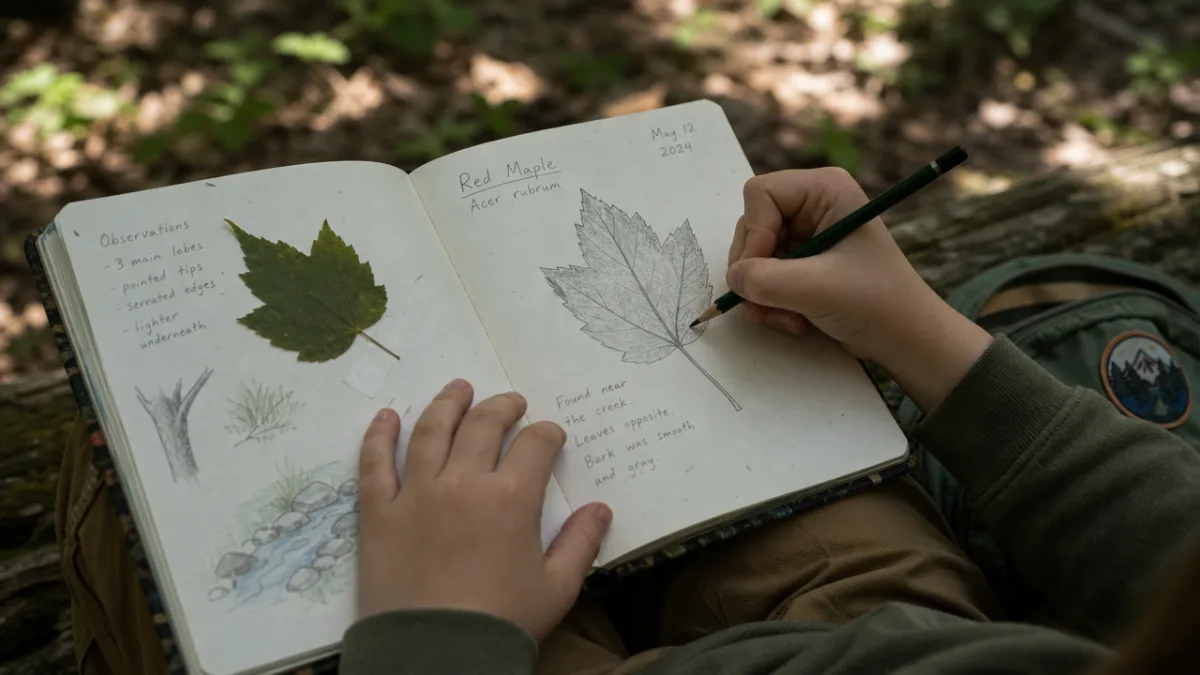
Autumn is perhaps the most naturally dramatic season for journaling, with its explosion of color and the fascinating biological processes playing out across every tree and meadow. Guide children to collect, press, and mount leaves from as many different tree species as they can find, labeling each with the tree’s name and the date and location of the collection. Encourage them to observe and document how seeds disperse — some on the wind like maple samaras spinning helicopter-like to the ground, others hitching rides on clothing and animal fur via tiny hooks and barbs. These observations naturally lead to wonderful questions about plant reproduction and adaptation that can spark hours of further investigation.
Tips for Parents: How to Encourage Without Overwhelming
The most common mistake adults make with children’s nature journals is applying too much pressure for accuracy, neatness, or completion. The moment a child feels their journal is being graded or compared to a standard, much of the joy evaporates. Your role as a parent or caregiver is to be a fellow explorer rather than an instructor or evaluator. Sit beside your child with your own journal — even a simple notebook — and make your own observations alongside theirs. Children are enormously motivated by watching adults engage genuinely in an activity rather than simply directing them.
Resist the temptation to correct your child’s drawings or spellings in their journal. If a six-year-old draws a butterfly that looks more like a potato with wings, that drawing is a perfect six-year-old’s representation of a butterfly, full of genuine observation and effort. Over time, with continued practice and growing visual literacy, the drawings will develop naturally into something increasingly detailed and accurate. Premature correction at the drawing stage can introduce self-consciousness and inhibition that shuts down creative confidence for years. The journal is a safe, experimental space — protect that quality fiercely.
Make journaling sessions feel like a special ritual rather than an obligation. Pack a small backpack with the journal, supplies, a water bottle, and a snack, and head to a favorite outdoor spot. Give the outing a name — perhaps “Field Notes Friday” or “Sunday Nature Walk” — so children look forward to it as a recurring event. Keep sessions to thirty to forty-five minutes for younger children and let older children extend them naturally when they are deeply engaged with a particular subject. The consistency of regular sessions builds habit and accumulates a body of observations that children find tremendously satisfying to look back on across seasons and years.
Extending the Experience: Taking Nature Journaling Further
Creating a Mini Field Guide
Once a child has filled one or two journals, they often have enough material to begin compiling a personal field guide to their local area. This is a wonderful project for older children aged nine and up, and it can span an entire school year or longer. Help them select their best specimen pages, organize them by category — insects, birds, plants, fungi, weather phenomena — and create an index. The process of organizing and reviewing accumulated observations is itself a powerful learning exercise, helping children synthesize what they have noticed and identify gaps in their knowledge that motivate further exploration.
A personal field guide also makes a remarkable gift for grandparents or family members, and children who create them feel an understandable sense of enormous pride. Consider helping them photocopy or scan their best pages and bind a second copy to share, while the original remains in their possession. If your child is particularly enthusiastic, local nature centers, school libraries, or community organizations sometimes invite young naturalists to share their field guides in small exhibitions or presentations, which can be a transformative and confidence-building experience.
Digital extensions can complement rather than replace the analog journal in valuable ways. Let older children photograph specimens they cannot bring home, using the images as references for later sketching sessions indoors. Apps like iNaturalist allow families to upload observations and receive species identifications from a global community of naturalists, turning a backyard observation into a contribution to citizen science databases used by researchers worldwide. Knowing that their observations have real scientific value gives children a sense of agency and importance that few other childhood activities can match.
Connecting with Other Young Naturalists
Nature journaling communities exist both online and in person, and connecting with other young naturalists can provide wonderful motivation and inspiration. The Club of Mud, the John Muir Laws Nature Journaling community, and numerous local naturalist clubs welcome young members and host events ranging from guided nature walks to online journaling challenges. Participating in a structured challenge — such as drawing one new species every day for a month — gives children a goal-oriented framework that many find highly engaging, especially if friends or siblings are participating alongside them.
Organizing small nature journal meetups with two or three neighboring families in a local park or garden is another delightful way to build community around the practice. Children often notice things that adults miss entirely, and when multiple young observers gather in a single location, the collective observations are invariably richer than any one child would have made alone. One child notices a spider web while another spots the dragonfly perched above it and a third finds the shed exoskeleton of a cicada nearby — together they have assembled a small ecosystem story that none of them would have discovered independently.
Ultimately, the DIY nature journal is far more than a craft project. It is an invitation to a lifelong practice of attention, wonder, and careful looking at the world. The journal a child makes from cardboard, printer paper, and twine at age seven may be the beginning of a habit that sustains them through adolescence, adulthood, and into old age. The pages fill with seasons and specimens and questions, and gradually a portrait emerges — not just of the natural world, but of the growing mind that observed it so thoughtfully and recorded it with such care and curiosity.
Safety and Mindfulness in the Field: Keeping Young Naturalists Safe and Present
Before heading out into nature with journals in hand, it is essential to cover some foundational safety principles with children of all ages. Even familiar outdoor spaces like a neighborhood park or a family garden contain elements that deserve respectful caution. Teach children never to taste or eat anything they find outdoors unless an adult has definitively identified it as safe — this applies to berries, mushrooms, seeds, and plant sap alike, many of which can cause serious harm despite an appealing appearance. Equally important is washing hands after handling specimens, particularly fungi, certain caterpillars, and plants in the milkweed or euphorbia families.
Sun protection, appropriate clothing, and hydration are practical matters that apply to any outdoor activity but deserve special mention for nature journaling sessions, which tend to involve sustained quiet sitting in one location rather than the active movement that keeps hikers warm and sunburn-aware. Encourage children to wear a hat and apply sunscreen before summer sessions, to dress in layers for autumn and spring outings, and to check for ticks after any session in long grass or woodland. Building these habits early ensures that the physical experience of nature journaling remains comfortable and positive, which is crucial for sustaining the practice long-term.
Beyond physical safety, nature journaling offers a powerful opportunity to teach mindfulness and environmental ethics. The Leave No Take It policy — the principle of observing and sketching rather than collecting and removing — is worth introducing from the very first journaling session. Children who learn to represent a flower on paper rather than picking it develop a respectful relationship with living things that extends far beyond the journal itself. Similarly, practicing stillness and quiet observation trains the kind of patient, present-moment attention that is increasingly recognized as one of the most valuable skills any young person can develop in a fast-paced, distracted world.
Mindful journaling practices can be woven gently into each session. Begin with a two-minute “arrival” exercise: sit quietly, close eyes, and simply listen — then open eyes and notice three things that were not immediately visible on arrival. End each session with a moment of gratitude, encouraging children to name one thing they are glad to have noticed or experienced. These brief rituals frame the journaling session as something meaningful and intentional rather than simply an activity to complete, and they help children transition smoothly between the busy pace of daily life and the slower, more receptive state of mind that good nature observation requires.








What do you think?
It is nice to know your opinion. Leave a comment.