










Elegant Craft Room Wall Art for Inspiration: Transforming Your Creative Space
A craft room is so much more than a place to stash your supplies and finish your projects. It’s your sanctuary — a personal studio where imagination actually gets to stretch its legs and ideas stop being just ideas. The atmosphere in that room matters more than most people realize. When your surroundings feel beautiful and inspiring, the work that comes out of your hands tends to show it. And wall art? It’s one of the most powerful, most accessible ways to set that tone.
Good craft room wall art pulls double duty: it decorates and it motivates. Whether you’re a fiber artist, a scrapbooker, a watercolor hobbyist, or someone who happily calls themselves a mixed-media enthusiast, the images, words, and textures on your walls are quietly speaking to you every time you sit down to create. Choosing those pieces with some thought and care is genuinely an act of self-care — and it can lift both your mood and your output more than you might expect.
This article is all about the many dimensions of selecting, arranging, and actually living with elegant craft room wall art. From the psychology behind why creative environments matter to the nuts and bolts of building a cohesive aesthetic, you’ll find plenty of guidance here for building a space that feels just as beautiful as the work you make inside it.
The Psychology of Inspirational Spaces
Environmental psychology research keeps telling us what most makers already feel intuitively: our physical surroundings have a real, measurable effect on our mental state, our emotions, and our creative output. A cluttered, visually chaotic environment raises stress hormones and narrows your thinking — which is exactly the opposite of what you need for the open-ended, associative thought process that most creative work depends on. A thoughtfully designed space, on the other hand, can calm your nervous system and quietly signal to your brain that this is a place where good things happen.
Wall art works as one of those calming, orienting signals. When you look up from a tricky project and your eyes land on a beautifully framed print, a hand-lettered quote that actually means something to you, or a gallery wall that traces your aesthetic journey — something shifts. That moment of pause is genuinely restorative. The image or phrase gives your mind a place to rest for a second, and from that rest often comes the clarity, or the renewed enthusiasm, needed to push through a creative block. This isn’t wishful thinking — it’s just how human perception and emotion interact with the designed spaces around us.
Choosing art that’s personally meaningful, rather than just generically pretty, makes all of this even more powerful. Mass-produced prints have their place, but when you hang something that carries a real story — a print from an artist you discovered at a local market, your grandmother’s handwriting framed behind glass, a reproduction of a painting that genuinely moved you — that piece becomes a little charge of emotional energy every time you walk past it. Your craft room walls are an opportunity to surround yourself with exactly those kinds of charges.
Choosing an Aesthetic Direction for Your Craft Room Walls
Before you buy or make a single piece of wall art, it’s worth spending a little time thinking about the overall aesthetic direction you want your craft room to have. This doesn’t mean you need a rigid, perfectly Pinterest-curated scheme — honestly, some of the most inspiring craft spaces feel layered and personal in a way that resists easy categorization. But having a loose framework helps you make decisions that feel like they belong together, and a cohesive space tends to feel calming rather than chaotic.
There are a handful of directions that tend to work especially well for craft rooms. A romantic, vintage-inspired look draws on botanical illustrations, aged typography, and soft sepia or blush tones. A clean Scandinavian-influenced minimalism favors simple line drawings, monochrome palettes, and lots of breathing room. A maximalist eclectic approach layers patterns, colors, and art styles from all kinds of traditions into something rich and energetic. A nature-forward aesthetic leans into pressed botanicals, landscape photography, and earthy organic tones. And a bold graphic modernism uses typography, geometric abstraction, and high-contrast color to make strong visual statements.
Within any of these directions, “elegant” is a useful filter to keep in mind. In this context, elegance doesn’t mean expensive or formal — it means intentional, considered, and refined. An elegant gallery wall in a maximalist craft room might be exuberantly colorful and densely hung, but every piece will have been chosen rather than accumulated. Elegance is essentially the opposite of visual noise. It’s the feeling of a space where things are present because they belong, not just because they showed up one day and never left.
Types of Wall Art That Work Beautifully in Craft Spaces
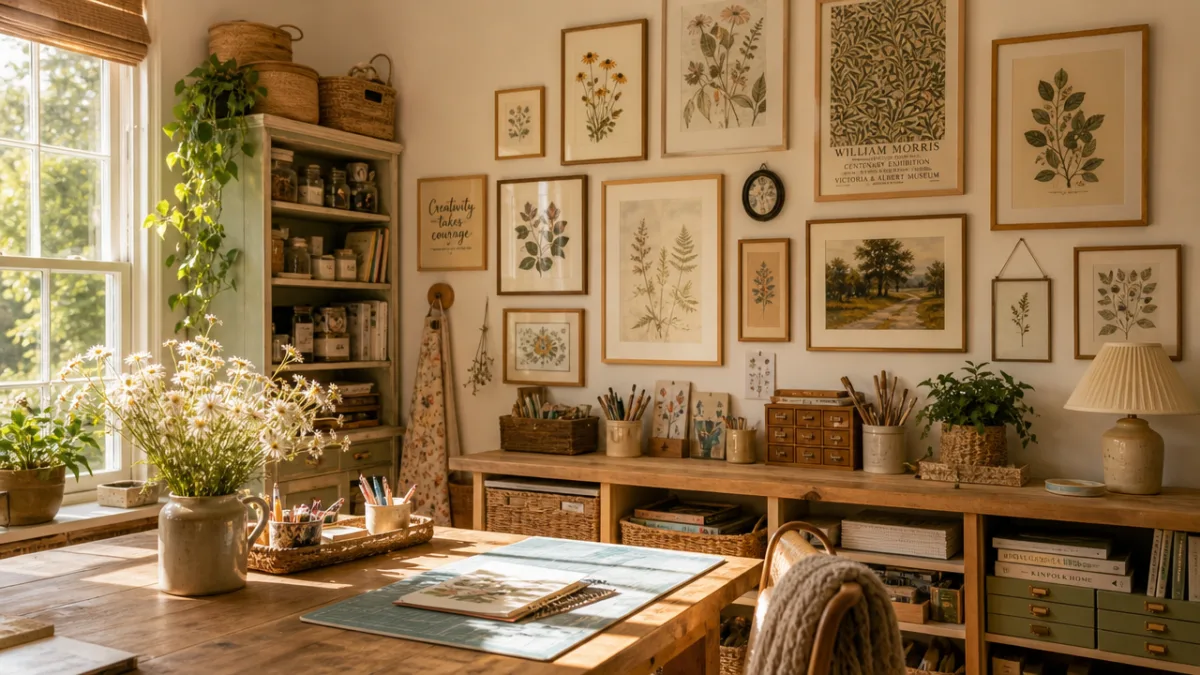
The range of wall art available to craft room decorators is genuinely delightful, and part of the fun of designing a creative space is that you can make, commission, or curate pieces in ways that would feel unusual anywhere else in the house. Your craft room wall art can — and maybe should — reflect the mediums you work in, the makers you admire, and the aesthetic sensibilities you’re actively developing through your own practice.
Framed prints and illustrations are among the most versatile options out there. They’re easy to swap out seasonally, can be rearranged without guilt, and can be sourced from a huge range of online and in-person sellers. Hand-lettered quotes from designers on platforms like Etsy carry a warmth and individuality that mass-produced signs just can’t match. Botanical prints — whether antique reproductions or fresh contemporary takes — bring a natural elegance to almost any color palette. Abstract art adds visual complexity and emotional resonance without locking you into any specific narrative.
Beyond prints, craft room walls are especially well suited to three-dimensional and textile art. A macramé wall hanging brings texture and warmth to a space that might otherwise feel flat. A grouping of small weavings or embroidery hoops works beautifully as both art and inspiration, a reminder of techniques you’ve been meaning to explore. Shadowboxes holding curated collections of meaningful objects — antique buttons, vintage thread spools, pressed flowers, small tools — blur the line between display and decoration in the most satisfying way. And a well-organized pegboard, arranged with some care and intention, can honestly transcend its functional origins and become genuine wall art.
Don’t underestimate the power of words in a craft room specifically. Quotes about creativity, making, imperfection, and process hit differently in a space where those things are actually being practiced every day. A framed print of Mary Oliver’s instruction to pay attention, or Georgia O’Keeffe’s reminder that it takes courage to be a painter, lands with particular weight when you’re sitting surrounded by your own tools and materials. Choose words that you genuinely believe rather than words that sound aspirational but feel hollow when you’re in the middle of a difficult project. The most inspiring quote in your craft room should be the one that makes you feel understood — not the one that makes you feel judged.
Creating and Curating a Gallery Wall
A gallery wall is probably the single most impactful wall art project you can take on in a craft room, and for a maker, there’s an extra layer of pleasure in approaching it as a design project in its own right. A well-executed gallery wall turns a blank expanse into a kind of visual autobiography — a record of your tastes, influences, and evolution as a creative person. Done with care, it can anchor the entire room and make every hour you spend in that space feel more meaningful.
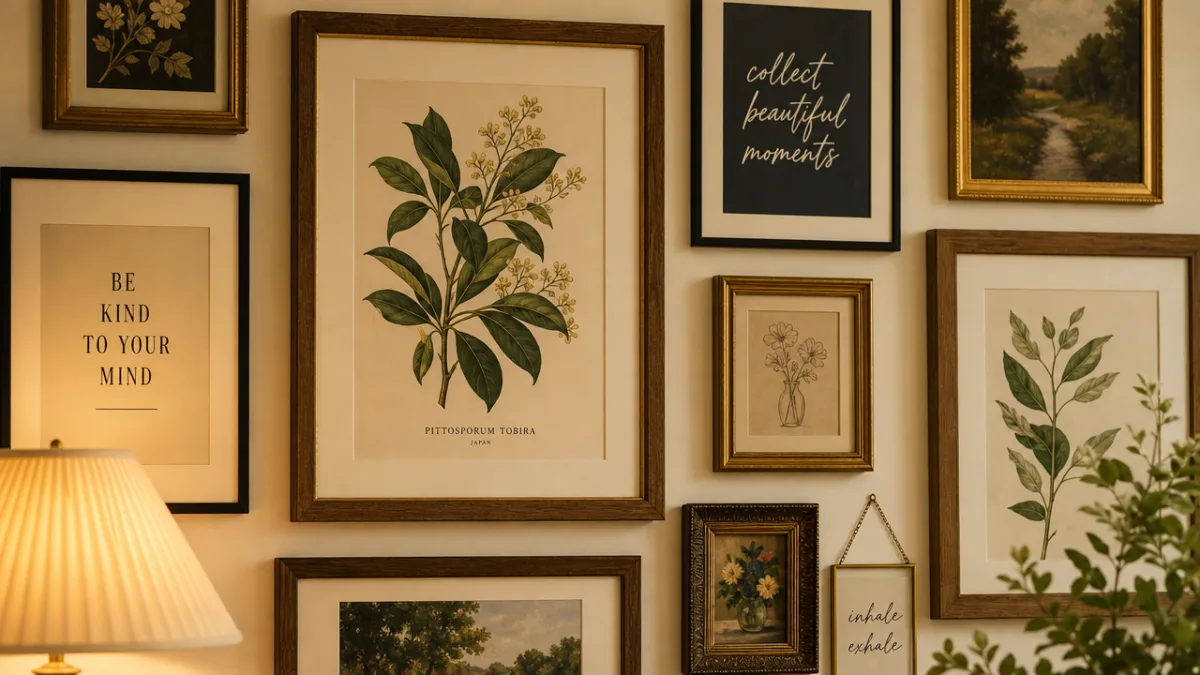
Planning really is essential here. Before you put a single nail in the wall, gather everything you’re considering and lay it out on the floor. Photograph the arrangement and actually study it. Look for balance — not the rigid, symmetrical balance of matching frames in identical rows, but the organic visual balance that comes from thoughtfully distributing weight, color, and size across the whole composition. A large statement piece on one side can be balanced by a cluster of smaller works on the other. A dense grouping of warm-toned prints can breathe a little more easily next to a larger piece in a cool neutral. Experiment on the floor until it feels right to you, then recreate it on the wall.
Frame choices matter an enormous amount in determining whether a gallery wall reads as elegant or just cluttered. A common approach is to choose one or two frame finishes — natural wood and matte black, for example, or antique gold and white — and stick with them across all pieces regardless of size or content. This creates a visual through-line that holds even a wildly varied collection of images together. Alternatively, you can commit to a single consistent frame style in different sizes for a more formal, almost museum-like quality. What tends to undermine a gallery wall’s elegance, more than anything else, is an excess of competing frame colors and finishes with no organizing logic connecting them.
DIY Wall Art Ideas for the Craft Room Maker
For someone who spends their free hours making things with their hands, the idea of buying all of their wall art feels a little off — and honestly, it should. Your craft room walls are the perfect place to display your own work, to practice new skills without any pressure, and to create pieces that are perfectly tailored to your space in a way that purchased art rarely manages to be. DIY wall art for a craft room can be as simple or as ambitious as you want, and the process of making it is itself an exercise in the kind of creative thinking your space is meant to support.
There are so many directions you could go, and most of them are more approachable than they look. A series of small watercolor studies — loose abstractions or simple botanicals — in matching frames creates a cohesive, sophisticated look that costs very little but reflects your personal aesthetic precisely. Hand-lettered quotes on watercolor paper, even with beginner calligraphy skills, carry a warmth and authenticity that printed versions almost never achieve. Large-scale macramé or fiber wall hangings are highly accessible to beginners and can be scaled to fill even a generously sized wall. A mood board framed behind glass brings the inspiration-gathering practice many of us do online into the physical space in a beautiful, tangible form.
Fabric and textile projects translate especially well to wall display. A single yard of an extraordinary fabric stretched over a canvas frame becomes instant art. Embroidered pieces — particularly on linen or natural fabric — have an heirloom quality that feels timeless and deeply personal. Even a thoughtfully arranged collection of pattern swatches, fabric samples, or yarn wraps, framed and hung, can serve as both art and reference material — a color palette and texture library that also happens to be genuinely beautiful to look at. In a craft room, the tools and materials of your practice are legitimate artistic subjects, and treating them that way elevates everything around them.
Maintaining and Refreshing Your Craft Room Art Over Time
A creative person’s tastes, interests, and skills are always shifting, and the wall art in your craft room should have room to shift right along with them. Treating your gallery walls and art arrangements as permanent fixtures is a good way to turn them into background noise — things you stop actually seeing because they’ve become too familiar. Building some flexibility into how you display your wall art from the start makes it much easier to refresh the space without undertaking a full renovation every time your aesthetic sensibilities evolve.
There are some practical ways to build that flexibility in. Leaning large frames against the wall rather than hanging them allows for easy repositioning without touching the walls at all. Picture rails — horizontal rails mounted near the ceiling, from which art hangs on adjustable hooks — are a traditional solution that’s still enormously practical, and they come in both minimalist and more ornate styles to suit whatever your room is going for. Clipboards mounted directly to the wall hold prints, postcards, and paper art without frames, making swaps quick and painless as your collection grows and changes. A large corkboard or linen pinboard can do the same thing on a bigger scale, and can become a beautiful, dynamic element of the room in its own right.
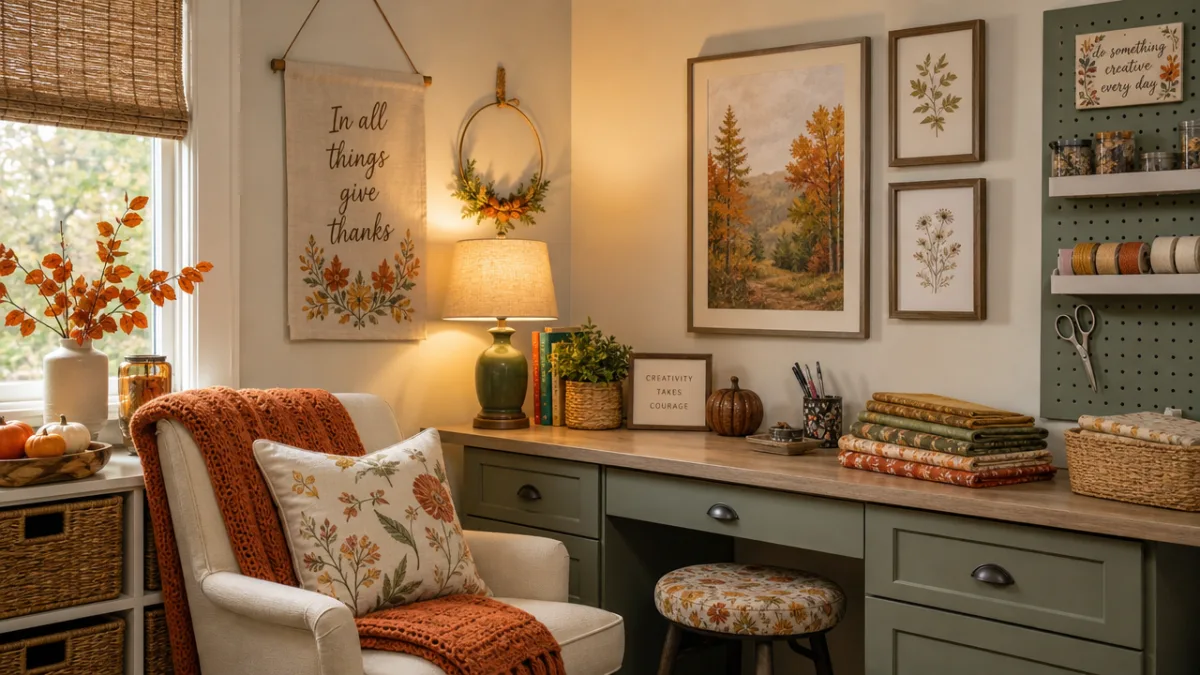
It’s also worth building some kind of seasonal refreshing into your creative rhythm. As the year moves through its cycles, your creative energy and aesthetic inclinations naturally shift with it. A late winter refresh that brings in brighter, more energetic art can feel genuinely reinvigorating during a season when motivation tends to flag. An autumn arrangement of deeper, warmer tones and more introspective imagery might support the reflective, project-completing energy that the season tends to invite. Treating your craft room as a living, evolving space rather than a finished destination keeps it aligned with who you are and what you need from your creative environment — which, like your creative practice itself, is never quite the same as it was before.
Final Thoughts: Your Walls as a Creative Statement
Your craft room walls are not neutral. Whether you fill them thoughtfully or leave that choice to chance, they’re communicating something about the space and about you. Choosing to approach your craft room wall art with intention and elegance is a small declaration that your creative practice matters — that the environment where you work is worth tending, and that beauty isn’t a luxury to be added once all the functional boxes are checked, but a genuine requirement for the kind of sustained, joyful making that sustains a creative life over years and decades.
Elegant doesn’t mean expensive. It doesn’t mean perfectly coordinated. It doesn’t mean following any particular trend or hitting some ideal aesthetic on social media. It means chosen, considered, and meaningful. It means a space where every element has been allowed to earn its place — where the art on the walls reflects the person who makes things inside those walls, and where sitting down to work each day feels like a small, reliable pleasure rather than something to push through.
Start wherever you are. Take down one thing you’ve been tolerating rather than loving. Hang one thing that genuinely moves you. Rearrange one cluster of frames until it feels right, not just acceptable. Each small act of curation is both a practical improvement to your space and an act of faith in your own creative vision. Your craft room walls are waiting to become the most inspiring thing in the room — and the most inspiring thing in that room should always be you.








What do you think?
It is nice to know your opinion. Leave a comment.