










Christmas Home Decor and DIY Ornaments: A Complete Guide to Festive Magic
The holiday season transforms our homes into sanctuaries of warmth, light, and memory. Christmas decorating is more than aesthetics — it is the annual ritual of layering your living space with meaning, nostalgia, and creative expression. Whether you are a seasoned crafter or someone picking up a hot glue gun for the very first time, there is a version of Christmas home decor that belongs entirely to you. This guide will walk you through everything from planning your color palette to crafting stunning DIY ornaments that will become family heirlooms.
Setting the Foundation: Choosing Your Christmas Aesthetic
Before purchasing a single strand of tinsel or cutting a length of ribbon, it helps enormously to decide on an overarching visual theme for your holiday decor. Your aesthetic will guide every purchase, every craft, and every arrangement you make throughout the season. Popular styles range from the cozy and rustic — think burlap, plaid, and pinecones — to the sleek and modern, which might feature matte black and gold accents alongside geometric ornament shapes. There is no wrong answer here; the goal is coherence and personal resonance.
A traditional Christmas palette leans heavily into deep reds, forest greens, and warm golds. This timeless combination draws from centuries of holiday iconography and pairs beautifully with natural materials like fresh greenery, wooden ornaments, and candlelight. If you prefer something more contemporary, consider a white and silver scheme with touches of dusty blue or sage green. These palettes feel crisp and elegant without sacrificing warmth, especially when layered with soft textiles like velvet ribbons and knit stockings.
Once you have chosen your aesthetic direction, do a walkthrough of your home and identify the key decorating zones. These typically include the entryway, the mantle, the main tree, windowsills, the dining table, and any built-in shelving. Treating each zone as part of a unified whole — rather than decorating them in isolation — is what separates a thoughtfully styled home from one that simply feels cluttered with holiday items. Keep a consistent thread of your chosen color palette and material story running through every zone.
Key Elements of Popular Christmas Aesthetics
- Rustic Farmhouse: Pinecones, burlap ribbon, wooden beads, buffalo check patterns, and warm amber lighting from Edison bulbs or candles.
- Modern Minimalist: Matte metallics, simple geometric ornaments, white or flocked trees, and restrained color palettes with deliberate negative space.
- Classic Traditional: Rich reds and greens, gold tinsel, nutcrackers, tartan plaid, and lush fresh or faux greenery swags.
- Scandinavian Hygge: Natural wood tones, white candles, simple star shapes, evergreen branches, and woven textile ornaments.
- Maximalist Glam: Jewel tones, layered metallic ornaments, feather picks, oversized bows, and richly textured fabrics like velvet and faux fur.
The Christmas Tree: Your Decorating Centerpiece
The Christmas tree remains the undisputed focal point of holiday home decor, and the way you decorate it sets the entire tone for the rest of your space. Begin by choosing your tree type — whether real, artificial, flocked, or pencil-slim — based on your room dimensions and aesthetic goals. A real tree brings incomparable fragrance and organic texture, while a quality artificial tree offers convenience and the freedom to fluff and shape branches precisely where you need them. A flocked tree dusted in faux snow is particularly striking in minimalist or Scandinavian-themed spaces.
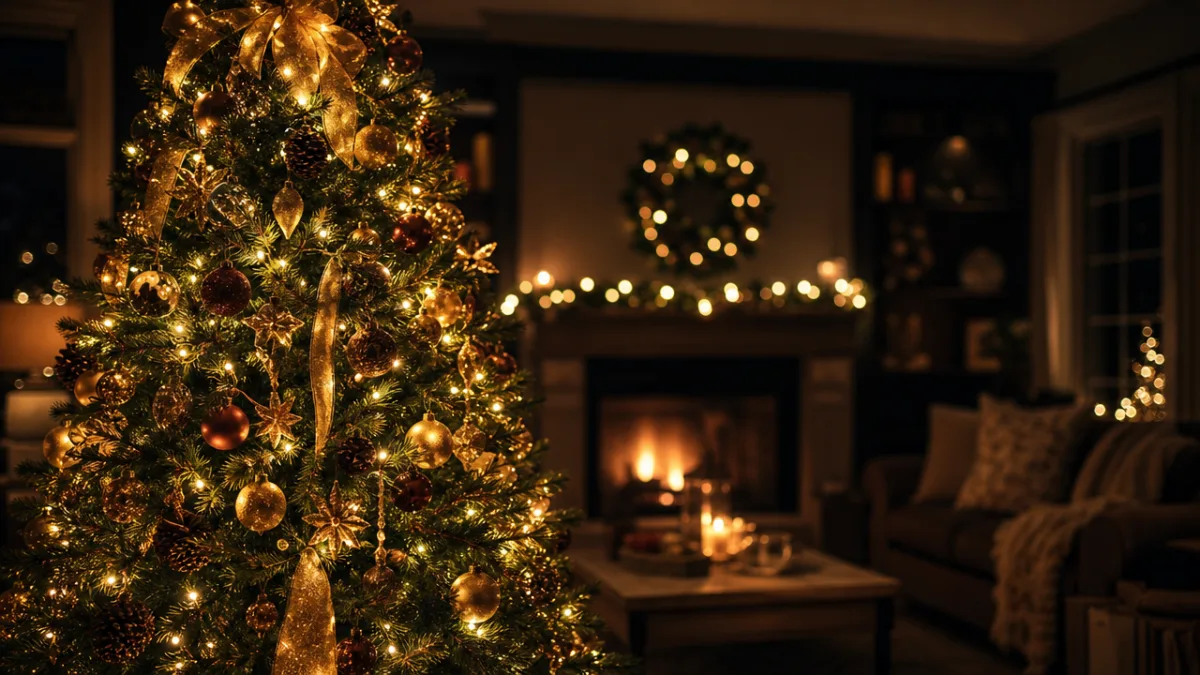
Layering is the professional decorator’s most important technique when dressing a Christmas tree. Begin with lights, working from the trunk outward to the tips and varying the depth to create a sense of dimension. Next, add your largest ornaments and ribbon, using them to fill gaps and establish visual weight. Then layer in medium ornaments in your primary color before filling remaining spaces with smaller accent pieces. Ribbon can be woven loosely through the branches in long loops, or twisted tightly into individual bows and tucked throughout the tree at varying depths.
The tree topper carries significant decorative weight because it draws the eye upward and signals completion. Traditional choices include stars and angels, but modern toppers range from oversized bows made from wired ribbon to simple bare branches spray-painted gold. Whatever topper you choose, ensure it is proportional to the tree — a topper that is too small looks lost, while one that is too large will cause the upper branches to droop ungracefully. If your tree stands near a ceiling, a flat star or a cluster of ribbon loops works better than a tall vertical topper.
DIY Ornaments: Crafting Your Most Personal Decorations
Handmade ornaments carry a depth of meaning that no store-bought decoration can replicate. Every scratch, imperfect brushstroke, and slightly uneven cut becomes part of the charm — a physical record of the time and care you invested in making your home beautiful. DIY ornaments also offer remarkable flexibility: you can tailor colors, materials, and themes precisely to match your aesthetic, and you can involve children in the process to create pieces that become irreplaceable as the years pass. The range of materials available to today’s crafter is truly extraordinary.
Salt dough ornaments are among the most beloved DIY projects because they require only flour, salt, and water, yet they yield results that can be painted, glazed, and customized in countless ways. To make the basic dough, combine two cups of flour, one cup of salt, and approximately three-quarters of a cup of water, kneading until smooth. Roll the dough to about a quarter-inch thickness, cut into desired shapes using cookie cutters, poke a small hole at the top for hanging, and bake at a low temperature until completely hard. Once cooled, these ornaments can be painted in any color, stamped with patterns, dusted with glitter, or left in their natural ivory state for a rustic look.
Clear glass or plastic ball ornaments offer another endlessly versatile canvas for DIY decoration. You can fill them with miniature scenes using tiny figurines, artificial snow, and small sprigs of preserved greenery. Alternatively, pour a small amount of craft paint inside the ball, swirl it to coat the interior, and allow it to dry for a marbled effect in any color combination imaginable. Other popular fills include faux snow and a sprig of berry stems, dried lavender with twine, strips of sheet music for a vintage look, or photographs printed small enough to curl inside. The possibilities genuinely are limitless.
Popular DIY Ornament Techniques
- Salt Dough Sculpting: Mix, shape, bake, and paint for fully customizable ornaments that last for decades when stored properly.
- Filled Clear Ball Ornaments: Swirl paint, insert natural materials, or create miniature scenes inside transparent globe ornaments.
- Macramé and Woven Ornaments: Use cotton cord to create small woven stars, trees, or heart shapes with a textural, bohemian quality.
- Decoupage Paper Ornaments: Apply torn tissue paper or napkin prints to plain ornaments with Mod Podge for a delicate, artful finish.
- Wooden Slice Ornaments: Sand thin wood slices smooth, paint or wood-burn designs onto them, and seal for a beautiful natural look.
- Resin Poured Ornaments: Embed dried flowers, glitter, or foil flakes in clear resin poured into mold shapes for jewel-like pieces.

Beyond the Tree: Decorating Every Corner of Your Home
A truly immersive Christmas home extends its festive spirit far beyond the living room tree. The entryway is often the most underdecorated zone in the home, yet it is the first thing guests and family members see upon arrival. A simple wreath on the front door immediately signals welcome and warmth. Indoors, consider a small console table decorated with a vase of evergreen clippings, a cluster of pillar candles at varying heights, and a few wrapped gift boxes used as decorative props. Adding a fragrant element here — whether from a fresh pine wreath, a candle, or a simmering pot of cinnamon and orange peels — makes the welcome feel multisensory and deeply inviting.
The mantelpiece, if you are fortunate enough to have one, is perhaps the most prestigious decorating real estate in the entire home. A well-dressed mantle typically features a garland as its base layer — either fresh, faux, or a combination of both — draped gracefully along its length and allowed to fall naturally at the ends. Into this garland, tuck ribbon, ornaments, battery-operated fairy lights, pine cones, and any small decorative objects that tie into your theme. Hang stockings from the mantle’s edge using decorative hooks, and place candles, lanterns, or framed artwork above to complete the vignette. The goal is abundance without chaos.
Holiday tablescaping deserves special attention, particularly if you host gatherings during the season. A Christmas dinner table is an opportunity to create a complete sensory experience for your guests. Start with a tablecloth or runner that anchors your color palette, then build a centerpiece using a combination of candles, greenery, ornaments, and seasonal elements like dried orange slices or cinnamon sticks. Place settings can be elevated with small ornament favor tags, sprigs of rosemary tucked into napkin folds, or gilded walnut place card holders. The details at the table communicate care and intentionality in a way that deeply moves the people gathered around it.
Room-by-Room Decoration Checklist
- Entryway: Wreath, doormat, console table vignette, fragrant candle or fresh greenery, lanterns.
- Living Room: Main Christmas tree, mantle garland and stockings, throw blankets in seasonal colors, pillow covers, holiday-scented candles.
- Dining Room: Table runner or cloth, centerpiece, holiday place settings, buffet or sideboard styling.
- Kitchen: Hanging herb bundles with ribbon, a small tabletop tree or wreath, holiday dish towels, decorative cookie tins.
- Bedrooms: Mini wreaths on mirrors, a small tabletop tree, fairy lights draped over headboards, holiday-themed throw pillows.
- Bathrooms: Small holiday candle, a sprig of evergreen tied with ribbon, seasonal hand towels, a tiny ornament or two in a glass bowl.
Sustainable and Budget-Friendly Christmas Decorating
One of the most rewarding shifts in holiday decorating culture in recent years has been the growing embrace of sustainable and cost-conscious approaches. The pressure to purchase entirely new decorations every year is not only financially draining but also environmentally costly. Instead, consider building a core collection of high-quality, timeless pieces — a few dozen classic ball ornaments in your chosen palette, a reliable artificial tree, and neutral textile elements like a white tree skirt — that serve as a permanent foundation. Into this foundation, you can introduce seasonal accents each year at minimal cost, simply rotating what is at the forefront.
Nature provides some of the most beautiful and entirely free Christmas decorating materials imaginable. A walk through your neighborhood or a nearby park can yield pinecones of varying sizes, bare branches that can be spray-painted or left natural, holly cuttings, dried seed pods, and evergreen clippings. These natural elements bring genuine organic texture that no synthetic decoration can perfectly replicate, and they biodegrade harmlessly once the season ends. A bundle of pinecones tied with a simple velvet ribbon makes an elegant table decoration. A glass vase filled with bare white branches and a string of fairy lights creates a striking alternative to a full-size tree in smaller spaces.
Upcycling household items is another deeply satisfying approach to budget Christmas decorating. Mason jars become luminaries when filled with Epsom salt and a tea light. Old wine corks tied together with twine form charming rustic garlands. Vintage book pages, folded into origami stars or rolled into cones, create entirely unique paper ornaments. Coffee filter snowflakes, while deceptively simple, look genuinely beautiful hanging in a window. These projects do not require a craft store budget or advanced skill — they require only a willingness to see ordinary objects as raw material waiting to be transformed. That spirit of resourceful creativity is, in many ways, the truest expression of what handmade Christmas decorating is all about.

Storing, Preserving, and Building Your Decoration Collection Over Time
The investment you make in DIY ornaments and quality Christmas decorations only pays off fully if you store them well and treat them as a growing collection rather than disposable seasonal goods. Proper storage begins with the right containers: clear plastic bins with tight-fitting lids allow you to see contents at a glance and protect against moisture, dust, and pests. Ornament storage boxes with individual cell dividers are essential for fragile pieces, while soft fabric bags work well for velvet ribbons and textile items. Label every container clearly so that setup next year becomes a pleasure rather than an archaeological excavation.
DIY ornaments require particular care in storage to ensure they survive from season to season in good condition. Salt dough pieces should be wrapped individually in tissue paper and kept in a cool, dry environment — humidity is their greatest enemy, causing them to soften or develop surface cracks over time. A light coat of varnish or Mod Podge applied before storage significantly extends their lifespan. Resin ornaments are hardier but should still be kept away from extreme heat. Filled glass ball ornaments should be drained of any organic material before storage and kept in their original individual wrappings to prevent shattering.
Think of your Christmas decoration collection as a living archive that grows richer and more meaningful with every year. Each season, add a few new DIY pieces — perhaps one made by each child in the household, dated and initialed on the back. Purchase one or two special ornaments during travels or from local artisans, noting where and when you acquired them. Retire pieces that no longer speak to you rather than keeping them out of obligation. Over a decade or two, this approach yields a collection that is deeply personal, visually cohesive, and filled with stories. When you unpack these boxes each December and lift each piece from its tissue wrapping, you are not just decorating a home — you are revisiting a life well lived and a holiday tradition tended with genuine love and care.








What do you think?
It is nice to know your opinion. Leave a comment.