










Poured New York City Fresh Bicoastal Lidded Stone Candle: A Celebration of Coastal Craft and Urban Scent
The Art of the Bicoastal Candle: Where Two Cities Meet in a Single Flame
Few objects in the modern home capture a sense of place quite like a well-crafted candle. The Poured New York City Fresh Bicoastal Lidded Stone Candle represents something genuinely special in the crowded world of artisan home fragrance — it is a product that does not merely smell pleasant but tells a story. Born from the creative tension between two great American coastal cities, this candle embodies the restless, ambitious energy of New York while drawing on the clean, airy sensibility that defines the best of West Coast living. The result is an olfactory experience that feels simultaneously bold and serene, urban and natural.
The concept of bicoastal living has long been romanticized in American culture, conjuring images of red-eye flights, dual zip codes, and a lifestyle that refuses to be pinned to a single geography. This candle translates that cultural idea into something tangible and intimate. When you strike a match and hold it to the wick, you are not just lighting a candle — you are inviting both the kinetic pulse of Manhattan streets and the salt-scrubbed freshness of a Pacific shoreline into your living room. It is an ambitious concept, and what makes this product remarkable is how seamlessly it delivers on that ambition through careful fragrance architecture and thoughtful material craft.
Understanding the appeal of this candle requires appreciating how far artisan candlemaking has evolved over the past two decades. What was once a cottage industry of simple paraffin pillars has matured into a sophisticated craft involving complex fragrance blending, premium sustainable waxes, and vessel design that treats the container as an object of lasting beauty. The Bicoastal Stone Candle sits comfortably at this elevated end of the market, appealing to consumers who care not only about how their home smells but about the objects they choose to populate their space, their values, and the stories those objects carry.
Fragrance Profile: Unpacking the “New York City Fresh” Scent Story
The phrase “New York City Fresh” might initially seem contradictory to anyone who has spent a summer afternoon on a Midtown sidewalk. Yet as a fragrance concept, it captures something true and specific about the city — the bracing clarity of a cold morning in Central Park, the sharp green scent of a farmers market in Union Square, the cool mineral quality of the Hudson on a clear autumn day. The perfumers behind this candle have clearly drawn on these precisely observed urban-natural moments to construct a scent that feels at once metropolitan and surprisingly clean. It is a fragrance that rewards attention, revealing new facets as it develops on the warm throw.
On the top notes, expect a burst of something bright and citrus-forward — the kind of sharp, zesty energy that mirrors the pace of New York morning commuters, coffee cups in hand, striding toward subway entrances. This initial impression is invigorating without being aggressive, like stepping out of an air-conditioned lobby into crisp autumn air. As those volatile top notes dissipate over the first hour or so of burning, the heart of the fragrance emerges: a cleaner, more aquatic character that nods to the bicoastal premise. Here the scent opens up and breathes, suggesting wide Pacific horizons and the smell of ocean air carried inland on a warm California wind.
The base notes anchor everything in something grounded and lasting. Warm woods, perhaps a suggestion of driftwood or clean musk, give the fragrance its longevity and depth. These base elements ensure that the candle does not simply disappear from the room when you are no longer paying active attention to it but instead leaves a gentle, sophisticated presence in the air — the olfactory equivalent of a good room after good company has left. The balance between these layers is the true achievement of this fragrance, and it is what separates a candle like this from the one-dimensional, synthetic-smelling alternatives that crowd the lower end of the market.
- Top Notes: Bright citrus, green leaves, cool bergamot — the energetic opening that channels Manhattan at its most vivid and alive.
- Heart Notes: Aquatic marine accords, light florals, sea salt — the bicoastal bridge that carries you from city to coastline in a single breath.
- Base Notes: Warm driftwood, clean musk, soft sandalwood — the lingering foundation that grounds the scent and gives it lasting presence throughout a room.

The Stone Vessel: Material Beauty and Functional Design
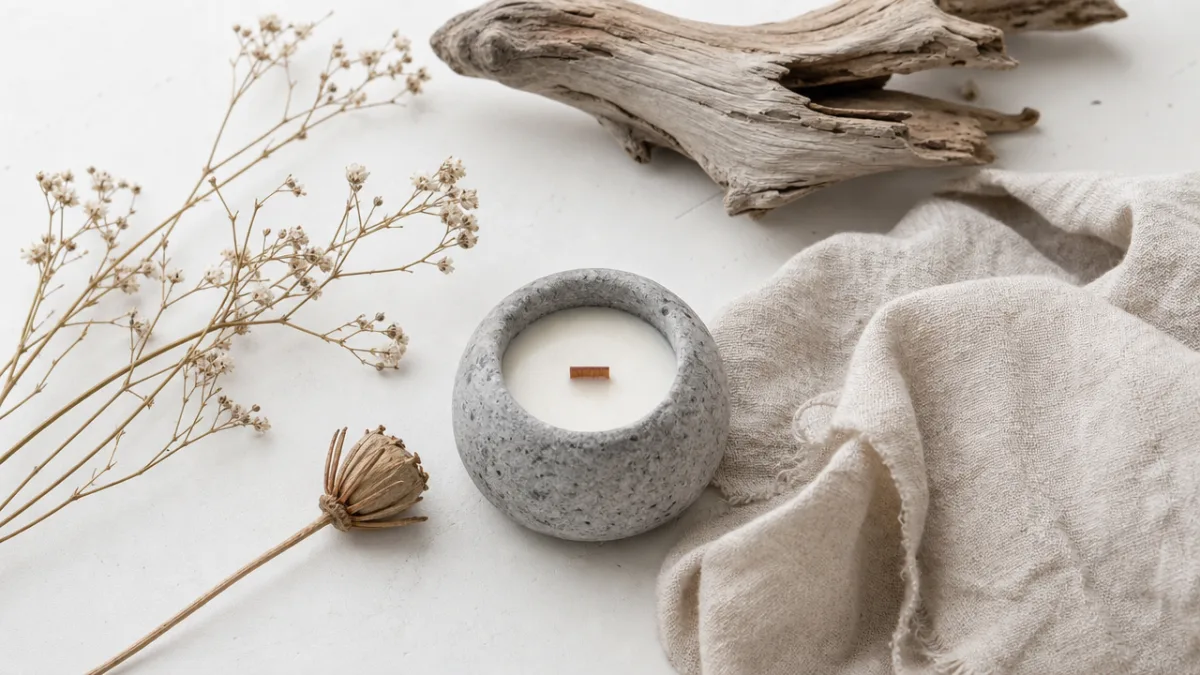
One of the most immediately striking features of this candle is its vessel. The stone container — whether carved from travertine, alabaster, or a similarly textured natural material — elevates the product far beyond the conventional glass jar that dominates the artisan candle market. Stone has a primordial weight and presence that glass simply cannot replicate. It sits differently on a shelf or tabletop, commanding attention without demanding it, communicating quality through its very density and the subtle variations in its natural surface. No two stone vessels are identical, which means every candle is, in a genuine sense, a one-of-a-kind object.
The tactile experience of handling a stone candle vessel is also worth noting. Where glass feels neutral and smooth in the hand, stone has warmth and texture — a slight roughness that invites touch and that connects the object to the natural world in a way synthetic materials never quite achieve. This matters because a candle container, particularly one as beautiful as this, does not disappear when the wax is exhausted. The stone vessel has a long afterlife as a storage jar, a small planter for a succulent, a vessel for cotton balls on a bathroom shelf, or simply an object of contemplative beauty sitting quietly on a desk. The lidded design enhances this longevity, protecting both the wax from dust during storage and giving the closed candle a sculptural, almost architectural quality.
From a practical standpoint, stone also has genuine functional advantages as a candle vessel. Its thermal mass means it absorbs and radiates heat differently from glass, contributing to a slower, more even burn. The lid, when placed over the candle to extinguish the flame, cuts oxygen cleanly without the wax-splashing risk that can come from blowing out a candle in a narrow glass vessel. This thoughtful pairing of beauty and function is a hallmark of truly well-designed objects, and it explains why stone-vessel candles have developed such a devoted following among consumers who take their home environment seriously.
When considering the environmental angle, stone also has a compelling story. Unlike plastic, which is petroleum-derived and rarely truly recyclable, or even glass, which requires significant energy to produce and recycle, a carved stone vessel is essentially an infinitely durable natural material. If you invest in a stone candle vessel and then use it for decades as a household object, you have participated in a fundamentally sustainable material lifecycle. This is not a trivial point in an era when consumers are increasingly scrutinizing the full lifecycle of the objects they bring into their homes, from production to disposal.
The Pour: Wax Selection, Wick Craft, and the Science of a Perfect Burn
Behind every exceptional candle is a careful and often painstaking process of formulation. The word “poured” in this candle’s name is not decorative — it points directly to the handcrafted nature of the product and to the decisions made at every stage of production. Premium artisan candles of this type are typically made with natural waxes, most often soy, coconut, or a carefully calibrated blend of the two, chosen for their clean-burning properties, their ability to hold fragrance at high concentrations, and their renewable sourcing. The choice of wax fundamentally affects everything from the color and texture of the finished candle to its scent throw, its burn time, and the smoothness of its surface.
Fragrance loading — the percentage of fragrance oil blended into the wax — is one of the most critical decisions in candle formulation. Too little, and the candle produces a weak, disappointing scent throw that fails to fill a room. Too much, and the excess fragrance oil cannot be fully bound by the wax, leading to seeping, poor combustion, and potential safety issues. Skilled chandlers spend considerable time testing different fragrance concentrations to find the sweet spot for each specific wax and fragrance combination. The New York Fresh bicoastal fragrance, with its layered complexity, would require particularly careful calibration to ensure that all three tiers of the scent — top, heart, and base — are represented both in the cold throw (the scent before lighting) and in the warm throw (the scent while burning).
The wick is another element that deserves more attention than it typically receives from candle consumers. A wick that is too thin will tunnel through the wax, leaving a deep well in the center surrounded by walls of unmelted wax — a frustrating waste of both product and money. A wick that is too thick will produce an oversized, flickering flame that burns too hot, consumes the wax too quickly, and can release soot into the air. The right wick for a stone vessel of this diameter will create a full melt pool — meaning the wax melts edge to edge within the first few hours of burning — ensuring both complete use of the candle and optimal fragrance diffusion throughout the burn life.
- First burn: Allow the candle to burn until the melt pool reaches the edges of the vessel — typically two to four hours — to prevent tunneling and establish an even wax memory from the start.
- Wick trimming: Before each subsequent burn, trim the wick to approximately one quarter of an inch to maintain a clean, controlled flame and prevent soot or mushrooming.
- Burn duration: Limit individual burn sessions to four hours maximum to prevent the vessel from overheating and to preserve the integrity of the fragrance at the base of the candle.
- Extinguishing: Use the stone lid to snuff the flame cleanly, avoiding smoke and preserving the fragrance of the unburned wax beneath the surface.

Home Styling: How to Incorporate the Stone Candle into Your Living Space
A candle this beautiful and considered deserves to be placed with intention. The stone vessel, with its natural texture and earthy palette, is extraordinarily versatile in terms of interior styling. In a minimalist space characterized by clean lines, neutral tones, and carefully edited objects, the candle functions as a textural accent — its rough surface providing contrast against smooth plaster walls or polished concrete floors. In a warmer, more maximalist environment layered with textiles, wood tones, and collected objects, it reads as a grounding element, a natural anchor amid the richness of pattern and color surrounding it.
Consider placement in terms of both aesthetics and fragrance delivery. A candle on a low coffee table in the center of a living room will distribute its scent more evenly through the space than one tucked in a corner on a high shelf. However, the visual impact of a stone candle on a mantelpiece — perhaps flanked by other natural objects like a piece of driftwood, a small plant, or a stack of beautiful books — can be genuinely spectacular. The key is to treat the candle not as an accessory but as a primary object, giving it the space and context it deserves rather than crowding it with competing items that dilute its visual presence.
The bicoastal scent story also suggests specific styling approaches that honor the fragrance’s dual identity. For a more New York-inspired aesthetic, pair the candle with urban-industrial materials — brushed brass, dark steel, aged leather — and place it in a context that feels curated and slightly austere, like a well-appointed loft apartment. For a West Coast interpretation, surround the candle with natural materials — woven textiles, ceramic vessels, organic linen — and allow more light and air into the composition, creating a tableau that feels sun-drenched and effortlessly relaxed. Either approach works beautifully; the candle has the range to inhabit both worlds.
As a gift object, the Bicoastal Stone Candle is particularly well suited to the person who has strong aesthetic opinions and a genuine appreciation for craft. It signals thoughtfulness and taste without being ostentatious, and it offers the recipient something they are likely to use and admire for the full lifespan of the candle and beyond. The stone vessel alone makes it a keepsake-quality gift, and the bicoastal narrative gives the recipient something to think about and share — a conversation piece as much as a home fragrance product. Few gifts achieve this combination of immediate sensory pleasure and lasting material value so successfully.
The Culture of Craft: Why Artisan Candles Matter in the Modern Home
The rise of the artisan candle market over the past decade reflects something significant about how our relationship with the domestic environment has changed. As more people work from home and spend greater portions of their lives within the same four walls, the quality and character of those spaces has taken on new importance. We are, increasingly, deliberate about the objects we live with, the scents we breathe, and the ways in which our home environment supports — or undermines — our mood, creativity, and wellbeing. The artisan candle is a small but potent tool in the pursuit of a home environment that is consciously and lovingly designed rather than merely inhabited by default.
There is also a broader cultural shift toward valuing the handmade, the local, and the traceable in an economy dominated by anonymous mass production. When you buy a poured candle from a small artisan operation — particularly one that names its product after a specific place, as this one does — you are participating in a different kind of commerce. You are supporting a maker who has invested significant knowledge, time, and skill in the creation of a product that could not exist without their particular expertise and vision. That relationship between maker and buyer, even when mediated by the impersonal channels of modern e-commerce, carries a meaning that mass-market candles simply cannot replicate.
New York, as a setting and inspiration for this candle, carries specific cultural weight in this context. The city has one of the most vibrant artisan and maker communities in the world, with a long tradition of craft businesses that have thrived — sometimes against considerable odds — in one of the world’s most expensive urban environments. A candle poured in New York carries the energy and ambition of that city, the sense that its maker chose the hardest possible arena in which to pursue their craft and succeeded in creating something genuinely beautiful. That backstory adds a dimension of meaning to the object that is invisible but palpable, the way a great wine carries the story of its terroir even to those who cannot name the vineyard.
Ultimately, the Poured New York City Fresh Bicoastal Lidded Stone Candle succeeds because it operates on multiple levels simultaneously. It is, at its most basic, a well-made candle that smells wonderful and burns cleanly. But it is also a beautiful object, a considered piece of vessel design, a fragrant narrative about two cities and the people who move between them, and an artifact of artisan craft at a high level of execution. In a market crowded with products that aspire to some of these qualities, this candle achieves all of them together — and that is no small accomplishment for any object, least of all one that fits in the palm of your hand.








What do you think?
It is nice to know your opinion. Leave a comment.