










Evening Self-Care: A Complete Guide to Winding Down and Nurturing Yourself
Why Evening Self-Care Matters More Than You Think
We live in a world that never really stops asking things of us — more output, more hustle, more availability. Which is exactly why your evenings are so valuable. That window of time after the workday ends? It’s yours. Evening self-care isn’t some indulgence for people with too much free time or money to spare. It’s a real, practical way of keeping yourself functioning — physically, mentally, emotionally. When you skip that transition from “go-mode” to “rest-mode,” your body and mind feel it. Sleep suffers, stress hormones stay elevated, and you just don’t feel like yourself.
And honestly, the research backs this up pretty clearly. People who build in some kind of intentional wind-down before bed fall asleep faster, sleep more deeply, and actually wake up feeling rested rather than just less exhausted. Your nervous system needs a bridge between the frantic pace of the day and the stillness of sleep. Without it, your brain keeps grinding through everything that happened — replaying, planning, worrying — long after you’ve closed your eyes.
But good sleep is only part of it. A consistent evening routine quietly builds something deeper: a real relationship with yourself. When you show up for your own needs at the end of every day, you’re sending yourself a message that your comfort and peace actually matter. Over time, that changes how you handle stress, how you treat the people around you, and how quickly you bounce back when things get hard. It’s a small daily investment with surprisingly far-reaching returns.
Setting the Scene: Creating Your Sanctuary Space
Before you even think about what activities to include in your evening routine, take a look at the space around you. Your environment is either working with you or against you — and most people don’t realize how much it affects their ability to unwind. You don’t need to redecorate or spend a lot of money here. A few small, intentional changes can shift the whole feeling of a room and tell your nervous system, “Hey, we’re safe. The day is done.”
Lighting is probably the most powerful thing you can change. Bright, cool-toned overhead lights — the kind most of us have — actively suppress melatonin production and keep your brain in alert mode. Switching to warmer, dimmer light after a certain hour (a lamp with a warm bulb, a few candles, even a Himalayan salt lamp) mimics the natural shift toward dusk. A lot of people are genuinely surprised by how quickly this works. Just dimming your lights after 8 p.m. can make you feel noticeably sleepier and more settled within a few evenings of trying it.
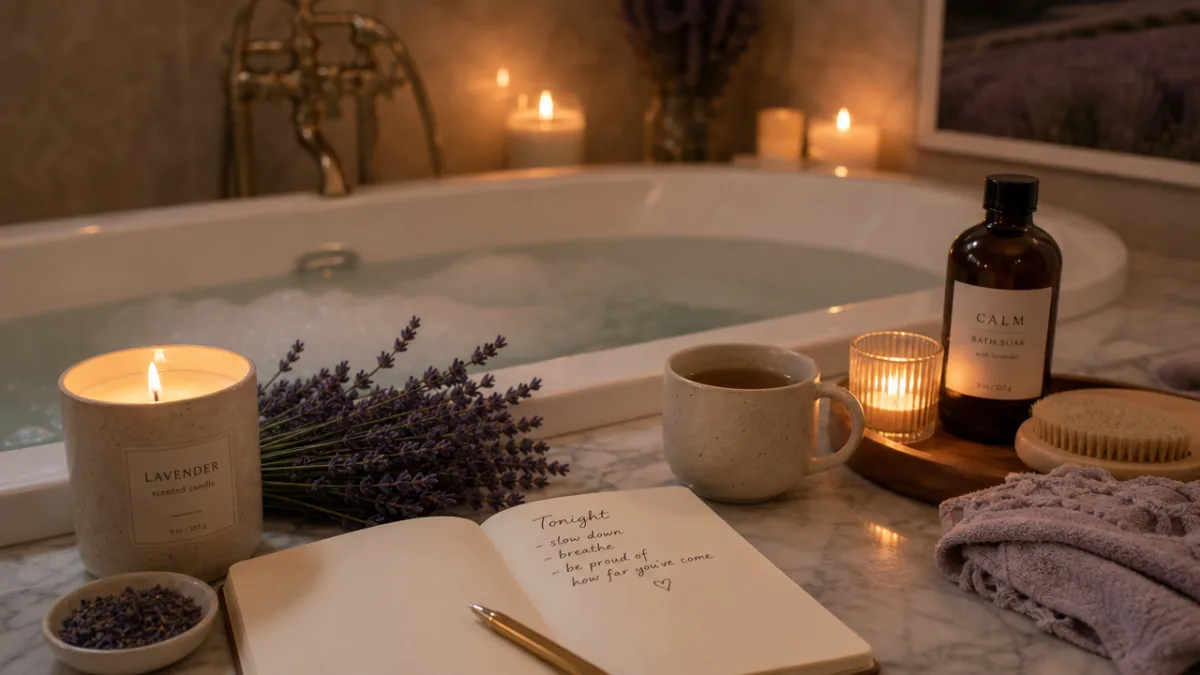
Sound and scent matter more than most people give them credit for. Whether it’s true quiet, soft music, nature sounds, or some low ambient noise, what you hear shapes how your body feels. And scent — lavender, cedarwood, chamomile, sandalwood — isn’t just pleasant. Studies have shown these essential oils actually reduce anxiety and support relaxation. Diffuse them, spritz them on your pillow, or light a scented candle. After a while, your brain starts making the association automatically: that smell means it’s time to slow down. It becomes its own little cue for calm.

Physical Self-Care: Caring for Your Body Before Bed
Your body absorbs a lot over the course of a day — the tension that creeps into your shoulders during a stressful call, the fatigue in your legs after hours on your feet, all the little physical stresses that build up quietly without you fully noticing. Physical self-care in the evening is about actually paying attention to that and giving your body some kindness before asking it to do the hard work of repair and recovery overnight. This isn’t about exercising or pushing yourself. It’s purely about release.
A warm bath or shower is one of the most well-researched evening rituals out there, and it’s also one of the most accessible. Here’s why it works: the warmth raises your core body temperature, and then when you step out and cool down, that drop actually signals to your brain that it’s time to sleep — mimicking what naturally happens as evening falls. Add some Epsom salts and you’re also getting a dose of magnesium through your skin, which helps with muscle relaxation and nervous system regulation. You don’t need much else. Paying mindful attention to the warm water, using a soap you love, or adding a simple scrub turns something you’d do anyway into something genuinely restorative.
A skincare routine serves a similar double purpose. Yes, it’s good for your skin — clearing away the day’s buildup of pollution, sunscreen, and makeup gives your skin what it needs to repair itself overnight. But there’s also something deeply satisfying about washing your face at the end of a long day, both literally and psychologically. When you follow that up with a moisturizer or oil applied with slow, deliberate movements, it stops being a chore and starts being a moment of real self-connection. The repetitive, tactile quality of it is, for a lot of people, one of the most reliably calming parts of their whole day.
Gentle movement is worth including too, even if it’s just ten minutes. A slow walk, some light stretching, or a few yoga poses can do a lot to release physical tension and lower cortisol — but the key word here is gentle. You’re not training; you’re unwinding. A few things worth trying:
- Child’s pose held for a minute or two is great for releasing the lower back and hips, especially if you’ve been sitting most of the day.
- Legs-up-the-wall is one of the most deeply calming positions you can do — it soothes the nervous system and helps with any swelling in your feet and legs.
- A seated forward fold stretches the hamstrings and naturally encourages you to turn your attention inward, which is exactly the direction you want to go at night.
- Slow neck and shoulder rolls target the spots where most of us hold stress without realizing it.
- A brief foot massage with warm oil is incredibly grounding — Ayurvedic tradition has been recommending it for centuries, and honestly, it just feels wonderful.
Mental and Emotional Self-Care: Processing Your Day
Physical exhaustion is one thing. But by the end of a long day, your mental and emotional reserves are often even more depleted — and that’s the part that tends to keep people staring at the ceiling at midnight. You lie down physically tired but mentally wired, replaying that awkward conversation or mentally rehearsing tomorrow’s to-do list. When there’s no intentional space to process and release the day, your mind just carries all of that into sleep, where it causes restless nights and stress-heavy dreams instead of genuine rest.
Journaling is probably the most consistently recommended tool for this, and it genuinely earns that reputation. Writing by hand helps your brain externalize the thoughts that might otherwise loop endlessly on their own. The good news is there’s no one right way to do it. Some people love a structured gratitude practice — writing down three to five specific things they appreciated about the day. Others get more relief from a total brain dump, just pouring everything out onto the page without any editing or direction. Some use the time for deeper reflection, asking themselves how they showed up and what they want to do differently. Whatever format actually gets you writing consistently is the right one.
Your relationship with technology in the evening might be the hardest thing to change, but it’s also one of the most impactful. Our phones and apps are genuinely designed to keep us hooked — that’s not cynicism, that’s just how they’re built. Scrolling social media or catching up on news before bed keeps your brain in reactive, stimulated mode and floods you with emotional content your mind then has to sort through while you’re trying to sleep. Even a modest boundary here — no screens for the last thirty minutes before bed — tends to produce noticeable improvements in both sleep quality and morning mental clarity within just a few days. Start there if it feels like too much to ask for more.

Nourishment and Hydration: Evening Rituals for Inner Wellbeing
What you eat and drink in the evening has a real effect on how well your body can rest and repair itself overnight. This isn’t about following strict rules or cutting things out — it’s about making choices that actually support how you want to feel. Everyone’s body is a little different, so paying attention to what works for you is itself a worthwhile practice. But there are some fairly reliable patterns that can give you a useful starting point.
Herbal teas have earned their place in evening routines across cultures all over the world, and it’s not just tradition. Chamomile, for instance, contains an antioxidant called apigenin that binds to receptors in the brain linked to both sleep and anxiety reduction. Valerian root, passionflower, lemon balm, and lavender teas all have varying levels of evidence behind their calming effects. But beyond the science, there’s just something inherently soothing about the whole ritual — holding a warm cup, breathing in the steam, sipping slowly. It’s a small ceremony that asks very little of you and gives quite a bit back.
Hydration is easy to overlook at night, but it matters more than most people think. A lot of us end the day mildly dehydrated — we were just too busy to drink enough water. Even mild dehydration affects your mood, your thinking, and the quality of your sleep. Making a glass of water part of your evening routine, maybe with a slice of cucumber or a squeeze of lemon to make it feel a bit more intentional, is a simple way to address this and add a small moment of mindfulness. On the food side, things like warm soups, foods high in magnesium and tryptophan, and slow-digesting complex carbohydrates can help keep your blood sugar stable overnight and support a more restful sleep.
Building a Sustainable Evening Routine: Making It Last
Knowing what goes into a good evening routine is only half the battle. Actually building one that survives contact with real life — with late work nights, family chaos, bad days, and general unpredictability — is where most people struggle. The most perfectly curated routine in the world is useless if it only happens when conditions are ideal. Sustainability means designing something around your actual life, not the version of your life you imagine having someday. That usually means starting much smaller than feels significant, building slowly, and choosing consistency over perfection every single time.
Habit stacking is one of the best strategies for making a new routine stick. Instead of treating your self-care practice as something that happens after everything else is done (which usually means it never happens), you attach each new habit to something you already do automatically. You always brush your teeth at night — great, that’s your anchor. Stack a few minutes of skincare on top of that. Then journal after. Then make your tea. Each piece connects to the next, and eventually the whole sequence runs on its own without requiring much willpower at all.
Just as important: let go of the idea that it has to be all or nothing. Life will throw evenings at you that are chaotic, emotionally exhausting, or just completely off the rails. Kids get sick. Deadlines land. Sometimes you are just done by 8 p.m. and that’s the reality. On those nights, one single element of your routine — one slow breath, one warm drink, one sentence in a journal — is worth infinitely more than skipping everything because you couldn’t do it “properly.” The ability to show up in a small way and not abandon the practice entirely is, genuinely, a form of self-care in itself.
As you build out your routine over time, a few principles are worth keeping in mind:
- Try to start at roughly the same time each evening. Consistency in timing helps regulate your internal clock and makes the whole routine feel natural rather than effortful.
- Start with just two or three things you actually want to do, not things you feel you should do. Let it grow from enjoyment, not obligation.
- Create environmental cues — a particular candle, a playlist, a specific spot in your home — that signal to your brain that your self-care time has started.
- Revisit and adjust your routine with the seasons. What feels restorative in January is often different from what you need in July.
- Protect this time like you’d protect any other real commitment. That means communicating it to people in your household and not letting it be the first thing you sacrifice when life gets busy.
The evening isn’t just the end of the day — it’s the foundation of the next one. How you spend those quiet hours shapes your sleep, your stress resilience, your physical health, and your mental clarity. This isn’t self-indulgence. It’s the steady, loving maintenance of the most important thing you’ve got: yourself. Start tonight, start small, and give the practice time to grow into something that actually changes how you feel — from the inside out.








What do you think?
It is nice to know your opinion. Leave a comment.