










The Complete Guide to Crystals: Healing, History, and How to Use Them
The Ancient Origins of Crystal Healing
Crystals have captivated human beings for tens of thousands of years, long before recorded history gave us the language to describe their allure. Archaeological evidence suggests that ancient peoples across every inhabited continent collected, carved, and revered gemstones and minerals for purposes that extended well beyond simple decoration. From the lapis lazuli traded across ancient Mesopotamian trade routes to the jade burial masks of Mesoamerican civilizations, crystals have always occupied a space at the intersection of the practical and the sacred.
The ancient Egyptians were perhaps the most prolific early users of crystals in a ceremonial and protective context. They adorned their pharaohs with turquoise, carnelian, and lapis lazuli, believing these stones carried divine protective properties. Powdered malachite was used as eye shadow not only for aesthetic purposes but because Egyptians believed it shielded the eyes from evil and invited the protection of the gods. Their elaborate burial rituals frequently included specific crystals placed on or near the body to guide the soul safely into the afterlife, demonstrating a profound belief in the spiritual potency of these minerals.
In ancient Greece and Rome, crystals were deeply embedded in mythology and daily life alike. The word “crystal” itself derives from the Greek word krystallos, meaning ice, because the ancient Greeks believed that clear quartz was water so deeply frozen by the gods that it could never melt. Roman soldiers carried hematite into battle, believing it made them invincible. Amethyst was worn as an amulet against intoxication, and the word comes from the Greek amethystos, meaning “not drunk.” This linguistic heritage reminds us that the belief in crystal energy is not a modern invention but a thread woven through the entire tapestry of human civilization.
Eastern traditions contributed enormously to the global understanding of crystals. In traditional Chinese medicine, jade was considered the most precious of all stones, associated with the virtues of wisdom, compassion, courage, and justice. Jade rollers and gua sha tools made from jade and rose quartz have been used in Chinese beauty rituals for centuries, a practice that has experienced a massive resurgence in contemporary wellness culture. In Hindu and Vedic traditions, nine specific gemstones known as the Navaratna were associated with planetary influences and were set in jewelry worn to harmonize cosmic energies and attract good fortune.
Understanding Crystal Energy and Vibration
The foundational concept behind crystal healing rests on the idea that all matter vibrates at specific frequencies, and that the highly ordered atomic structure of crystals produces stable, coherent energetic patterns. Unlike organic matter, which is in constant states of growth, decay, and change, crystals form over millions of years under precise geological conditions, resulting in extraordinarily consistent molecular lattices. Proponents of crystal healing suggest that this structural stability allows crystals to emit steady vibrational frequencies that can interact with the more chaotic energetic fields of the human body.
Modern science does offer a partial bridge to these ideas through the concept of piezoelectricity, which is the property of certain crystals to generate an electric charge when subjected to mechanical pressure. Quartz crystals are used in watches, sonar equipment, microphones, and countless electronic devices precisely because of this measurable energetic property. The quartz crystal oscillator in your wristwatch vibrates at an extraordinarily consistent frequency, making it one of the most reliable timekeeping mechanisms ever devised. While this scientific application does not directly validate metaphysical healing claims, it does demonstrate that crystals possess real, measurable energetic properties that have profound practical applications.
Crystal healers and practitioners work with the concept of chakras, the seven primary energy centers of the body according to Hindu and yogic traditions. Each chakra is associated with specific colors, emotions, physical organs, and correspondingly, specific crystals. The root chakra at the base of the spine, associated with grounding and security, corresponds to red and black stones like red jasper and black tourmaline. The crown chakra at the top of the head, associated with spiritual connection and higher consciousness, resonates with clear quartz and amethyst. Working with these correspondences forms the backbone of most contemporary crystal healing practice.
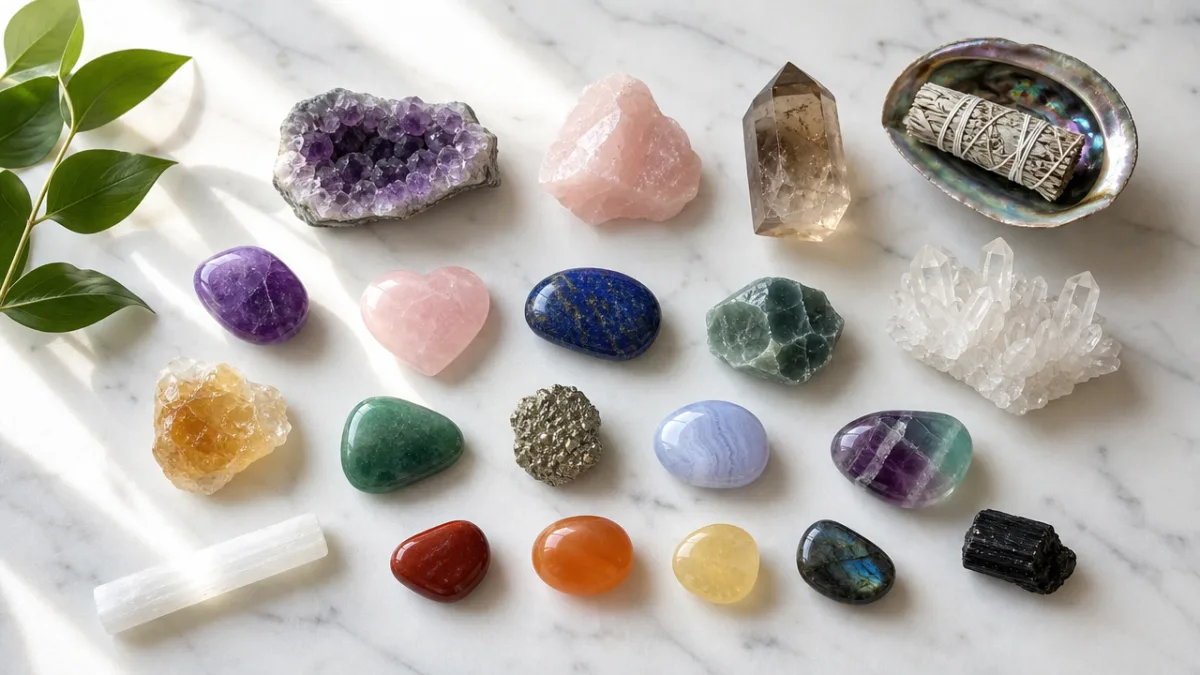
The Most Popular Crystals and Their Properties
Clear quartz is often called the master healer and is perhaps the most versatile and widely used crystal in the healing arts. Its perfectly transparent structure is said to amplify energy and intention, making it an ideal companion for meditation, manifestation work, and enhancing the properties of other crystals placed near it. Clear quartz points are frequently used to direct energy in healing sessions, with the tip pointing toward the body to draw energy in or away from the body to release stagnant or negative energy. It is also prized for its ability to be programmed with specific intentions, effectively acting as a crystalline storage device for focused thought and purpose.
Amethyst is one of the most beloved and recognized crystals worldwide, prized for its stunning purple hues that range from pale lavender to deep violet. It is associated with the third eye and crown chakras and is traditionally used to support calm, clarity, intuition, and spiritual awareness. Many people place amethyst on their nightstands or under their pillows to encourage restful sleep and to facilitate vivid, insightful dreaming. Amethyst geodes, those spectacular hollow rock formations lined with purple crystal clusters, are popular in home decor and are believed to purify the energy of the spaces in which they are placed, creating an atmosphere of tranquility and protection.
Rose quartz is the quintessential stone of love in all its forms, including romantic love, self-love, compassion, and emotional healing. Its soft pink energy is associated with the heart chakra and is used to attract new love, deepen existing relationships, and heal old emotional wounds that may be preventing genuine connection. Rose quartz face rollers and gua sha tools have become staples in modern skincare routines, combining the ancient tradition of crystal use with contemporary wellness practices. Many practitioners recommend keeping a piece of rose quartz in the bedroom or carrying it close to the body to maintain a consistent connection with its nurturing, heart-opening energy.
Some of the most commonly sought-after crystals and their primary associations include the following:
- Black Tourmaline — Protection, grounding, deflecting negative energy, and creating energetic boundaries
- Citrine — Abundance, confidence, creativity, solar energy, and manifesting prosperity
- Labradorite — Transformation, intuition, magic, and protection during times of change
- Lapis Lazuli — Truth, wisdom, communication, and awakening the higher mind
- Selenite — Purification, cleansing, clarity, and charging other crystals
- Obsidian — Shadow work, truth-revealing, protection, and releasing deeply held trauma
- Malachite — Transformation, emotional healing, abundance, and amplifying intentions
- Moonstone — Feminine energy, intuition, new beginnings, and emotional balance
Beyond these well-known varieties, the crystal world encompasses thousands of minerals, each with its own unique geological origin, appearance, and attributed energetic signature. Collectors and practitioners often find themselves drawn to specific stones in ways that feel instinctive and personal, and many in the crystal healing community encourage trusting this intuitive pull when selecting crystals. Whether you are drawn to the iridescent flash of labradorite or the grounding weight of a smooth basalt river stone, the crystal that catches your attention may be precisely the one whose energy is most relevant to your current life circumstances.

How to Cleanse, Charge, and Program Your Crystals
One of the first things new crystal enthusiasts learn is the importance of cleansing their stones when they first acquire them and at regular intervals thereafter. The reasoning behind this practice is that crystals absorb and store energy from every person and environment they encounter, and a stone that has been handled by many people or stored in an energetically dense environment may carry residual energies that are not aligned with your intentions. Cleansing essentially resets the crystal’s energetic slate, returning it to a neutral state ready to be worked with intentionally. There are numerous methods for cleansing crystals, and the best choice depends on the specific stone and the practitioner’s preferences.
Several popular and effective cleansing methods are used within the crystal healing community. Smudging, which involves passing the crystal through the smoke of burning herbs such as white sage, palo santo, or rosemary, is one of the most ancient and widely practiced methods. Sound cleansing using singing bowls, tuning forks, or even clapping hands around the crystal uses vibrational frequencies to dislodge stagnant energy. Placing crystals in sunlight or moonlight is another beloved method, with the full moon being considered particularly potent for recharging and cleansing simultaneously. However, it is important to note that some crystals, including amethyst, rose quartz, and citrine, can fade with prolonged sun exposure, making moonlight the safer and more universally applicable option.
Charging a crystal is the process of filling it with a specific type of energy after cleansing, and programming refers to setting a clear intention within the crystal for a defined purpose. To program a crystal, practitioners typically hold the cleansed stone in both hands, enter a calm and focused meditative state, and clearly visualize or verbalize the specific intention they wish to embed within the crystal. This might be a desire for clarity during a challenging decision, support for a healing process, or the attraction of a particular life circumstance. The more specific and emotionally charged the intention, the more effectively practitioners believe the crystal retains and radiates that focused energy.
Water cleansing is popular but must be approached with considerable care, as many crystals are water-soluble or can be damaged by moisture. The Mohs hardness scale provides a useful general guideline, with stones ranking below 6 typically considered unsafe for water immersion. Crystals that should never be cleansed in water include:
- Selenite — dissolves readily in water and will permanently deteriorate
- Malachite — toxic compounds can leach into water, making it dangerous
- Pyrite — oxidizes and will rust when exposed to water
- Halite — essentially a form of salt crystal that dissolves almost immediately
- Angelite — porous structure absorbs water and can crack or crumble
- Lepidolite — contains mica which can flake and degrade with water exposure
Incorporating Crystals Into Daily Life and Practice
One of the most accessible ways to begin working with crystals is to carry them on your person throughout the day. Small tumbled stones tuck easily into pockets, purses, or bras, keeping the crystal’s energy field in close proximity to your own. Many practitioners suggest choosing a daily carry stone intuitively each morning, selecting whatever crystal you feel most drawn to without overthinking the choice, and later reflecting on whether that stone’s traditional associations aligned with the experiences and emotions of your day. This practice builds both a personal relationship with individual stones and a growing intuitive literacy around energetic needs.
Crystal grids are another powerful and visually beautiful way to work with crystal energy. A crystal grid is a geometric arrangement of multiple crystals placed in a specific pattern, often based on sacred geometry principles such as the Flower of Life or the Seed of Life. The geometric arrangement is believed to create a network of interconnected energy that is greater than the sum of its individual parts, amplifying and directing the collective energy of all the crystals involved toward a unified intention. Common applications for crystal grids include manifesting specific goals, protecting a home or space, supporting healing processes, and cultivating particular emotional states such as peace, love, or creative inspiration.
Meditation is perhaps the most profound and transformative way to develop a deep relationship with crystal energy. Holding a crystal or placing several on or around the body during meditation allows for an extended, uninterrupted period of energetic attunement. Many meditators report that certain crystals seem to produce distinct physical sensations during meditation, such as warmth, tingling, or a sense of expanded awareness. Whether these sensations arise from genuine energetic interaction or from the powerful focusing effect of intentional attention, the result is often a deeper, more vivid meditative experience. Even for those who approach crystals from a primarily psychological or symbolic perspective, the act of meditating with a meaningful object can serve as a powerful anchor for intention and focused awareness.

Selecting, Sourcing, and Caring for Your Crystal Collection
Building a crystal collection is a deeply personal journey that unfolds differently for every individual. Some collectors are drawn first by beauty, acquiring pieces that speak to them aesthetically before exploring their metaphysical attributes. Others begin with a specific intention or need, researching which crystals are traditionally associated with their area of focus and seeking those out deliberately. Many experienced practitioners recommend beginning with a small, foundational collection of versatile stones rather than immediately acquiring dozens of specialized varieties. A starter collection might include clear quartz, amethyst, black tourmaline, rose quartz, and citrine, as these five stones together address a broad range of energetic needs and provide an excellent introduction to working with crystal energy.
Ethical sourcing has become an increasingly important consideration for conscientious crystal collectors and practitioners. The global crystal and gemstone industry, while providing livelihoods for miners and artisans in many developing countries, has also been associated with problematic labor practices, environmental destruction, and lack of supply chain transparency in some regions. Crystals marketed as coming from specific locations are not always accurately labeled, and the industry lacks the robust certification systems found in some other sectors of the gemstone trade. Responsible consumers are encouraged to buy from reputable dealers who can speak knowledgeably about the origins of their inventory, to favor locally sourced or ethically certified stones where possible, and to be willing to pay prices that reflect fair compensation throughout the supply chain.
Caring for your crystals properly ensures they remain beautiful and energetically vibrant for years or even generations. Beyond regular energetic cleansing, physical care involves storing crystals safely to prevent chips, scratches, and breakage. Harder stones can scratch softer ones when stored together, so grouping stones by hardness or wrapping delicate pieces individually in soft cloth or velvet pouches is advisable. Display pieces should be kept out of prolonged direct sunlight to prevent color fading. Regular physical cleaning with a soft, dry cloth removes dust and fingerprints while also serving as an opportunity for a moment of mindful connection with each piece in your collection, reinforcing your intentions and deepening the personal relationship that makes crystal work most meaningful.
The crystal community is a rich and welcoming global network of enthusiasts, practitioners, geologists, artists, and collectors who share a deep appreciation for the beauty and potential of Earth’s mineral kingdom. Whether your interest lies in the scientific marvel of crystal formation, the cultural history of gemstone use across civilizations, the aesthetic pleasure of a well-curated collection, or the deeply personal practice of using crystals as tools for mindfulness, intention-setting, and energetic awareness, there is a place for you within this community. As with any meaningful practice, the most important qualities to bring are curiosity, openness, and a willingness to trust your own experience as a valid and valuable source of knowledge about what works for you.








What do you think?
It is nice to know your opinion. Leave a comment.