










🌲 Timberline Drift Candle – Redwood & Moss: A Deep Dive into the Art of Olive Oil and Soy Wax Scented Candles
The Allure of Nature-Inspired Fragrance: Why Redwood & Moss Captivates the Senses
There’s something about the smell of an old-growth forest that just stops you in your tracks. When you light a candle with redwood and moss in it, you’re not just adding a nice scent to the room — you’re conjuring a whole landscape. Pacific Coast redwoods have a smell unlike anything you’d find in a bottle of synthetic fragrance: deep, woody, a little resinous, with that cool, damp earthiness of moss clinging to the forest floor underneath. That’s exactly the feeling the Timberline Drift Candle is going for, and it’s what sets it apart from your average home fragrance.
Redwood is a fascinating fragrance note because it doesn’t quite fit anywhere obvious. It’s not as sharp as cedar, and it’s not as sweet as sandalwood. It lands somewhere in the middle — rich but not heavy, complex without being a lot to deal with. Add moss to the mix, which brings this green, faintly mineral quality that smells like rain-soaked earth and riverbanks, and suddenly you’ve got something genuinely transportive. Lighting this candle on a quiet evening is a little like stepping under a forest canopy and taking your first real breath in months.
Nature-inspired fragrances like this have been making a serious comeback lately, and honestly it makes a lot of sense. Most of us are spending our days in cities, staring at screens, largely cut off from anything that grows or breathes. The urge to reconnect with wild spaces has become almost a cultural ache. Candles that actually smell like forests, coastlines, or open land serve a real psychological purpose — they give you a moment of escape, slow things down, and root your senses in something tangible. The Timberline Drift Candle does that job remarkably well.
Understanding the Wax Blend: The Science Behind Olive Oil and Soy Wax
One of the most interesting things about the Timberline Drift Candle is what it’s actually made of. Instead of standard paraffin — a petroleum byproduct that’s dominated the candle industry for decades but is known to produce soot and release some questionable compounds when burned — this candle uses a blend of olive oil and soy wax. That’s not just a marketing angle. It reflects a genuine effort to make something that burns cleaner, smells better, and is easier on the environment.
Soy wax has been a solid paraffin alternative since the 1990s. It burns cooler and slower, which means your candle lasts noticeably longer. It also produces far less soot, so your walls and ceiling stay cleaner over time. And for a scented candle, soy wax has another big advantage: it holds fragrance oil really well and releases it gradually throughout the burn. That means you get a steady, consistent scent experience from the first time you light it to the very last — not a big initial hit that fades away to almost nothing.
The olive oil in the blend is where things get especially interesting. Olive oil has been used in lamps for thousands of years, and bringing it into modern candle-making has some real benefits. It softens the wax and gives the candle this beautiful, creamy appearance, while also helping it burn in a smooth, even pool. Olive oil also takes the edge off the scent throw — instead of fragrance that announces itself loudly the moment you walk into the room, you get something more diffused and ambient, like a smell you slowly become aware of and enjoy discovering. Put the two ingredients together and you’ve got a wax that’s as nice to look at as it is to burn.

Craftsmanship and the Making of an Artisan Candle
Great candles don’t happen by accident — they take patience, precision, and a real willingness to sweat the small stuff. The Timberline Drift Candle is made in small, carefully monitored batches rather than cranked out on an assembly line, and that distinction genuinely matters. Mass production is optimized for speed and volume, which usually means cutting corners on fragrance quality, burn performance, and the kind of finishing details that separate a good candle from a great one. Working in smaller batches lets makers stay hands-on — adjusting the temperature when fragrance gets added to the wax, controlling how quickly the candle cools, making sure the wick is perfectly centered — all the little things that add up to a noticeably better product.
Getting the fragrance right is its own kind of art. Creating a scent that actually captures what redwood and moss smell like — without sliding into something cloying or artificially sharp — takes a lot of testing and a lot of iteration. Good fragrance oils from reputable suppliers get blended at very specific load rates (that’s the ratio of fragrance to total wax weight) to make sure both the cold throw, what the candle smells like sitting unlit on your shelf, and the hot throw, the scent when it’s burning, land exactly where they should. Too little fragrance and the candle feels flat and disappointing. Too much and it becomes overwhelming, and can actually mess with how the candle burns.
Wick selection is something most people never think about, but it’s one of the most consequential decisions in candle making. The right wick depends on the diameter of the vessel, how dense the wax blend is, and how much fragrance is in the mix. A wick that’s too thin causes tunneling — the wax melts in a narrow column down the middle while a thick ring of perfectly good wax stays solid around the edges forever. A wick that’s too thick runs too hot, throws a big flame, produces soot, and burns through your fragrance way faster than it should. Artisan makers typically test dozens of wick options to find the one that creates a full, even melt pool, a clean flame, and reliable performance all the way to the bottom of the candle.
Burning Rituals and Best Practices: Getting the Most from Your Timberline Drift Candle
Even an exceptional candle will let you down if you don’t treat it right. Most people don’t think much about candle care, but a few simple habits make a real difference — longer life, better scent, a cleaner burn. The Timberline Drift Candle’s olive oil and soy wax blend is especially responsive to being looked after properly. Give it a little attention and it’ll give you dozens of hours of that deep, forest-floor fragrance in return.
The most important rule, especially with a soy and olive oil blend, is nailing the first burn. The very first time you light it, let it burn long enough that the entire surface of the wax liquefies all the way to the edges of the vessel. Depending on the diameter of the candle, that usually takes somewhere between two and four hours. If you blow it out before the wax has fully melted across the top, you create what’s called a “memory ring” — and that ring will cause tunneling every single time you burn the candle from then on. Start it right and every subsequent burn will follow suit.
After that first burn, keeping a few habits going will see the candle all the way through its lifespan in great shape. These include:
- Trimming the wick to about 6mm (a quarter inch) before each lighting. A longer wick produces a bigger, mushrooming flame that burns hotter, generates more soot, and eats through your fragrance faster than it needs to.
- Keeping the candle away from drafts, open windows, and air conditioning vents. Moving air disrupts an even burn, makes the flame flicker erratically, and leads to uneven wax and soot marks on the vessel.
- Burning for no more than four hours at a stretch. Longer sessions cause the wax to overheat, which can hurt fragrance performance and occasionally stress the vessel itself.
- Stopping when there’s about 10mm of wax left at the bottom. Burning past that point risks overheating the container and destroys whatever fragrance is left in that last bit of wax.
- Keeping the lid on when the candle isn’t in use, and storing it away from direct sunlight. UV light breaks down fragrance oils over time and can cause the wax to discolor.
None of this is complicated, and once it’s just part of how you use candles, it stops feeling like a checklist. The payoff is real — a well-cared-for Timberline Drift Candle can burn for fifty to sixty hours with consistent, balanced fragrance the whole way through. That makes it not just a genuinely lovely thing to have around, but also a much better value than cheaper candles that burn fast and smell like almost nothing within a few uses.

The Aesthetic and the Atmosphere: How the Timberline Drift Candle Transforms a Space
A candle is never just a candle. It’s also an object with its own presence, and it sets a tone for the room it lives in. The Timberline Drift Candle was designed with that in mind — its visual identity matches its fragrance identity. The vessel tends toward clean, grounded shapes, whether ceramic, amber glass, or matte-finished containers in the kinds of muted tones you’d find in a forest moving between seasons. The creamy, slightly irregular surface of the olive oil and soy wax blend has an organic, handmade quality that you simply don’t get from anything that came off a production line.
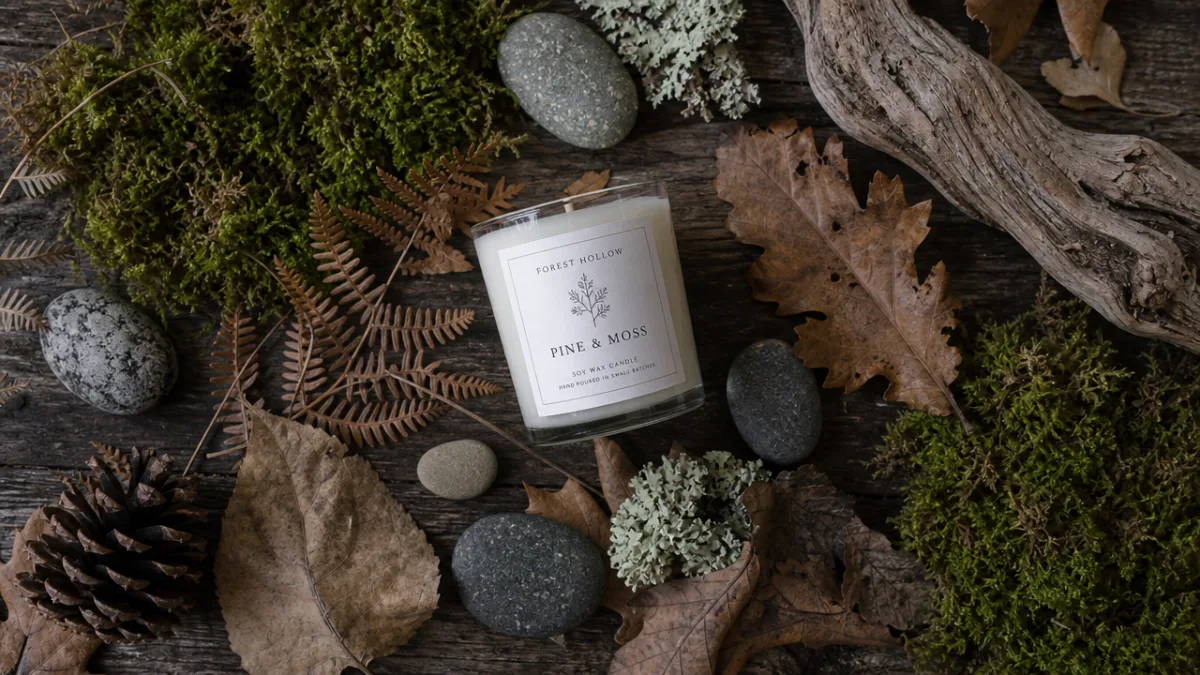
It’s also a surprisingly versatile piece, aesthetically. It fits just as naturally in a spare, Scandinavian-influenced living room as it does in a warmer, more layered space full of old books and woven throws. The earthy greens and browns suggested by the redwood and moss scent profile slot right into biophilic design — the interior philosophy built around bringing natural elements inside. Set alongside a smooth river stone, a small fern, or a piece of driftwood, and this candle becomes part of a little composed moment of the natural world, relocated to your home.
And then there’s the light itself, which is worth thinking about on its own terms. Studies into how we respond to different light sources have found that the warm, flickering glow of a candle triggers a fundamentally different neurological response than the overhead electric lighting we spend most of our lives under. It signals rest, safety, and closeness — associations our nervous systems have been building around firelight for an extraordinarily long time. Pair that with a fragrance as deeply rooted in nature as redwood and moss, and you’ve got a layered sensory experience that goes well past “nice smell.” It’s genuinely restorative in a way that’s hard to articulate but easy to feel.
Sustainability, Ethics, and the Conscious Consumer’s Choice
Choosing soy wax and olive oil over paraffin is ultimately an ethical decision as much as a practical one. Paraffin is a petroleum refining byproduct — tied to fossil fuels, non-renewable, and known to release compounds like toluene and benzene when burned in enclosed spaces. Soy and olive oil, by contrast, are both plant-derived, renewable, biodegradable, and burn significantly cleaner. For people who are paying attention to the environmental footprint of what they buy, that’s not a small distinction — it’s a real alignment between values and daily habits.
Soy wax also comes with some additional ethical questions worth thinking through. A lot of the world’s soy supply comes from large-scale agricultural operations with problematic environmental track records, particularly in South America where soy farming has been linked to deforestation. Responsible makers using soy wax should be sourcing from certified, traceable supply chains — ideally domestic, or at minimum from operations with verifiable environmental standards. It’s worth asking those questions when you buy any soy-based product, and it’s worth supporting makers who are upfront about where their materials come from.
The fragrance side of things also deserves a closer look from a health and sustainability standpoint. A lot of commercial fragrance oils contain synthetic musks, phthalates used as carriers, and other additives that raise legitimate questions about health impacts and how they persist in the environment. More and more premium artisan makers are moving toward fragrance oils formulated without these compounds — phthalate-free, compliant with safety standards from organizations like IFRA (the International Fragrance Association), and tested for skin and respiratory safety. The Timberline Drift Candle’s commitment to clean ingredients runs all the way from the wax to the fragrance blend, which makes it a purchase that’s easier to feel good about.
Taken together, the Timberline Drift Candle stands for something a little bigger than a single product. It sits at the crossroads of several things a lot of us are genuinely trying to figure out right now: how to stay connected to the natural world, how to prefer things made with real care over things churned out at scale, how to choose materials that are cleaner and more sustainable, and how to be more intentional about what we bring into our homes. Choosing a candle like this is a small act, but it’s part of a larger way of thinking — about beauty, honesty in materials, and being a little gentler in how we move through the world.








What do you think?
It is nice to know your opinion. Leave a comment.