










Crochet Daisy Wall Hanging Free Patterns Perfect for Cozy Cottagecore Vibes
The Cottagecore Aesthetic and Why Crochet Daisy Wall Hangings Belong in Every Home
Cottagecore is more than a passing trend — it is a deeply felt return to simplicity, nature, and handmade beauty. Rooted in the romanticism of rural life, this aesthetic celebrates wildflowers, linen textures, warm candlelight, and the quiet joy of creating something with your own two hands. Among all the crafts that fall under the cottagecore umbrella, crochet stands out as one of the most beloved and most accessible, offering makers a way to produce stunning, tactile pieces that feel genuinely personal and deeply connected to a slower, more intentional way of living.
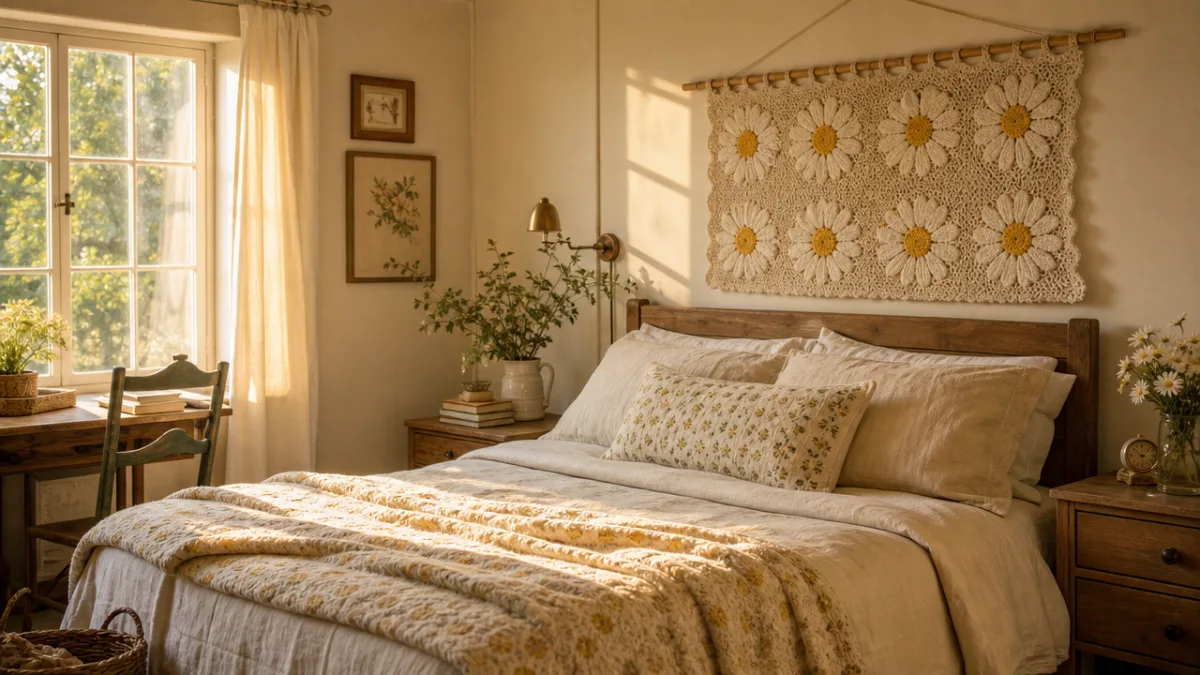
Within the world of crochet home décor, the daisy motif has claimed a very special place. The daisy is universally recognizable, cheerful without being garish, and carries centuries of symbolic meaning — innocence, new beginnings, and the gentle optimism of spring. When rendered in yarn and arranged into a wall hanging, the daisy transforms from a simple flower into a statement piece that can anchor an entire room’s visual identity. Whether your walls are whitewashed plaster or warm-toned wood paneling, a crochet daisy wall hanging brings softness, warmth, and an undeniably handmade soul to any space.
The best part? You do not need to invest in expensive patterns or enroll in advanced courses to make one. There is an abundance of free crochet daisy wall hanging patterns available online, created and shared generously by makers across the globe. These patterns range from beginner-friendly single-motif designs to elaborate multi-daisy arrangements with fringe, macramé-inspired elements, and creative color combinations. Whether you are picking up a hook for the first time or adding to a well-practiced skill set, there is a free daisy wall hanging pattern waiting for you.
Understanding the Cottagecore Color Palette for Daisy Wall Hangings
Color choice is everything when it comes to creating a wall hanging that truly fits the cottagecore aesthetic. The palette tends toward the soft and muted — think cream, sage green, dusty rose, warm terracotta, buttercup yellow, and the gentle grays of overcast mornings. These shades evoke the natural world without overwhelming the senses, creating a sense of harmony that feels effortless rather than designed. When you select yarn for your daisy wall hanging, leaning into these hues will almost always yield a result that feels cohesive and beautifully on-theme.
That said, there is room within the cottagecore world for bolder expression. Some makers choose to work their daisies in vivid sunflower yellows against rich forest greens, or in unexpected combinations like rust orange and cream that feel earthy and autumnal. The key is to stay connected to nature as your guiding principle. If you can picture the color growing in a meadow, blooming in a garden, or appearing in a field at golden hour, it likely belongs in your cottagecore crochet palette. Trust your instincts and do not be afraid to swatch before committing to a full project.
Yarn texture also plays a significant role in the final look. Cotton yarn produces crisp, defined stitches that photograph beautifully and hold their shape well over time — ideal for daisy petals that need clear definition. Wool or wool-blend yarns add warmth and a slightly rustic quality that suits the cottagecore mood perfectly, especially in cooler color tones. For an extra layer of whimsy, some makers incorporate a strand of linen or jute twine into certain sections of their wall hanging, adding a natural, textured contrast that grounds the piece and amplifies its handmade character.
Essential Materials and Tools for Your Crochet Daisy Wall Hanging Project
Before you cast on your first stitch, gathering the right materials will make the entire process smoother and more enjoyable. The good news is that crochet wall hangings are genuinely low-cost projects, especially when you take advantage of yarn you already have in your stash. Most daisy wall hanging patterns require only a few basic tools and a modest quantity of yarn, making them ideal for beginners who want a meaningful finished object without a significant financial investment. Here is a general breakdown of what you will need to get started.
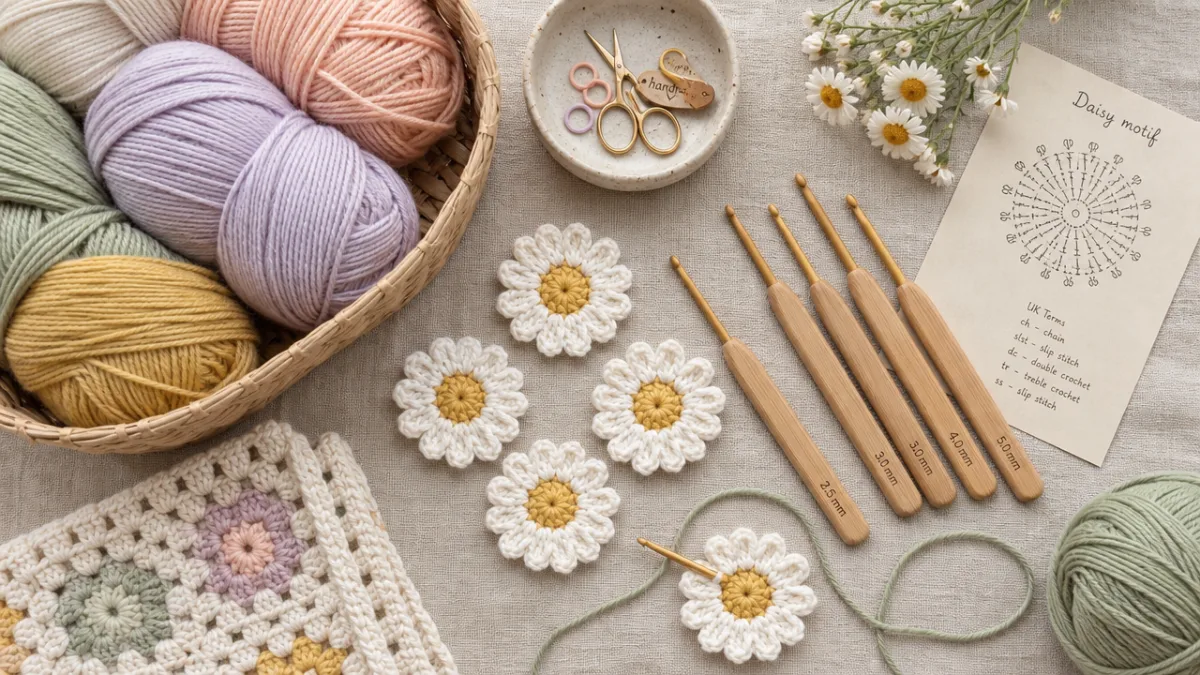
For most daisy wall hanging patterns, you will want a crochet hook in the range of 3.5mm to 5mm, depending on the weight of yarn you select. A 4mm hook paired with a DK or light worsted weight cotton yarn is a reliable starting combination that produces neat stitches with good definition — exactly what daisy petals require. You will also need a yarn needle for weaving in ends and assembling motifs, a pair of scissors, and a wooden dowel or branch from which to hang your finished piece. Many makers prefer to use a natural wood dowel or even a found branch for an extra touch of organic charm.
Beyond the basics, consider having the following on hand as you prepare for your project:
- Stitch markers to track rounds in your daisy motifs, especially if you are new to working in the round.
- A tape measure or ruler to check your gauge and ensure your motifs are uniform in size before joining them together.
- Blocking mats and pins, which allow you to wet-block your finished motifs into perfect, consistent shapes before assembling the wall hanging.
- Twine, jute, or macramé cord for fringe elements and for hanging your finished piece securely on the wall.
- A selection of yarn colors so you can experiment with combinations before committing to your final palette.
It is worth noting that the dowel or hanging rod you choose can be as much a part of the design as the crochet itself. A smooth, store-bought wooden dowel gives a clean, polished look, while a twisted or gnarled branch gathered from a walk in the woods brings a wonderfully wild, organic energy to the finished piece. Some makers even wrap portions of their dowel in yarn or twine for a fully cohesive aesthetic. There is no wrong choice here — follow what resonates with your personal vision for the finished piece and the space it will occupy.
Choosing the Right Yarn Weight and Fiber for Wall Hangings
Yarn selection deserves its own moment of attention because it will determine not just the look of your wall hanging, but its durability and the ease with which you work through the pattern. Wall hangings are not subject to the wear and washing that garments endure, which opens up your fiber options considerably. You can work with natural fibers like cotton, linen, and wool, as well as blends that combine the best qualities of each. For daisy motifs specifically, a yarn with low elasticity — like cotton — tends to work best because it allows petals to lie flat and hold their shape without curling or stretching over time.
If you want a rustic, textural look, a single-ply or loosely spun yarn can add beautiful depth and a slightly artisanal quality to your finished piece. These yarns can be slightly trickier to work with since they may split on the hook, but the visual result is often worth the extra patience they require. For absolute beginners, a smooth, tightly plied cotton in a medium weight is the most forgiving option and will produce clean, easy-to-see stitches that make following a pattern much more manageable.
Many free patterns for crochet daisy wall hangings are written for worsted weight yarn, which makes them accessible to the widest possible range of makers. If you want to scale up for a dramatic, large-format wall hanging, you can use bulky yarn and a larger hook — just be aware that your finished dimensions will differ from those listed in the pattern. Conversely, working in fingering or sock weight yarn with a smaller hook produces a delicate, heirloom-quality piece that takes more time but yields extraordinarily fine detail in every petal and center of each daisy motif.
Step-by-Step Overview of a Classic Crochet Daisy Motif
Understanding how to make a single daisy motif is the foundation of every daisy wall hanging pattern you will ever encounter. Most daisy motifs begin with a magic ring or a chain joined into a ring at the center, from which you build outward in rounds. The center of the daisy — often worked in yellow, gold, or warm cream — is typically a compact circle of single crochet or half double crochet stitches, creating a dense, rounded hub that anchors the petals radiating outward from it. Getting this center neat and even sets the tone for everything that follows.
From the center, petals are created using a variety of methods depending on the pattern. One of the most common approaches involves working chains and slip stitches to create elongated loops that are then secured at their base, forming petal shapes around the circumference of the center circle. Another popular method is the foundation petal technique, in which each petal is worked as a small, individual spike or shell stitch that grows directly out of a stitch in the previous round. Both approaches produce beautiful results, though the chain-loop method tends to be slightly faster and works especially well in fine or lightweight yarns.
Once you have completed your first daisy motif, you will likely find that the second and third come significantly faster. The rhythm of the pattern becomes intuitive quickly, and many makers describe working daisy motifs as almost meditative — the repetitive, predictable sequence of stitches allowing the mind to settle into a calm, focused state that is itself part of the appeal of crochet as a practice. This quality makes daisy wall hangings particularly well-suited to crafters who use their hobby as a form of stress relief and mindful creative expression.
Joining Motifs and Assembling Your Wall Hanging
Once you have a collection of finished daisy motifs — the exact number will depend on your chosen pattern and the size of the wall hanging you are making — the next step is joining them together and assembling the final piece. There are several methods for joining crochet motifs, and free patterns will typically specify which one they recommend. The flat slip stitch join and the join-as-you-go method are both popular choices for wall hangings because they produce a flat, seamless connection between motifs that photographs beautifully and hangs evenly on the wall.
If your pattern calls for a more decorative join, you might work a small chain or picot stitch between adjacent motifs, creating a lacy, open-work effect between each daisy. This kind of join adds airiness to the piece and allows light to filter through the work in a way that is particularly beautiful when the wall hanging is placed near a window. The join you choose will subtly shift the overall mood of the piece, so it is worth thinking through your options before committing — or even crocheting a quick swatch of two joined motifs to see how each method looks in your chosen yarn.
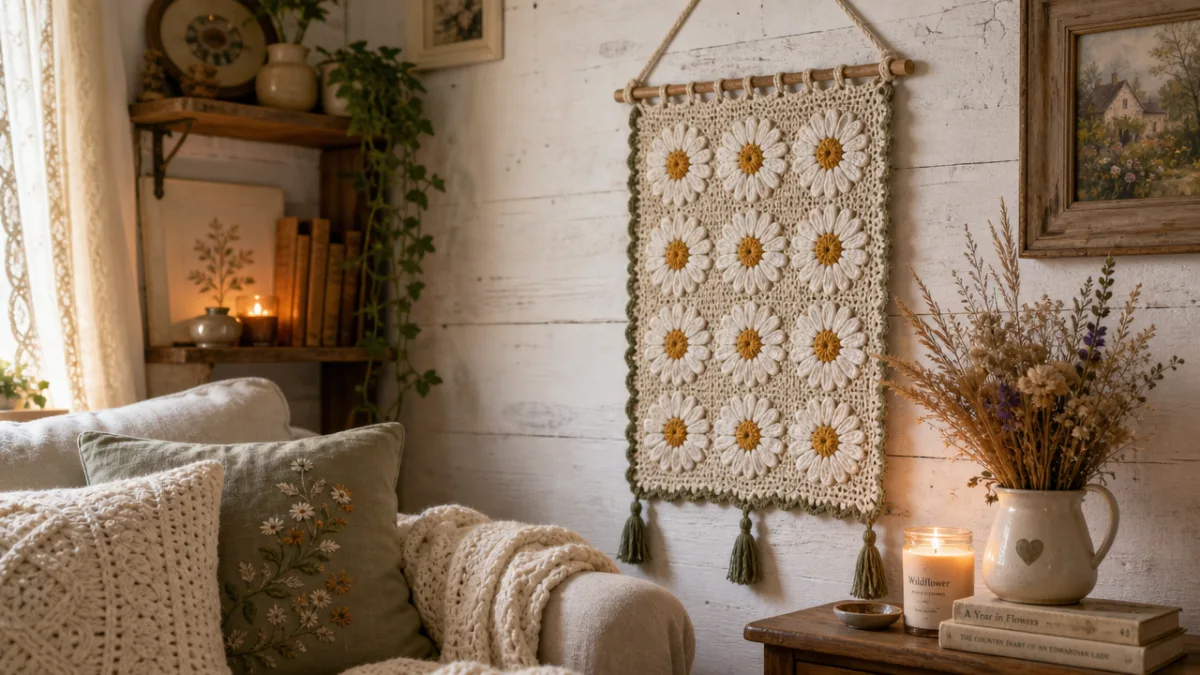
After joining, attaching your wall hanging to its dowel or branch is the final step before fringe or tassels — if your design includes them. Most patterns recommend folding the top row of the piece over the dowel and seaming it in place with a yarn needle, though some makers prefer to use lark’s head knots worked in matching yarn for a more decorative finish. Add fringe to the bottom edge by cutting lengths of yarn or twine, folding them in half, and pulling them through the lower edge of the piece with a hook, then knotting them securely. Trim the fringe to an even length using sharp scissors and a ruler for a polished, professional finish.
Where to Find the Best Free Crochet Daisy Wall Hanging Patterns
The crochet community is extraordinarily generous when it comes to sharing free patterns, and daisy wall hangings are among the most well-represented categories in the free pattern landscape. Several dedicated crochet websites host extensive libraries of free patterns sorted by skill level, theme, and stitch type, making it easy to browse until you find exactly the project that speaks to you. Ravelry remains one of the most comprehensive resources for finding free and paid crochet patterns, with a robust search function that allows you to filter by yarn weight, gauge, skill level, and even specific motifs like the daisy.
Beyond Ravelry, platforms like Pinterest serve as incredible visual discovery tools for crochet inspiration. A single search for “crochet daisy wall hanging free pattern” on Pinterest will surface hundreds of finished projects, mood-board-style collections, and direct links to pattern tutorials hosted on individual maker blogs. These blogs — often run by passionate crochet designers who share their patterns freely as a gift to the community — frequently include detailed photo tutorials, video walkthroughs, and printable PDF versions of their patterns that you can reference offline while you work.
YouTube is another invaluable resource, particularly for visual learners who prefer to watch a technique demonstrated in real time rather than read through written instructions. Many talented crochet educators on YouTube have created full, detailed tutorials for daisy wall hangings of all sizes and styles, walking viewers through every step from the magic ring to the final fringe trim. Watching a tutorial alongside a written pattern can be enormously helpful when you encounter an unfamiliar stitch or a confusing construction sequence, and the comment sections of these videos are often full of helpful tips from other makers who have worked through the same project.
Tips for Customizing a Free Pattern to Make It Your Own
One of the great joys of working from a free pattern is the freedom to adapt it to your own taste, skill level, and space. Even the most straightforward daisy wall hanging pattern becomes a completely unique creation when you make intentional choices about color, scale, and finishing details. Start by considering the wall space you are designing for — a small accent wall might call for a modest, single-row arrangement of three or five daisy motifs, while a large statement wall could support a dramatic grid of twenty or more daisies in a graduating color wash from pale cream at the top to rich terracotta at the bottom.
You can also introduce additional design elements that go beyond the base pattern to add personality and visual interest. Consider incorporating leaves worked in varying shades of green between your daisy motifs, adding botanical realism and a sense of the flower growing naturally across the surface of the piece. Beads threaded onto the fringe strands at the bottom of the hanging catch the light beautifully and add a subtle, whimsical touch. Embroidered details worked onto the finished crochet using a contrasting yarn color can also add depth and dimension to the daisy centers or petal edges.
Finally, do not overlook the opportunity to personalize your wall hanging through the choice of hanging hardware. A driftwood branch gathered from a beach or lakeside walk carries the memory of a meaningful place directly into your home décor. A hand-carved or laser-engraved wooden dowel adds a custom, artisanal quality. Even the way you wrap and knot the hanging cord at each end of the dowel can become a design statement in itself. Every decision you make, from yarn fiber to hanging cord, contributes to a finished piece that is genuinely and unmistakably yours.
Caring for Your Crochet Daisy Wall Hanging and Making It Last for Years
A well-made crochet daisy wall hanging is not just a decorative object — it is a piece of craft that carries time, intention, and skill within every stitch. With the right care, it can remain beautiful and vibrant for many years, becoming one of those beloved home objects that marks the passage of seasons and accumulates sentimental value as time goes by. Understanding how to care for your wall hanging properly is an important final step in the making process, and one that is often overlooked in the excitement of completing and hanging a new piece.
Dust is the primary enemy of textile wall art. Over time, even in a clean home, crochet wall hangings will collect fine dust particles that can dull their colors and flatten their texture. A gentle shake outdoors every few months will remove loose surface dust, while a soft-bristled brush — like a clean paintbrush or a dedicated fabric brush — can be used to coax dust from deeper within the stitches without disturbing the structure of the piece. For a more thorough clean, most cotton or cotton-blend wall hangings can be hand washed in cool water with a gentle wool wash or pH-neutral soap, then reshaped and laid flat to dry away from direct sunlight.
Sunlight, while beautiful, is one of the factors most likely to cause fading in yarn over time, particularly in natural fiber yarns dyed with non-lightfast dyes. If your wall hanging is positioned near a window that receives strong direct sunlight for many hours each day, consider moving it to a slightly less exposed location or using sheer curtains to filter the most intense UV exposure during peak hours. This simple precaution can significantly extend the life and vibrancy of your piece, keeping those daisy petals looking as fresh and bright years from now as they did on the day you finished and hung them for the first time.
Sharing Your Work and Finding Community in the Crochet World
Completing a crochet daisy wall hanging is an accomplishment worth celebrating and sharing. The crochet community — both online and in person — is one of the warmest and most welcoming creative communities in the crafting world, and sharing your finished work is a wonderful way to connect with other makers, receive encouragement, and discover new patterns and techniques. Instagram and Pinterest are particularly well-suited to showcasing finished crochet pieces, as their visual formats allow the texture and color of your work to shine in photographs.
When you share your work, tagging the designer of the free pattern you used is a lovely way to acknowledge their generosity and help direct other makers to the resource. Many pattern designers genuinely appreciate seeing their patterns brought to life by makers around the world, and they often reshare finished photos that arrive in their notifications, which can help introduce your own work to a wider audience. This cycle of generosity and acknowledgment is part of what makes the free pattern community so vibrant and sustainable — when makers support the designers who support them, everyone benefits.
If you are looking for a deeper sense of community and accountability in your crochet practice, consider joining a crochet-along — sometimes called a CAL — centered on daisy or floral motifs. These organized group projects, in which hundreds or thousands of makers work through the same pattern on the same timeline, create a shared experience that is both motivating and joyful. Many free crochet daisy wall hanging patterns have been released as part of CALs, with the designer sharing each section of the pattern across several weeks and a dedicated social media hashtag allowing participants to share their progress and cheer each other on through every round and row.








What do you think?
It is nice to know your opinion. Leave a comment.