










Garage Gym Setups for $500, $1,000, and $1,500 — What You Can Realistically Build
Why a Garage Gym Is One of the Smartest Fitness Investments You Can Make
The average gym membership in the United States costs somewhere between $40 and $70 per month, which adds up to $480 to $840 every single year — and that’s before you factor in gas, parking, and the time spent commuting back and forth. When you start doing that math over a span of three to five years, the numbers become surprisingly compelling for anyone considering building a home setup. A garage gym isn’t just a convenience; it’s a long-term financial decision that pays dividends in both time and money.
Beyond the economics, there’s a powerful psychological argument for training at home. No waiting for equipment, no judgment from strangers, no wiping down machines after the person who was dripping sweat on them before you. You can train at 5 a.m. in your pajamas, blast whatever music you want at whatever volume feels right, and take as long as you need between sets without anyone hovering. For a lot of people, removing those friction points is the difference between actually working out consistently and finding reasons to skip.
The goal of this article is to give you a practical, realistic breakdown of what you can build at three different price points — $500, $1,000, and $1,500. These aren’t aspirational wish lists padded with equipment nobody actually needs. These are functional setups designed around the most effective movement patterns: pushing, pulling, hinging, squatting, and carrying. Whether you’re a beginner just getting started or an intermediate lifter who’s tired of crowded commercial gyms, there’s a viable path here for you.
The $500 Garage Gym: Functional, Focused, and Surprisingly Complete
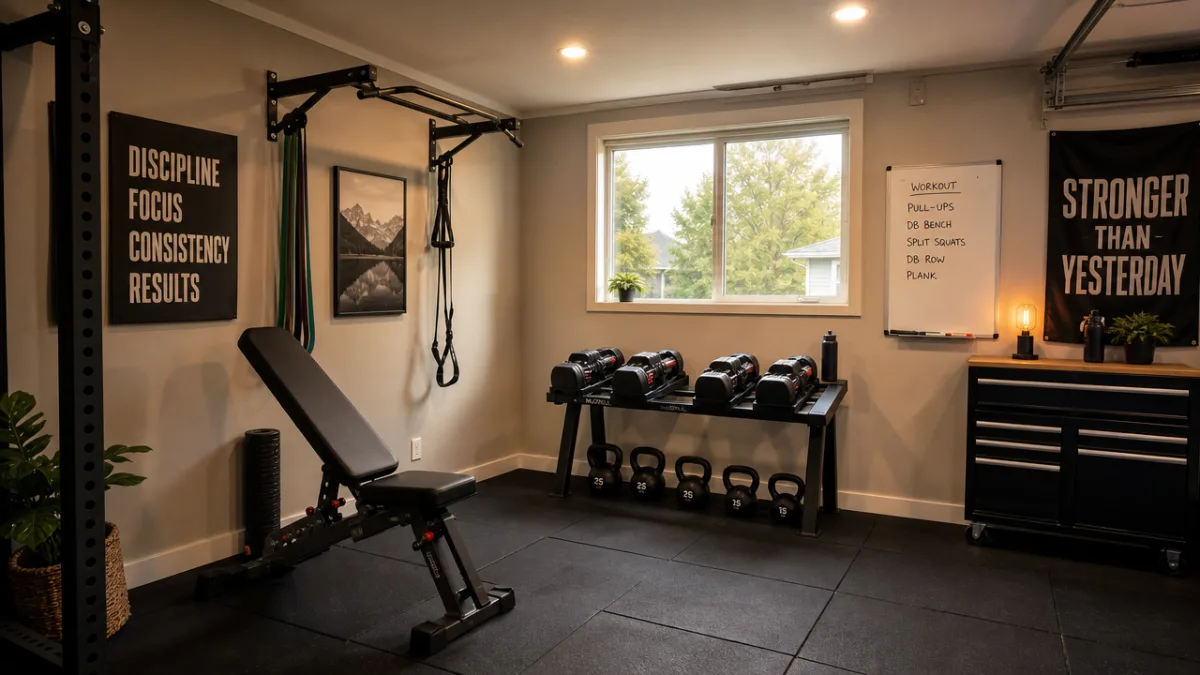
Five hundred dollars sounds like it might not go very far when you start browsing fitness equipment online, but the key is prioritizing versatility over volume. The single most impactful purchase at this price point is a quality set of adjustable dumbbells. Brands like Bowflex, PowerBlock, and Yes4All offer adjustable sets in the $150 to $300 range that replace an entire rack of fixed dumbbells. With a pair that adjusts from 5 to 52.5 pounds, you have access to hundreds of exercises covering virtually every muscle group.
With the remaining budget after dumbbells, you’ll want to invest in a few low-cost, high-return accessories. A pull-up bar — either a doorframe-mounted version or a freestanding unit — opens up an entire category of pulling movements for $30 to $80. Add a resistance band set ($25 to $40) and you’ve now got tools for mobility work, banded accessory exercises, and even assisted pull-up training. A quality yoga mat or interlocking foam tiles for flooring protection rounds out the essentials and protects both your equipment and your garage floor.
Here’s a realistic $500 budget breakdown to give you a concrete starting point:
- Adjustable dumbbells (5–52.5 lbs): $200–$280
- Doorframe or freestanding pull-up bar: $40–$80
- Resistance band set (5 bands, varied tension): $25–$40
- Foam floor tiles or rubber mat (4×6 ft minimum): $40–$70
- Adjustable flat/incline bench (budget option): $80–$120
What can you actually accomplish with this setup? More than most people expect. You can train a full push-pull-legs split, perform effective cardiovascular conditioning using complexes and circuits, develop real pulling strength through doorframe pull-ups and band rows, and build meaningful muscle and strength across every major muscle group. The limitation isn’t capability — it’s ceiling. Once you’re pressing the 52.5-pound dumbbells for reps, you’ll need to invest in heavier options. But for the vast majority of beginners and many intermediate lifters, this setup will serve them well for 12 to 18 months before they hit a genuine ceiling.
The $1,000 Garage Gym: Adding the Barbell and Unlocking Real Strength Training
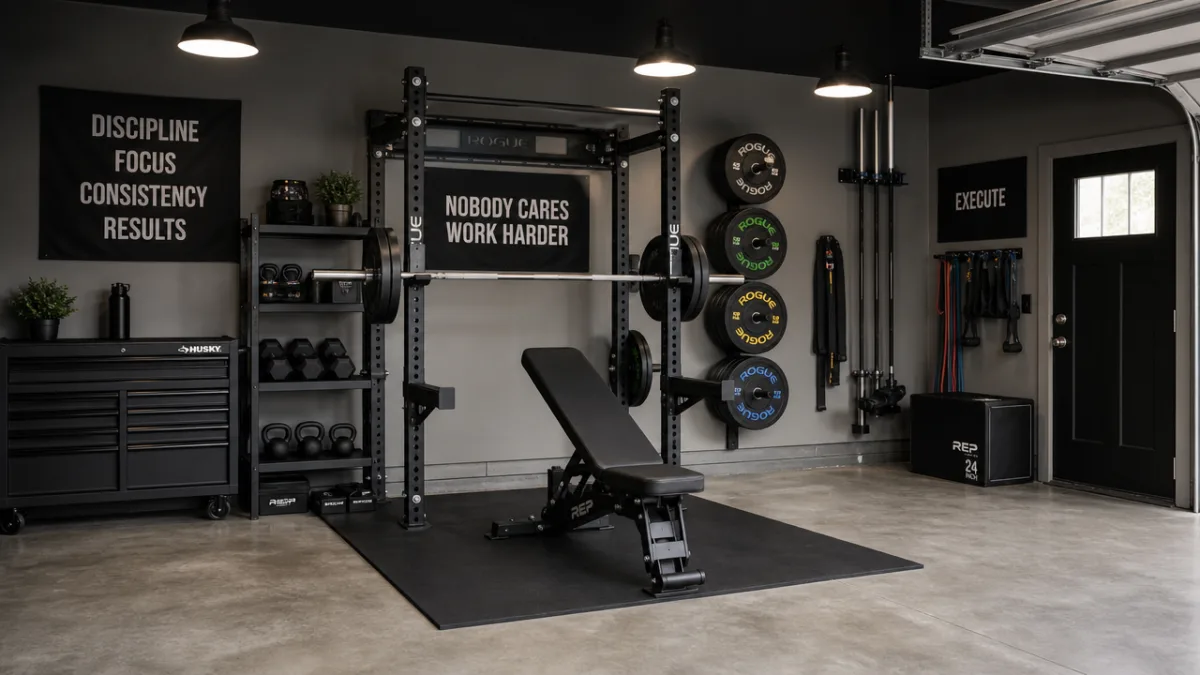
The jump from $500 to $1,000 is where your garage gym crosses a meaningful threshold. This is the budget level at which you can responsibly add a barbell and plates to your setup, and that single addition changes everything. The barbell is arguably the most effective training implement ever invented. Squats, deadlifts, bench press, overhead press, rows, cleans — these are the foundational movements that build the most strength, muscle, and athletic capacity, and all of them are centered around a barbell. Adding one transforms your garage from a solid dumbbell gym into a legitimate strength training facility.
At this price point, you don’t need to buy the fanciest barbell on the market. A mid-range 20kg Olympic barbell from a reputable brand like Titan Fitness, CAP Barbell, or Rogue’s entry-level offerings will serve you well for years. Expect to spend $150 to $250 on a quality bar. For plates, bumper plates (rubber-coated) are preferable if your budget allows because they protect your floor and allow you to drop the bar safely, but standard iron plates are a perfectly functional and more affordable alternative. A starter set of 255 pounds total weight — two 45s, two 25s, two 10s, two 5s, and two 2.5s — will run $150 to $250 depending on the material and brand.
The other critical addition at this price point is a power rack or squat stand. This is non-negotiable if you’re going to be lifting heavy barbells without a spotter. A basic squat stand with safety arms costs $150 to $250 and provides the safety infrastructure you need to train squats and bench press with real weight and real confidence. Pair this with an adjustable bench that can handle heavy loads (look for a weight capacity of at least 600 lbs) and you have a complete strength training station. Here’s what a well-balanced $1,000 setup might look like:
- Adjustable dumbbells from the $500 setup: carried over
- Olympic barbell (20kg): $150–$250
- Weight plates (255 lbs total): $150–$250
- Squat stand with safety arms: $150–$250
- Heavy-duty adjustable bench: $120–$180
- Additional rubber flooring (full bay coverage): $80–$120
Training variety at this level is substantial. You can now run virtually any serious strength program — Starting Strength, StrongLifts 5×5, GZCLP, Juggernaut, or any number of intermediate barbell programs that have produced real results for real lifters for decades. The big compound movements are now all accessible: back squat, front squat, Romanian deadlift, conventional deadlift, bench press, overhead press, barbell row, and power clean. Combined with the dumbbell accessories from your $500 foundation, this is a gym that serious athletes would happily train in every day.
The $1,500 Garage Gym: Comfort, Capacity, and Serious Long-Term Training
At $1,500, you have the financial room to address everything that the lower-budget setups lack: additional weight capacity, cardio infrastructure, quality-of-life improvements, and equipment that will genuinely last a decade or more with proper care. This isn’t about buying luxury for its own sake — it’s about building a gym that removes every reasonable excuse and creates an environment where excellent training feels not just possible but inevitable. The upgrades at this tier are targeted and purposeful.
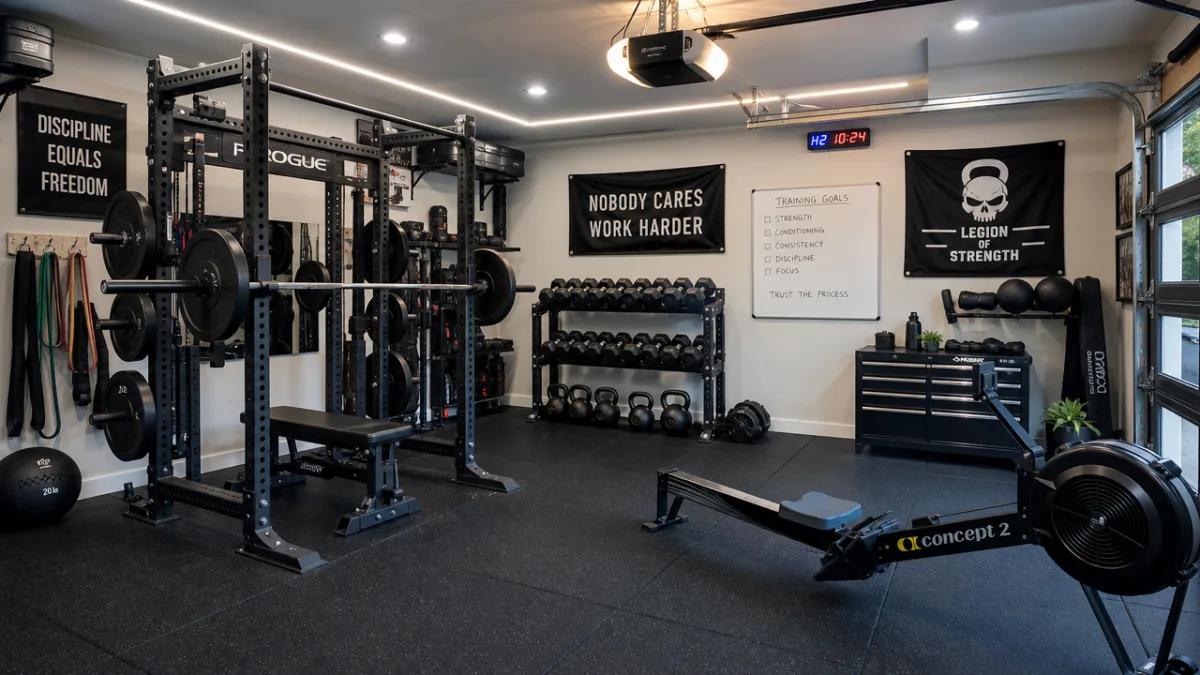
The most impactful additions at this price point fall into two categories. First, significantly more weight — specifically, expanding your plate collection and potentially upgrading to a full power cage rather than just a squat stand. A full cage with four uprights, a pull-up station integrated into the top, and multiple j-hook positions offers far more safety and versatility than a squat stand alone. Entry-level cages from Titan Fitness or Rep Fitness can be found in the $350 to $500 range and are genuinely excellent equipment that will outlast most commercial gym machines. Second, adding some form of cardiovascular training equipment elevates this from a pure strength gym to a complete fitness facility.
For cardio at this price point, you have several realistic options. A basic rowing machine in the $300 to $400 range (Concept2 rowers frequently appear on used markets for excellent prices) offers full-body conditioning that complements strength training beautifully. Alternatively, a jump rope ($15 to $30), a set of kettlebells ($80 to $150 for a pair), or a weighted sled ($100 to $200) can provide intense conditioning work in minimal space. The choice depends on your training goals and how much space you’re working with. Here’s a comprehensive $1,500 budget outline:
- Everything from the $1,000 setup: carried over
- Upgrade from squat stand to full power cage: additional $150–$250
- Additional weight plates (100–150 lbs more): $80–$150
- Kettlebell pair (35 lb and 53 lb): $80–$140
- Conditioning tool (rower, sled, or assault bike): $200–$400
- Wall-mounted storage for plates and bars: $60–$100
- Gym chalk and accessories: $20–$40
What you’ve built at $1,500 is genuinely impressive — not by home gym standards, but by any standard. The ability to squat, deadlift, press, row, do pull-ups, perform kettlebell work, and cycle through cardiovascular conditioning modalities means virtually no fitness goal is out of reach. Whether you’re training for strength, body composition, athletic performance, or general health and longevity, this gym covers it. And unlike a commercial gym membership, every dollar you’ve spent is an asset that retains value and serves you indefinitely.
Smart Buying Strategies That Stretch Every Dollar Further
Regardless of which price point you’re targeting, how you buy your equipment matters almost as much as what you buy. The used market for fitness equipment is genuinely one of the best-kept secrets in home gym building. After every New Year and every spring, people who bought equipment with the best of intentions list barely-used dumbbells, barbells, and benches on Facebook Marketplace, Craigslist, and OfferUp at 30 to 60 percent below retail. Patience and consistent monitoring of these platforms can allow you to build a $1,500 gym for $700 to $900 with no meaningful quality compromise.
When shopping used, there are a few categories where condition matters enormously and a few where it barely matters at all. Barbells should be inspected carefully — check that the sleeves spin freely, that there’s no significant rust on the shaft, and that the knurling (the textured grip pattern) is still sharp rather than worn smooth. Plates, on the other hand, are nearly impossible to ruin. Iron is iron. A 45-pound plate that looks rough on the outside still weighs exactly 45 pounds and will function perfectly for decades. Benches should be tested for wobble and structural integrity, but cosmetic wear is irrelevant.
Beyond the used market, timing your purchases around major sales events can generate meaningful savings on new equipment. Black Friday, Amazon Prime Day, and the post-New Year period in January (when manufacturers run clearance deals to move overstock from the holiday rush) are all reliable windows for significant discounts. Signing up for email lists from retailers like Rogue, Rep Fitness, Titan Fitness, and Fringe Sport means you’ll be notified the moment sales go live. If you’re not in a rush — and most people aren’t — building your gym incrementally over six to twelve months while waiting for deals is a completely viable strategy that can produce a better gym for less money than buying everything at once at full retail.
It’s also worth thinking carefully about what you don’t need to buy. A lot of home gym content online is driven by affiliate marketing incentives that push people toward purchasing more equipment than they genuinely need. You do not need a cable machine unless you have a specific reason to prioritize isolation exercises. You do not need a Smith machine — in fact, most experienced coaches would argue it’s an inferior tool for most training goals. A dedicated weight bench is genuinely useful, but you can perform many pressing variations on the floor with effective results. Start minimal, train consistently, identify what you’re actually missing, and then make targeted additions based on real training experience rather than theoretical wish lists.
Setting Up Your Space for Safety, Longevity, and Daily Use
The physical equipment is only half of what makes a garage gym work. The other half is how you set up your space — and thoughtful organization dramatically affects whether you’ll actually use the gym every day or gradually stop walking in there because it feels cluttered, inconvenient, or uninviting. Before you buy your first piece of equipment, spend time honestly assessing your available space. A standard single-car garage bay is approximately 10 by 20 feet, which is plenty for a full barbell setup. A two-car garage offers the kind of space that allows for a genuinely impressive facility.
Flooring is the element most people underestimate and most people regret skimping on. Dropping a barbell on bare concrete is hard on both the bar and the floor, and training on concrete with no cushioning is hard on your joints over time. Interlocking rubber horse stall mats — available from Tractor Supply or Rural King for roughly $50 per 4×6-foot mat — are the gold standard for garage gym flooring. They’re dense, durable, easy to clean, and provide excellent shock absorption. Covering even a 10×10-foot area with three mats costs about $150 and transforms the feel of the space entirely.
Temperature management is a practical concern that varies by region but deserves serious consideration everywhere. Training in a 95-degree garage in July or a 20-degree garage in January is genuinely uncomfortable and, in extreme cases, unsafe. A basic oscillating fan ($30 to $50) handles warm months adequately for most people. For cold climates, a small electric space heater ($60 to $100) can make a winter garage gym not just survivable but comfortable. Neither of these purchases is glamorous, but both pay enormous dividends in training consistency across the full calendar year, and training consistency is ultimately the only variable that determines results over the long term.
Finally, think about the small organizational and motivational elements that make a space feel like yours. Wall-mounted plate storage keeps your floor clear and makes loading and unloading bars much faster. A simple Bluetooth speaker ($30 to $60) connected to your phone makes music or podcasts instantly accessible. Even something as simple as cleaning the garage before you set it up — painting the floor, organizing the shelves along the walls, hanging a mirror — transforms the psychological experience of walking into the space. A gym you enjoy being in is a gym you’ll actually use, and that simple truth is worth taking seriously when you’re designing your setup from the ground up.








What do you think?
It is nice to know your opinion. Leave a comment.