










The Art of Painting: A Comprehensive Guide to Techniques, History, and Creative Expression
The Rich History of Painting Through the Ages
Painting might just be the oldest thing humans have ever done for the sheer love of doing it. We’re talking tens of thousands of years back — the cave paintings at Lascaux in France and Altamira in Spain are proof that even our earliest ancestors felt compelled to put images on walls. They used mineral pigments and whatever natural materials they could find, and somehow, those marks have survived to tell us something profound about who we are. From those rough beginnings, painting grew into one of the most celebrated art forms the world has ever known, reflecting the culture, spirituality, and inner lives of every civilization that picked up a brush.
The ancient Egyptians took painting in a whole new direction, turning it into a visual language sophisticated enough to line the walls of tombs and temples with imagery designed to guide the dead through the afterlife. Greek and Roman painters pushed further toward naturalism and perspective — fewer of their works survived, unfortunately, but their influence echoed through European art for centuries. Then came the Byzantine era, which swung things in a more spiritual direction, favoring symbolic meaning over realistic depiction. That iconographic style still shows up in religious art today, which is a pretty remarkable staying power.
The Renaissance is where things really explode, though. Leonardo da Vinci, Michelangelo, Raphael — these weren’t just talented painters, they were thinkers who brought scientific curiosity into the studio. They developed techniques like sfumato, chiaroscuro, and linear perspective that genuinely changed what was possible on a flat surface. They also changed how people thought about artists in general, elevating the painter from craftsman to visionary intellectual. That idea stuck, and we’re still living with it today.
Understanding the Major Painting Mediums
Before you can really develop as a painter, you need to understand your options when it comes to medium — meaning the material that carries the pigment and determines how your paint actually behaves. This isn’t just a technical detail; your choice of medium shapes everything about how you work and what your paintings feel like. The main ones you’ll encounter are oil, acrylic, watercolor, gouache, tempera, and fresco, and each one has its own personality, history, and quirks.
Oil paint has been the heavyweight champion of Western art since the fifteenth century, largely thanks to Flemish painters like Jan van Eyck who helped put it on the map. The basic idea is simple — pigment mixed with a drying oil like linseed or walnut — but what you can do with it is anything but simple. Oil dries slowly, which is either a blessing or a frustration depending on your temperament. That slow drying time lets you blend colors with incredible smoothness, go back in and make changes, and build up layer after layer of rich, glowing color. It’s still the go-to for many professional painters, and for good reason.
Watercolor and acrylic are a study in contrasts, but both have devoted followings. Watercolor, where pigment is suspended in a water-soluble binder, has a reputation for being tricky — and it is — but when you nail it, the luminosity is unlike anything else. That transparent glow simply can’t be faked in another medium. Acrylic, on the other hand, is the new kid by historical standards, having only come along in the mid-twentieth century. What it lacks in centuries of tradition it makes up for in flexibility: thin it down and it behaves almost like watercolor; pile it on thick and it reads like oil. It dries fast, sticks to almost anything, and cleans up with water. It’s easy to see why so many contemporary artists have embraced it.
Essential Techniques Every Painter Should Know
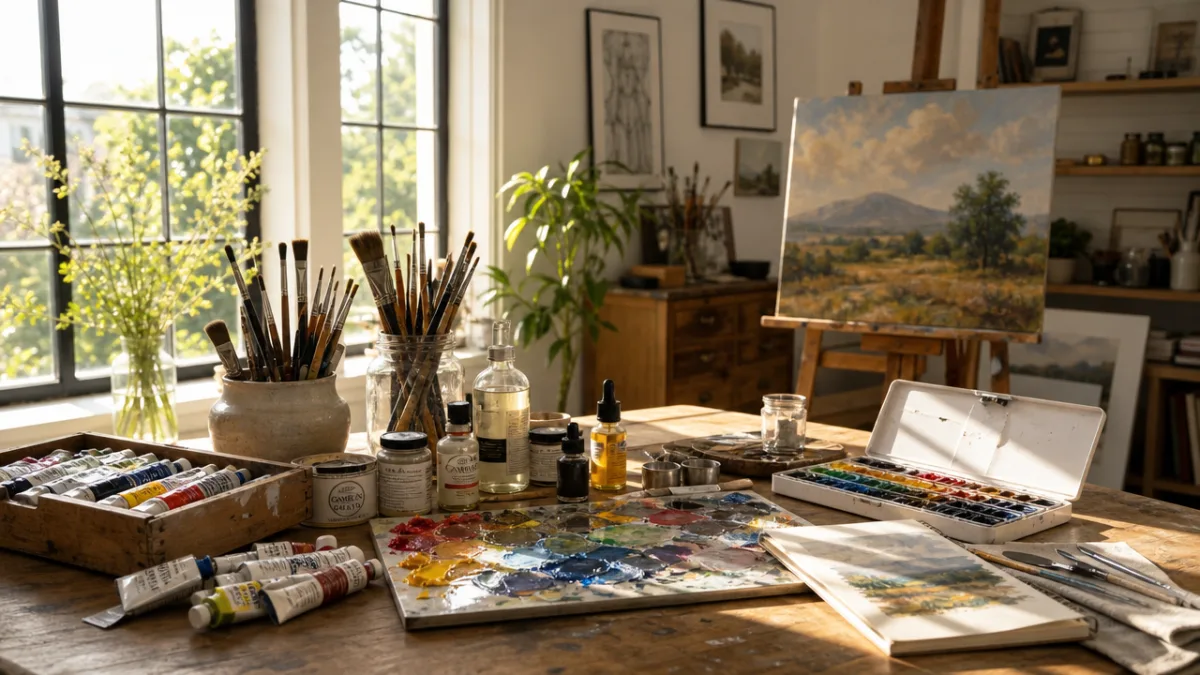
No matter what you’re painting or what medium you’re using, certain foundational techniques show up again and again, and knowing them gives you a real toolkit to work from. Once these skills become second nature, you can stop thinking about the mechanics of painting and put your energy into the creative side. We’re talking about everything from basic brushwork and color mixing to more advanced things like glazing, impasto, and wet-on-wet blending — approaches that can look completely different in practice but share the same underlying logic.
Color theory is probably the single most important conceptual tool a painter can have. Understanding the color wheel, how primary, secondary, and tertiary colors relate to each other, and what concepts like complementary contrast, temperature, and value actually mean in practice — all of this allows you to make deliberate choices rather than just hoping the mix turns out right. When you understand why a warm orange next to a cool blue creates that visual vibration, or why adding white to a color shifts not just its lightness but how warm or cool it reads, you stop guessing and start deciding. That shift makes an enormous difference.
Composition is the other foundational skill that tends to separate paintings that grab you from ones that feel somehow off, even when you can’t immediately say why. How you arrange shapes, colors, lines, and values within the picture plane directs where the viewer’s eye goes and creates a feeling of balance, tension, or movement. Things like the rule of thirds, leading lines, a clear focal point, and thoughtful use of negative space have been guiding painters for centuries. And yes, plenty of accomplished artists break these rules — but they break them deliberately, which is only possible if you understood them in the first place.
Beyond those fundamentals, there are specific techniques worth getting familiar with that can add texture, depth, and visual interest to your work. They cross medium boundaries and show up in all kinds of styles:
- Impasto: Applying paint thickly so that brush or palette knife marks remain visible, creating a sculptural, textured surface that catches light dynamically. Vincent van Gogh is perhaps the most famous practitioner of this technique.
- Glazing: Layering thin, transparent coats of paint over dried layers beneath to build luminous, complex color effects. Old Masters used glazing extensively to achieve the jewel-like quality of their work.
- Scumbling: Dragging a dry brush loaded with opaque or semi-opaque paint loosely over a dried layer, allowing the underlayer to show through and creating a soft, broken texture.
- Wet-on-wet: Applying fresh paint directly into still-wet paint to blend colors softly on the canvas, a technique central to alla prima (direct) painting and popularized by artists like Bob Ross.
- Dry brushing: Using a brush with very little paint to create rough, scratchy marks, often used to suggest texture in hair, grass, or weathered surfaces.
Painting Styles and Movements That Shaped Modern Art
If you look at the sweep of Western painting history, what you see is a long series of movements and counter-movements, each one responding — sometimes urgently, sometimes rebelliously — to the world around it. From the idealized beauty of the Renaissance to the raw emotional force of Expressionism, these stylistic shifts weren’t just about changing tastes. They were about changing ideas: what is art for, and what should it actually do? Getting familiar with these movements gives you a much richer sense of where your own work fits into a larger conversation.
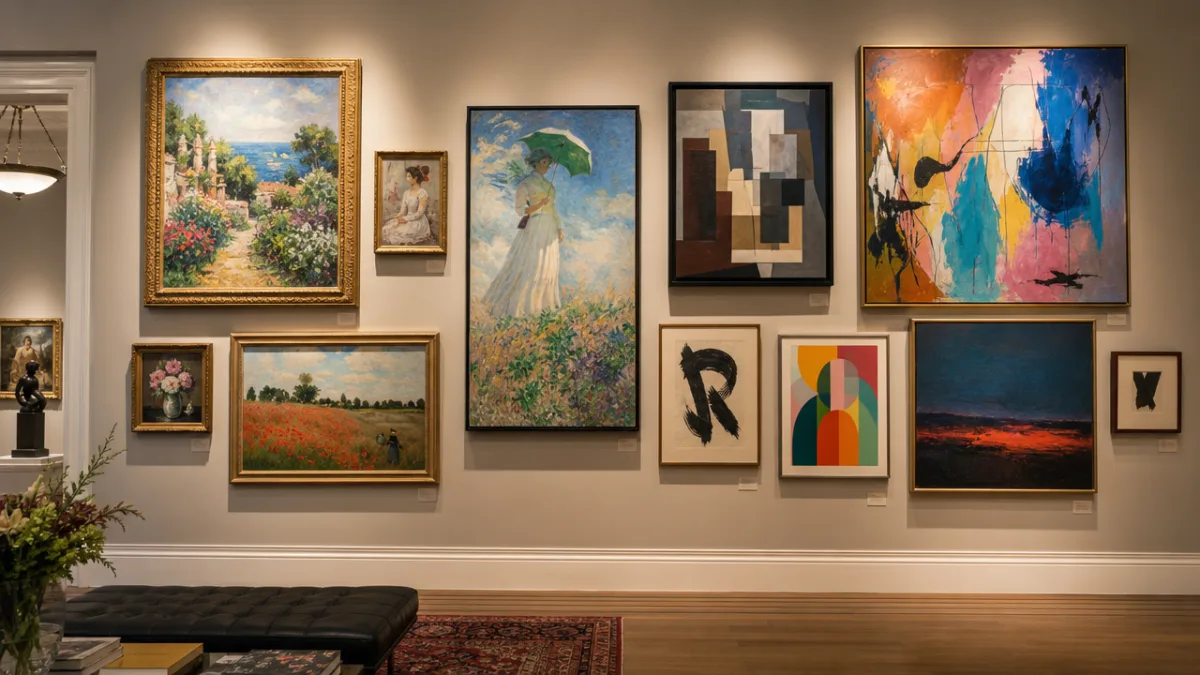
Impressionism is a perfect example of a movement that felt radical at the time and now seems almost inevitable. When Monet, Renoir, Pissarro and their contemporaries started painting outdoors in the 1860s and 70s, they were breaking pretty much every rule the French art establishment held dear. Instead of carefully finished studio compositions, they were capturing light and atmosphere in the moment, using loose brushstrokes and a bright palette that shocked critics. They got ridiculed for it. And then they permanently changed painting, opening the door to everything that came after.
Post-Impressionism, Cubism, Surrealism, Abstract Expressionism — each of these pushed things further into new territory in its own way. Picasso and Braque’s Cubist experiments essentially blew up the idea of a single viewpoint, reconstructing objects from multiple angles simultaneously. Jackson Pollock and Mark Rothko decided to abandon recognizable imagery altogether, making the case that color, gesture, and form could communicate powerfully on their own, without depicting anything from the physical world. What all of these movements share is a willingness to ask uncomfortable questions about what painting even is — and collectively, they settled on an answer: it can be about anything, or nothing, and the artist’s inner experience is as valid a subject as a bowl of fruit.
Setting Up Your Painting Practice: Space, Tools, and Habits
Here’s something that doesn’t get talked about enough: a huge part of developing as a painter has nothing to do with talent or technique. It’s about setting up the right conditions to actually work consistently. That means having a space you can use, materials you can find when you need them, and habits that make sitting down to paint feel natural rather than like a production. A lot of aspiring painters get stuck not because they lack ability but because the practical side of their practice is working against them.
Your painting space doesn’t need to be a dedicated studio or particularly large. But it does need to be organized, and ideally it shouldn’t double as your dining table or living room floor if you can help it. Lighting matters more than most beginners realize — painters in the Northern Hemisphere have traditionally preferred north-facing natural light because it stays consistent throughout the day, but a good setup of daylight-balanced artificial lights works well too. The other thing that quietly makes a big difference is having your materials organized and ready to go. If getting started requires half an hour of setup every single time, that friction quietly erodes your motivation over weeks and months.
When it comes to tools, resist the urge to buy everything at once. Quality beats quantity, especially with brushes and paints. A handful of good-quality brushes in a few different shapes and sizes will serve you far better than a drawer full of cheap ones that don’t hold their shape or deposit paint the way you want. The same logic applies to paint itself — artist-grade paints have significantly more pigment than student-grade options, which means richer color and better lightfastness. A limited palette of genuinely good colors is always a smarter starting point than a rainbow of mediocre ones.
Building a regular practice is really no different from building any other skill-based habit. Showing up consistently — even for just thirty to sixty minutes a few times a week — will take you further than occasional all-day sessions ever will. Many painters swear by keeping a sketchbook or doing small studies on the side, not as finished work, but as a low-pressure way to stay in the creative habit and work through ideas quickly. And don’t underestimate the value of simply looking — really looking — at light, color, form, and texture in your everyday surroundings. That kind of active observation is part of the practice too, even when you’re nowhere near a brush.
Finding Your Voice: Developing a Personal Style in Painting
Every painter eventually starts wondering about style — specifically, their own. How do you find it? How do you make work that’s recognizably yours? The answer, honestly, is both simpler and more demanding than most people expect. You can’t decide to have a style and then manufacture one. It grows out of sustained practice, broad exposure to art history, honest self-reflection, and the willingness to make choices based on what you actually love rather than what seems like it might sell or impress the right people.
Copying the masters has been a cornerstone of artistic training forever, and it’s still one of the best tools available. Sitting down to reproduce a Rembrandt or a Sargent or a Cézanne is a completely different experience from standing in front of it in a museum. You have to make every decision they made, which forces you into their thinking in a way that pure looking never does. Over time, this kind of intimate engagement helps you internalize not just technical methods but something harder to name — a particular way of seeing and responding. As those influences accumulate alongside your own creative choices, something genuinely personal starts to emerge from the mix.
Finding your voice also means making peace with failure, or at least getting comfortable enough with it that it doesn’t stop you. Every painter produces work they’re unhappy with — that never stops, regardless of experience level. What changes with time and practice is what you do with those disappointments. A mature painter has learned to look at an unsuccessful painting and ask what it’s telling them, rather than treating it as evidence that they shouldn’t be doing this at all. Keeping some kind of reflective record — notes about what worked, what didn’t, and why — can speed that learning up considerably.
It’s also worth remembering that style is much bigger than just how you apply paint. It shows up in the subjects you keep returning to, the colors you’re drawn to, the scale you prefer working at, the pace you bring to the process, the medium you choose. A painter who consistently circles back to certain themes, who has a recognizable emotional register, and who makes consistent formal choices across their work will develop a real artistic identity — often without consciously setting out to build one. The key is staying genuinely attentive to your own responses: what actually excites you, moves you, or challenges you, as both someone who makes art and someone who looks at it.








What do you think?
It is nice to know your opinion. Leave a comment.