










33 Home Office Organization Ideas to Tidy Up Your Workspace
Why a Well-Organized Home Office Changes Everything
Working from home has become a way of life for millions of people, and the state of your workspace has a profound effect on your productivity, focus, and mental well-being. A cluttered desk is not just an eyesore — it creates cognitive friction that slows your thinking and makes every task feel heavier than it needs to be. Research consistently shows that physical disorder translates into mental disorder, and that clearing your environment can actually help clear your mind.
The good news is that transforming a chaotic home office doesn’t require a complete renovation or a massive budget. Many of the most effective organization strategies involve nothing more than rethinking how you use the space you already have. A few smart storage choices, some thoughtful decluttering, and a consistent daily routine can turn even the smallest, most cramped corner into a functional and inspiring place to work.
This article brings together 33 of the best home office organization ideas gathered from professional organizers, interior designers, and real remote workers who have solved the same problems you’re facing. Whether you’re working from a dedicated room, a nook under the stairs, or a spot at the kitchen table, you’ll find actionable ideas here that you can start implementing today. The goal is a space that works for you — one that feels calm, purposeful, and ready for whatever the workday brings.
The Psychology Behind Clutter
Understanding why clutter bothers us helps us fight it more effectively. When your brain encounters a disorganized environment, it processes each visible item as an unfinished task or an open loop that demands attention. This is known as the Zeigarnik effect, and it means that every stray cable, every forgotten sticky note, and every pile of unfiled papers is quietly draining your mental energy even when you’re not looking directly at it. Reducing visual noise is one of the fastest ways to reclaim focus.
The emotional weight of a messy workspace can also trigger avoidance behaviors. Many people find themselves procrastinating not because the work is hard, but because sitting down in a chaotic environment feels overwhelming before they’ve even started. By establishing a tidy, inviting workspace, you eliminate one of the most common and least recognized sources of work-related stress. The act of organizing itself becomes a confidence-building ritual that signals to your brain that you are in control of your day.
Finally, a well-organized home office communicates professionalism — to yourself and to others. In an age of video calls and virtual meetings, your background speaks for you before you say a word. A clean, curated space tells clients and colleagues that you take your work seriously. More importantly, it reinforces that sense of identity for yourself, making it easier to transition mentally from home mode into work mode every single morning.
Desk Organization: The Command Center of Your Day
Your desk is the most important piece of real estate in your home office, and how you organize its surface and surrounding area will determine how smoothly your day flows. The first principle of effective desk organization is to keep only the items you use daily within arm’s reach. Everything else — reference materials, occasional supplies, backup equipment — should be stored nearby but off the main surface. This single rule eliminates the creeping clutter that turns a tidy desk into a disaster zone within a few weeks.
Desk organizers come in an enormous variety of styles and configurations, so there is no excuse for letting pens, paper clips, and sticky notes roam free. A tiered desktop organizer with compartments of different sizes can handle everything from scissors to charging cables in one compact footprint. Alternatively, a set of small trays or shallow baskets grouped together creates a modular system you can reconfigure as your needs change. The key is to give every item a designated home so that putting things away becomes automatic rather than effortful.
Cable management deserves special attention because tangled cords are one of the most visually distracting elements of any desk setup. Use adhesive cable clips to route wires along the back edge of your desk, a cable management box to hide power strips and excess cord length, and velcro ties to bundle cables together neatly. Color-coded cable labels take this one step further, making it easy to identify which cord belongs to which device without unplugging everything to find out. A few dollars and an afternoon of work can make your desk look dramatically cleaner.
Vertical Space and Wall Organization
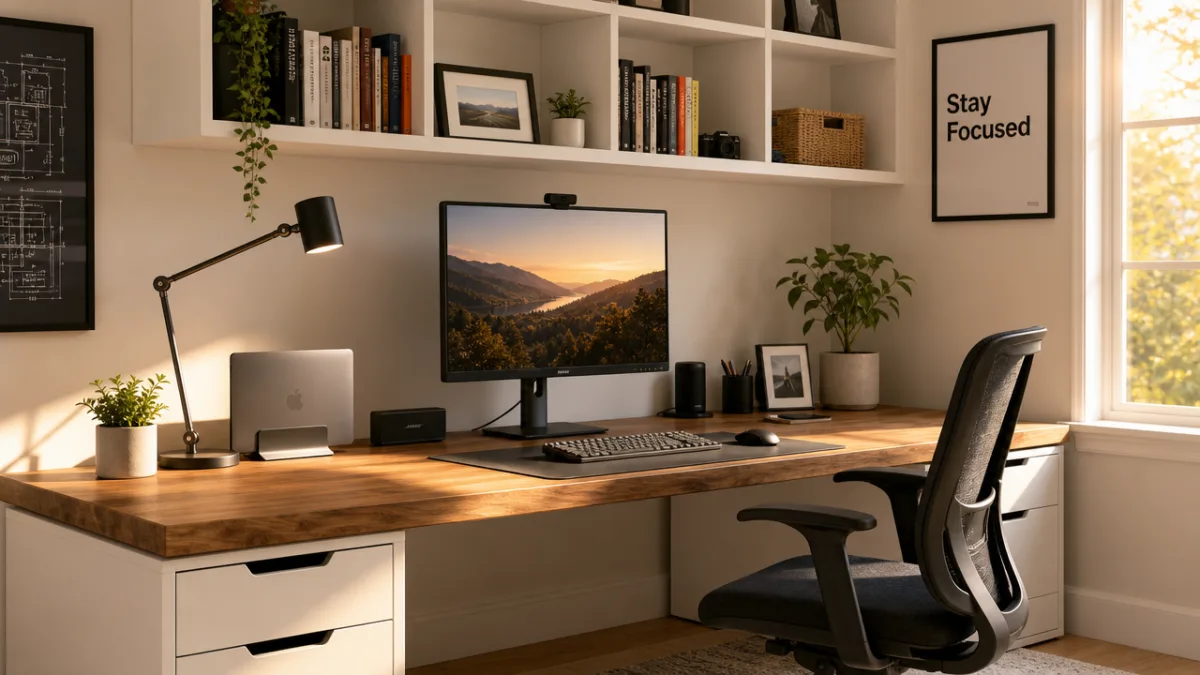
Most people think about desk organization in two dimensions — what goes on the surface and what goes in the drawers. But the wall above and around your desk is valuable real estate that is almost always underused. Floating shelves installed at eye level give you accessible storage for books, binders, and frequently referenced materials without adding any footprint to your floor plan. A pegboard mounted above or beside your desk takes this concept even further, creating a completely customizable wall system for tools, supplies, headphones, and anything else you want within reach.
Wall-mounted file organizers and magazine racks are excellent for managing the paper flow that seems to accompany every kind of work. Rather than letting documents pile up on your desk while you decide what to do with them, a tiered wall organizer creates an inbox, processing, and outbox system that keeps paper moving through your office rather than accumulating on every available surface. Label each section clearly so that the system is easy to maintain and easy for others in your household to use correctly if they need to drop something off for you.
Don’t overlook the back of your office door as a storage opportunity. An over-the-door organizer with pockets can hold everything from office supplies and notebooks to personal items like headphones and a spare charger. If your office is also your creative space, the door can even display a corkboard or magnetic panel for inspiration, project notes, or mood boards. These solutions add meaningful storage capacity without taking up any floor or wall space that might otherwise feel tight in a smaller room.
Paper and Filing Systems That Actually Work
Paper is the silent enemy of home office organization. Despite the promises of a paperless future, most people who work from home still deal with a steady stream of documents — invoices, contracts, reference sheets, mail, and handwritten notes — that need to be captured, processed, and stored in a way that makes them retrievable when needed. The mistake most people make is waiting until paper accumulates into an intimidating pile before dealing with it. The solution is to build a simple, consistent system and process paper the moment it lands in your office.
The foundation of any good filing system is a small set of clearly defined categories. Fighting the urge to create elaborate subcategories is important because overly complex systems fall apart the moment life gets busy. Most home offices can manage perfectly well with broad categories like finances, insurance, home, health, and work projects. Use color-coded hanging folders inside a filing cabinet or a portable file box to make it easy to find and return documents at a glance. The color coding does double duty: it speeds up filing and retrieval, and it makes it visually obvious when something has been misfiled.
For ongoing projects that require frequent access to physical documents, a desktop file sorter or a tiered tray organizer keeps active files visible and at hand without mixing them into long-term storage. The moment a project wraps up, those materials should be filed properly or scanned and shredded. Going digital with a scanner and cloud storage can dramatically reduce the volume of paper you need to store, and services like Google Drive or Dropbox make it possible to retrieve any document from anywhere in seconds. Adopting a naming convention for your digital files — something like date-category-description — eliminates the frustration of hunting through endless folders of unhelpfully titled documents.
Managing Mail and Incoming Paper
Mail is one of the most common sources of desk clutter because it tends to arrive in unpredictable volumes and requires decisions that are easy to defer. The best antidote is a landing zone — a designated tray or basket near your office entrance where all incoming mail goes immediately upon arrival. Rather than letting it scatter across whatever surface is nearest, the landing zone gives paper a single, consistent first stop. Schedule a brief daily or weekly time to sort and process the contents of that tray so that it never grows beyond a manageable size.
When sorting through mail, work by the touch-it-once principle: every piece of mail you pick up should be immediately dealt with, filed, delegated, or shredded — not set aside for later. Junk mail goes directly into recycling without reading. Bills that need action go into your designated action file. Documents to keep go directly into their correct folder. Items requiring a response get a sticky note with a deadline and move to a visible action tray. This workflow sounds simple because it is, and its simplicity is exactly what makes it sustainable over months and years.
Reducing the volume of paper entering your office is just as valuable as managing the paper that does arrive. Opt out of paper billing wherever possible, switching to electronic statements for utilities, banks, and credit cards. Unsubscribe from catalogs and promotional mailers using a service like CatalogChoice or PaperKarma. Register with the Direct Marketing Association to reduce unsolicited mail. Every piece of paper you prevent from entering your office is one less thing you need to process, file, or find space for — and the cumulative effect of these small changes is surprisingly significant.
Storage Solutions for Supplies and Equipment
Office supplies have a tendency to multiply and migrate, ending up in junk drawers, on windowsills, and behind monitor stands where they quietly add to the visual chaos of a workspace. The solution is intentional storage that matches the frequency and manner in which you use each type of supply. Items you reach for multiple times a day — your favorite pen, a notepad, a stapler — belong on your desk in an organizer that keeps them immediately accessible. Items you use occasionally, like extra staples, tape, or spare notebooks, belong in a drawer or cabinet nearby.
Drawer organizers are one of the most underrated tools in home office organization. A drawer without dividers becomes a jumbled mess within days, no matter how carefully you start out. Adjustable bamboo or plastic drawer organizers create defined compartments that prevent items from shifting around and help you see exactly what’s inside at a glance. Measure your drawers before purchasing any organizer to ensure a proper fit, and think critically about what actually belongs in each drawer rather than just filling compartments with whatever is closest. A well-organized drawer can hold an impressive amount of material in a completely accessible, stress-free way.
For larger equipment and technology — external hard drives, backup batteries, spare cables, webcams, and other peripherals — closed storage is usually the best approach. A cabinet with doors, a storage ottoman with an interior compartment, or a dedicated technology drawer keeps this kind of equipment out of sight without making it difficult to access. Labeling bins and baskets inside these storage units means you never have to rummage blindly. Open shelving works beautifully for decorative items and books, but technology and supplies generally look more organized behind doors where their visual complexity is hidden from view.
Smart Storage for Small Offices and Tight Spaces
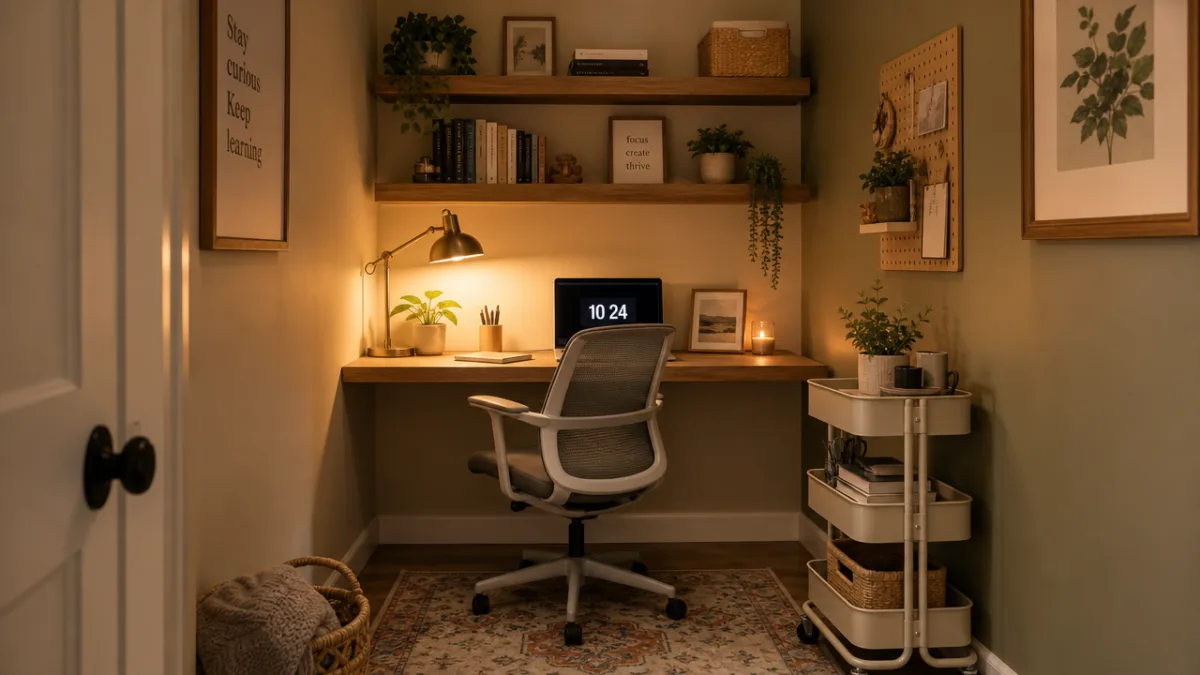
Not everyone has the luxury of a dedicated room to call their home office. Many people are carving out workspaces in corners of bedrooms, in converted closets, or at one end of a dining table. In these situations, storage must be even more thoughtfully designed because every inch counts and the workspace often needs to blend seamlessly into the surrounding living space. Furniture that serves double duty — a storage bench that also provides seating, a bookcase that also serves as a room divider — becomes especially valuable in these contexts.
A wall-mounted fold-down desk, sometimes called a Murphy desk, is one of the cleverest solutions for extremely small spaces. When open, it provides a proper work surface with integrated storage for supplies and a laptop. When closed, it folds flat against the wall and looks like a decorative panel, completely concealing your workspace. This type of furniture has become increasingly sophisticated and stylish, moving far beyond the utilitarian versions of decades past into genuinely attractive pieces that can anchor a room’s design while serving a practical purpose.
Rolling carts are another favorite solution for compact or multi-use spaces because they offer storage that can move where it’s needed and then be tucked away or rolled under a desk when not in use. A three-drawer rolling cart can organize office supplies, craft materials, or technology accessories, and most styles are narrow enough to fit in surprisingly small gaps. When your workday ends, rolling the cart into a closet or alongside a bookcase effectively makes your office disappear, helping you mentally separate work and home life even when they share the same physical space.
Daily Habits and Routines That Maintain Order
Organization is not a one-time event — it is a set of habits practiced consistently over time. The most beautifully organized office will descend into chaos within a few weeks if it is not maintained through daily routines. The good news is that maintenance takes far less time and effort than the original organizing project, provided it is done consistently. A five-minute end-of-day reset — putting away supplies, clearing the desktop, processing any loose paper — is enough to keep most home offices in good working order indefinitely.
Building your organizational habits around existing routines makes them far easier to maintain. Many productive home workers tie their workspace reset to another daily transition, such as making their afternoon cup of coffee, shutting down their computer, or finishing their last meeting of the day. The trigger doesn’t matter as long as it reliably activates the cleanup routine. Over time, these small actions become automatic — part of the rhythm of your workday rather than tasks you have to remember or motivate yourself to do.
A weekly deeper review, lasting perhaps fifteen to thirty minutes, keeps longer-term organization in check. This is the time to process any backlog in your paper filing, return borrowed items to their proper places, restock supplies that are running low, and reassess whether your current organizational systems are still meeting your needs. Workplaces evolve and so do the demands placed on them, so periodic reviews ensure your organization grows with you rather than becoming an obstacle as your work changes. Scheduling this review as a recurring calendar appointment treats it with the same importance as any other professional task.
Decluttering as an Ongoing Practice
One of the most important mindset shifts in home office organization is understanding that decluttering is not a one-time purge but an ongoing practice woven into the fabric of how you work. Every time you reach for something and find that you haven’t used it in months, that is an opportunity to ask whether it still deserves space in your office. Every time you acquire something new — a piece of technology, a supply, a reference book — it is worth considering what existing item it replaces or whether you truly need it at all.
The one-in, one-out rule is a simple and effective framework for preventing clutter from accumulating after an initial declutter. For every new item that enters your office, one existing item should leave. This doesn’t require careful weighing of every decision — most of the time it simply means that when you buy a new notebook, you use up or recycle an old one, or when you upgrade a piece of equipment, you responsibly recycle or donate the item it replaces. Applied consistently, this rule keeps your storage from gradually filling back up after all the hard work of organizing it.
Sentimental items and “just in case” items are often the hardest to let go of but are frequently the biggest contributors to clutter. If you are holding onto something solely because it might be useful someday, ask yourself honestly how likely that scenario really is, and whether you could easily find a replacement if the need ever arose. For items with genuine sentimental value, consider whether your office is truly the right place for them or whether they would be better appreciated displayed elsewhere in your home. Keeping your office ruthlessly purposeful — filled only with things that serve your work — creates an environment of remarkable calm and efficiency.
Creating an Inspiring and Functional Aesthetic
Organization and aesthetics are not competing values — they are deeply complementary ones. A space that is organized but sterile and uninviting will not sustain your motivation over the long term, just as a space that is beautiful but chaotic will undermine your productivity. The most effective home offices manage to be both visually pleasing and practically organized, with every decorative choice doing double duty as storage, inspiration, or functional improvement of the environment. Achieving this balance is absolutely within reach with a little intentional planning.
Color plays a powerful role in how a space feels and functions. Neutral backgrounds — white, light gray, warm beige — make a room feel larger and calmer, and provide a flexible canvas that accommodates changing tastes and styles over time. Pops of your favorite color in desk accessories, storage containers, and small decorative items add personality without overwhelming the space. Keeping your storage containers in a cohesive color palette — all white, all natural wood, all black — creates a sense of visual unity that makes even densely organized shelves look intentional and curated rather than cluttered and random.
Plants, artwork, and lighting are the finishing touches that transform a functional office into a genuinely enjoyable place to spend time. A single desk plant like a pothos, succulent, or small fern introduces life and natural color while improving air quality and mood. A piece of art or a motivating print on the wall gives your eyes a pleasant place to rest during moments of thought. And good lighting — ideally a combination of natural light and warm artificial light — makes everything look better and keeps you alert and energized throughout the day. These elements cost relatively little but pay enormous dividends in terms of how much you enjoy and look forward to spending time in your home office.
Personalizing Your Space Without Creating Clutter
The challenge with personalization is that meaningful objects tend to accumulate over time, eventually crossing the line from inspiring to cluttered. A thoughtful approach to curating your personal items keeps the space feeling like yours without letting it become a storage unit for things that simply have no other home. Choose a small number of meaningful objects — a favorite photo, a memento from a meaningful trip, a cherished gift — and display them intentionally rather than scattering personal items across every surface. Quality and intention beat quantity every time.
A dedicated inspiration or mood board, whether physical or digital, gives your creative and motivational impulses a proper home that doesn’t spill out onto your working surfaces. A corkboard or magnetic whiteboard mounted on the wall becomes the official place for clippings, printed inspirations, project notes, and aspirational images. Because it has a defined boundary — the edges of the board — it contains the material that might otherwise drift across your desk and shelves. Updating it seasonally or at the start of new projects keeps it feeling fresh and relevant rather than becoming just another layer of background clutter.
Ultimately, the most personalized and inspiring home office is one that reflects not just who you are but who you want to become professionally and creatively. Surrounding yourself with objects, images, and colors that connect to your goals and values turns your workspace into an environment that actively supports your best work. When your office feels good, you want to be in it. When you want to be in it, you do your best work. And when you do your best work, maintaining the space that makes it possible becomes not a chore but an act of genuine self-investment.
- Use a tiered desktop organizer to corral pens, scissors, and small supplies in one compact unit that keeps your surface clear.
- Install floating shelves above your desk to move books and binders off the work surface and into accessible vertical storage.
- Adopt a landing zone tray for incoming mail and papers so that clutter has a single first stop rather than spreading across every surface.
- Use drawer dividers in every drawer to prevent the inevitable drift into chaos that happens in unorganized drawers.
- Label everything — bins, folders, drawers, and shelves — so that returning items to their correct place takes zero mental effort.
- Do a five-minute end-of-day reset to maintain order without ever facing a large, discouraging cleanup project.
- Apply the one-in, one-out rule to prevent new acquisitions from gradually refilling cleared storage space.
- Use cable management tools including clips, ties, and boxes to eliminate the visual chaos of tangled cords beneath and behind your desk.
- Choose a cohesive color palette for storage containers and organizers to create visual unity on shelves and desk surfaces.
- Schedule a weekly review to process filing backlogs, restock supplies, and assess whether your systems still match how you actually work.








What do you think?
It is nice to know your opinion. Leave a comment.