










18 Tips to Start a Balcony Flower Garden: A Complete Guide to Blooming in Small Spaces
Why a Balcony Flower Garden Is Worth Every Effort
Transforming a balcony into a vibrant flower garden is one of the most rewarding projects a home gardener can undertake. Whether you have a sprawling terrace or a narrow strip of outdoor space barely wide enough for two chairs, flowers have an extraordinary ability to soften concrete edges, draw pollinators, and create a private oasis above the noise of everyday life. The psychological benefits alone — reduced stress, improved mood, a daily reason to step outside — make the effort more than worthwhile.
Many people assume that meaningful gardening requires a plot of land, but balcony gardening has quietly become one of the fastest-growing trends in urban horticulture. Apartment dwellers, condo residents, and city professionals are discovering that with the right planning and a handful of well-chosen plants, a small elevated space can rival any traditional garden bed in color, fragrance, and biodiversity. The limitation of space actually encourages creativity in ways that open gardens often do not.
Starting a balcony flower garden does require some upfront thought about weight limits, sun exposure, wind conditions, and container choices. But none of these considerations should intimidate a beginner. Once you understand the fundamental principles and work through the practical checklist of tips below, you will find that maintaining a balcony flower garden becomes a genuinely enjoyable daily ritual rather than a chore. This guide walks you through eighteen essential tips organized into the key areas that matter most.
Assessing Your Space Before You Plant a Single Seed
Understanding Sun Exposure
Before purchasing any plants or containers, spend at least two to three days observing your balcony at different times of day and noting exactly how many hours of direct sunlight it receives. A south-facing balcony in the northern hemisphere may receive six to eight hours of full sun, making it ideal for sun-loving flowers like petunias, marigolds, and geraniums. A north-facing balcony might receive only dappled or indirect light for much of the day, which shifts your plant palette toward shade-tolerant beauties like impatiens, begonias, and fuchsias.
Sun exposure is the single most important factor in determining which flowers will thrive in your specific space. A plant labeled “full sun” that gets placed in a shaded corner will become leggy, produce few flowers, and slowly decline regardless of how carefully you water and fertilize it. Conversely, a shade-loving plant exposed to harsh afternoon sun may scorch and wilt within days. Matching the plant’s requirement to your balcony’s reality is the foundational step that every successful balcony gardener gets right.
Take note of seasonal changes as well. The angle of the sun shifts considerably between summer and winter, and a balcony that receives abundant light in June might be heavily shaded by the building’s overhang from October through February. If you are starting your garden in spring or autumn, project forward or backward in time and ask neighbors on the same building orientation what their experience has been throughout the year. This kind of informed planning prevents costly mistakes and disappointment.
Checking Weight Limits and Structural Considerations
Balconies are engineered to hold specific maximum loads, and a container garden filled with moist potting soil, heavy ceramic pots, and mature plants can accumulate surprising weight very quickly. A single large terracotta pot with wet soil can weigh forty pounds or more, and if you plan to line your balcony railing and floor with multiple containers, those numbers multiply fast. Before you begin purchasing anything, check with your building manager or refer to your lease agreement to understand the weight capacity of your outdoor space.
The practical solution for weight-conscious gardeners is to choose lightweight containers made from materials like fiberglass, resin, foam, or fabric. These modern alternatives mimic the look of terracotta or stone while weighing a fraction as much. Lightweight potting mixes that include perlite or coir instead of dense garden soil further reduce the load without compromising drainage or plant nutrition. Distributing weight evenly across the balcony floor rather than concentrating it all in one corner also helps stay within safe structural limits.
Additionally, consider where you position your heaviest containers. Placing them near load-bearing walls or structural beams rather than at the outer edge of the balcony is a sensible precaution. If you are unsure about any aspect of your balcony’s structural integrity, consulting a building engineer is never excessive caution — it is responsible planning. Your garden should be a source of joy, and peace of mind about safety is part of that equation.
Choosing the Right Containers and Soil
Matching Container Size to Plant Type
One of the most common mistakes beginner balcony gardeners make is planting flowers in containers that are too small for their root systems. A petunia crammed into a four-inch pot will exhaust its soil nutrients and water supply within days of hot summer weather and never reach its full, cascading potential. As a general rule, most flowering annuals need at least a ten- to twelve-inch diameter container to thrive, while larger statement plants like dwarf dahlias or patio roses require pots fourteen inches or wider to develop strong root systems and reliable blooms.
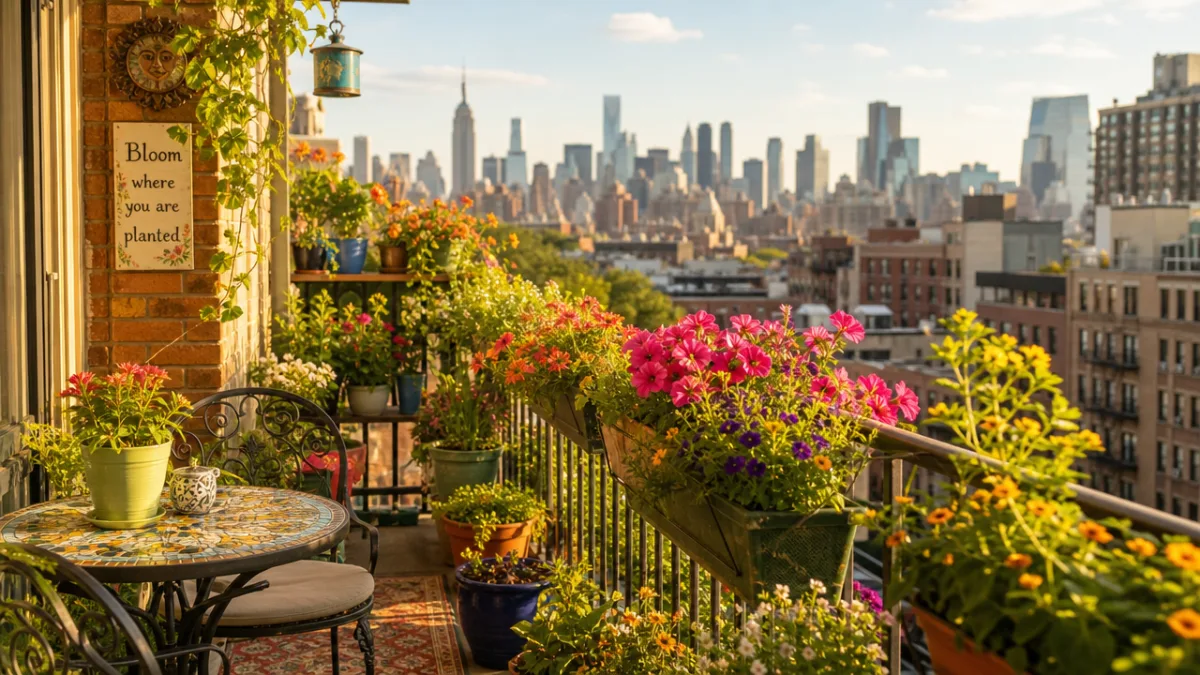
Window boxes mounted along balcony railings are a particularly efficient use of vertical space and are ideal for trailing flowers like lobelia, bacopa, and million bells. Look for window boxes that are at least eight inches deep to give roots enough room to grow, and ensure the mounting brackets are secured firmly to both the railing and, where possible, the wall. Hanging baskets suspended from overhead brackets or a ceiling hook add a further vertical dimension and are perfect for cascading fuchsias, ivy geraniums, and sweet potato vine interplanted with compact flowers.
Self-watering containers are an excellent investment for balcony gardeners who travel frequently or struggle to maintain consistent watering schedules. These pots feature a built-in reservoir at the base that allows plants to draw moisture upward through capillary action, significantly reducing the frequency of hand watering needed during peak summer heat. While they cost more upfront than standard containers, the improved plant health and reduced water waste they enable make them genuinely worthwhile, particularly for anyone growing thirsty flowers like fuchsias or impatiens in a hot, exposed location.
Selecting the Best Potting Mix
Garden soil from the ground should never be used in containers. It compacts easily in pots, drains poorly, may introduce pests or diseases, and is generally too heavy for balcony use. Instead, choose a high-quality, peat-free or peat-reduced potting mix specifically formulated for container gardening. These mixes are designed to hold adequate moisture while still allowing excess water to drain freely, which is essential for preventing root rot — one of the leading causes of container plant death.
For flowering plants, look for potting mixes that include slow-release fertilizer granules already incorporated into the blend. These granules feed your plants gradually over three to six months, providing a steady baseline of nutrition without requiring constant liquid feeding during the early weeks of establishment. You can supplement with liquid fertilizer later in the season when flower production intensifies and plants begin drawing nutrients faster than slow-release granules can supply them.
Adding perlite to your potting mix at a ratio of roughly one part perlite to four parts mix improves drainage and aeration significantly, particularly beneficial in larger containers where the center of the pot can become compacted over time. For particularly dry and exposed balconies, mixing in water-retaining crystals or granules can help buffer the soil against rapid drying on hot, windy days. Experiment with small quantities first to find the right balance for your specific microclimate and plant selection.
Selecting Flowers That Thrive in Containers
Best Annual Flowers for Balcony Gardens
Annual flowers that complete their entire life cycle within one growing season are the backbone of most balcony flower gardens because they bloom prolifically over a very long period, often from late spring right through the first frost of autumn. Among the most reliable and widely available choices are petunias, which come in an extraordinary range of colors and forms; calibrachoa, often called million bells, whose tiny trumpet-shaped flowers cascade beautifully over pot edges; and marigolds, whose warm orange and yellow tones deter some pests while providing cheerful color for months without much fuss.
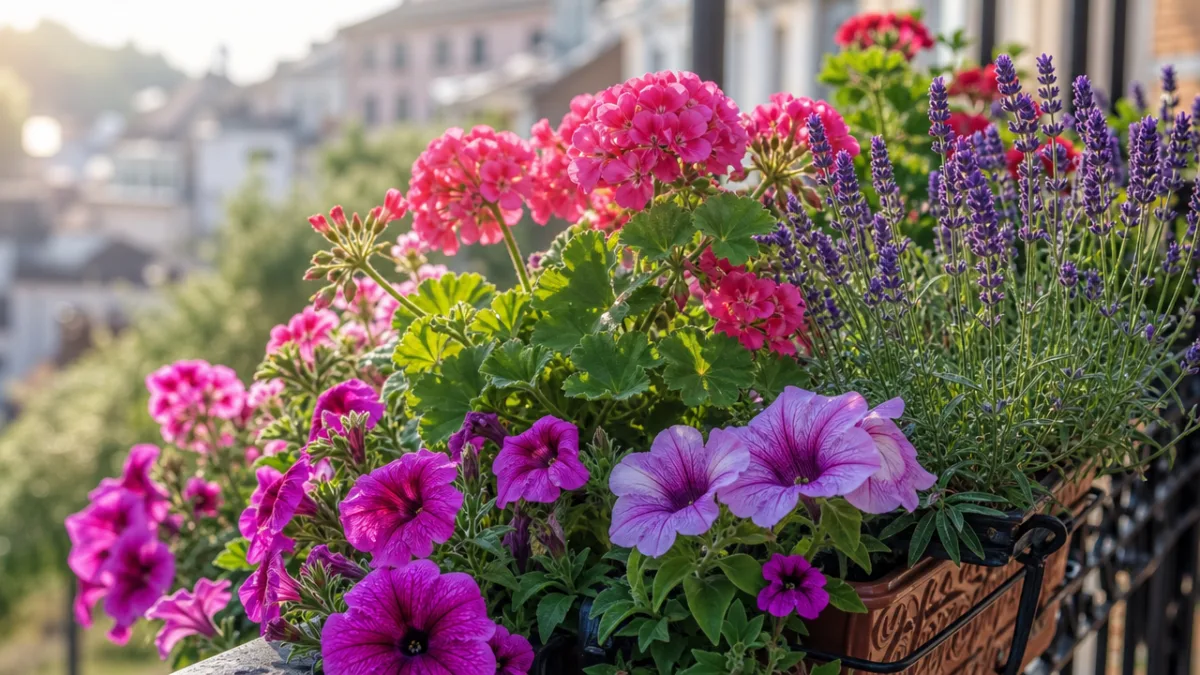
Geraniums, more accurately called pelargoniums, deserve special mention because they combine vivid flower clusters with attractive foliage, tolerate some drought, and thrive in hot and sunny balcony positions that might stress more delicate plants. Trailing varieties are particularly stunning in hanging baskets and railing boxes where their stems can tumble freely downward. Impatiens and New Guinea impatiens fill an essential niche for shaded balconies, producing dense mounds of jewel-toned blooms all season with minimal care beyond consistent watering.
Zinnias, cosmos, and nasturtiums are excellent choices for gardeners who prefer to grow from seed rather than purchasing transplants. They germinate quickly, grow vigorously, and produce large, showy flowers attractive to butterflies and bees. Nasturtiums have the added bonus of edible flowers and leaves with a peppery flavor, making them both ornamental and practical. Selecting a variety of flower types with different shapes, heights, and textures creates visual interest and ensures your balcony garden looks layered and designed rather than haphazardly assembled.
Perennials and Shrubs Worth Including
While annuals dominate the balcony flower scene, including a few perennials or compact flowering shrubs adds structural permanence and year-round interest that purely annual plantings cannot provide. Lavender is a particularly good choice: it is drought-tolerant, wonderfully fragrant, beloved by pollinators, and produces attractive silver-grey foliage during months when it is not in bloom. Compact varieties like ‘Hidcote’ or ‘Munstead’ stay small enough for a generously sized container and can survive mild winters outdoors with protection.
Dwarf patio roses have improved enormously in recent decades and now offer genuine disease resistance, reliable repeat flowering, and compact growth habits well suited to large containers. Varieties like the Flower Carpet series or the Drift series grow to around eighteen inches tall and wide, producing waves of flowers from early summer through autumn. Pair them with trailing annuals like verbena or calibrachoa at the pot’s edge to create a lush, layered composition that looks far more sophisticated than a single species planting.
Ornamental grasses, while not flowering plants, serve as invaluable textural companions in a balcony flower garden, providing movement and contrast that makes neighboring flowers look even more vivid by comparison. Small varieties like Festuca glauca with its steel-blue blades, or Carex oshimensis ‘Evergold’ with cream-striped foliage, occupy little space while contributing dramatically to the overall composition. They are also extremely low-maintenance, tolerating periods of drought and requiring little more than an occasional trim to stay tidy.
Watering, Feeding, and Ongoing Care
Developing a Consistent Watering Routine
Containers dry out dramatically faster than garden beds, especially on exposed balconies where sun and wind accelerate evaporation. During the peak of summer, most flowering container plants need watering at least once daily, and in very hot or windy conditions, twice daily watering may be necessary for smaller pots or shallow window boxes. The simplest way to check whether watering is needed is to push your finger an inch into the potting mix — if it feels dry at that depth, water thoroughly until water flows freely from the drainage holes.
Always water at the base of the plant rather than overhead when possible, directing moisture directly toward the root zone where it is needed. Overhead watering can encourage fungal disease on leaves and flowers, particularly in humid conditions or when water sits on foliage overnight. Using a watering can with a long, narrow spout or a hose with an adjustable wand attachment gives you the precision to water at soil level without soaking the flowers. Drip irrigation systems with timers are a worthwhile investment for larger balcony gardens and take the guesswork and labor out of daily watering entirely.
Watering in the early morning is generally best because it gives any moisture that does land on foliage time to evaporate before night, reduces water loss to midday heat, and ensures plants have adequate hydration as they enter the hottest part of the day. Evening watering is the second-best option if mornings are not practical, though in humid climates it slightly increases the risk of fungal problems. Midday watering during intense summer heat is the least effective approach, as much of the water evaporates before reaching the roots, and cold water meeting hot foliage can occasionally cause leaf scorch.
Fertilizing for Maximum Flower Production
Container-grown flowers are heavy feeders compared to plants in the ground, because frequent watering gradually leaches nutrients from the potting mix through the drainage holes. After the slow-release fertilizer incorporated into fresh potting mix has been depleted — typically after six to eight weeks — you will need to supplement with regular liquid feeding to maintain strong growth and continuous bloom. A balanced liquid fertilizer with roughly equal parts nitrogen, phosphorus, and potassium works well for general flowering plants throughout the season.
Once plants are well established and actively flowering, shifting to a high-potassium or “tomato-type” liquid fertilizer encourages more flower production and helps existing blooms develop deeper color. High-potassium formulations are particularly beneficial for petunias, fuchsias, pelargoniums, and calibrachoa during their peak flowering months. Feed every ten to fourteen days during the growing season, following the manufacturer’s dilution instructions carefully, as over-fertilizing can burn roots and cause lush foliage growth at the expense of flowers.
Organic liquid fertilizers like seaweed extract, fish emulsion, or worm casting tea are excellent options for gardeners who prefer to avoid synthetic products. They feed more gently and gradually, support beneficial microbial activity in the potting mix, and are less likely to cause fertilizer burn if applied at the correct dilution. While they may not produce the explosive growth response of high-analysis synthetic fertilizers, they support balanced, healthy plant development and are particularly suitable for edible flowers like nasturtiums where chemical residue is a concern.
Deadheading, Pruning, and Pest Management
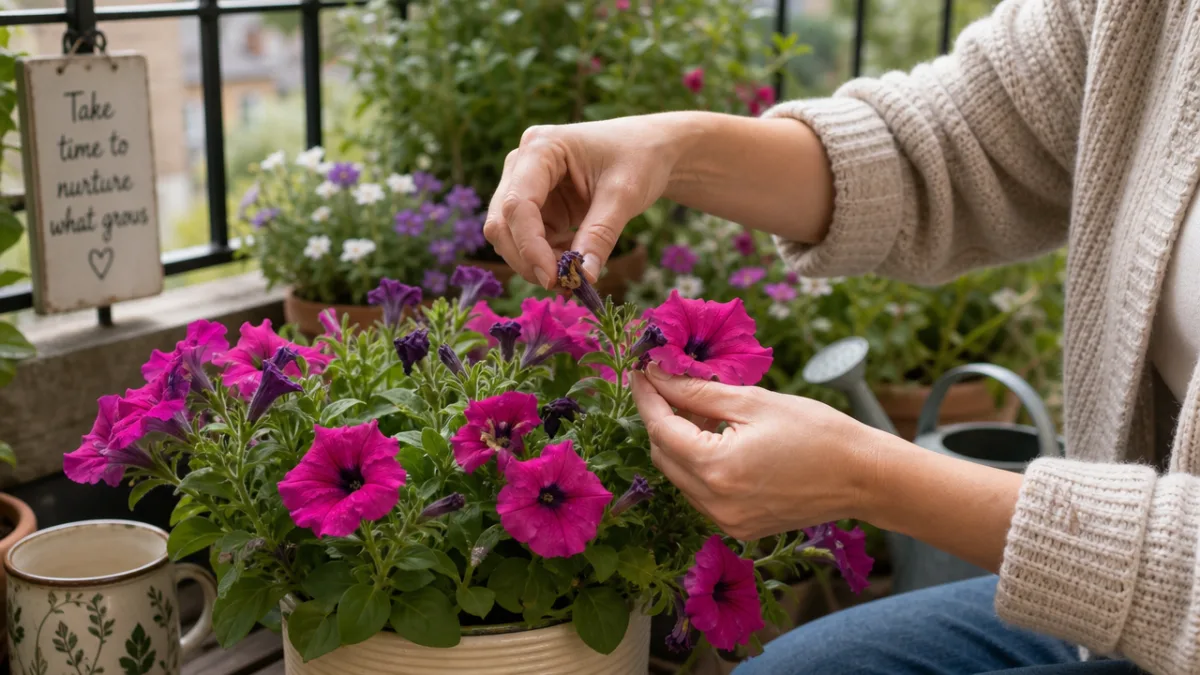
Deadheading — the simple practice of removing spent or faded flowers — is one of the most impactful things you can do to keep a balcony flower garden looking fresh and to prolong the flowering period. When a plant is allowed to set seed on a spent flower, it receives a hormonal signal to slow or stop producing new blooms. Removing the faded flower before seed development tricks the plant into continuing to produce more flowers in its ongoing effort to reproduce. For petunias, calibrachoa, geraniums, and marigolds, regular deadheading can extend the flowering season by weeks or even months.
Beyond deadheading, light pruning or “pinching back” leggy stems in midsummer helps many annuals maintain a compact, bushy habit and encourages a fresh flush of new growth and flowers. Petunias in particular tend to become straggly by July or August, and cutting them back by one-third stimulates vigorous regrowth that produces an excellent late-season display. It feels counterintuitive to cut back a plant that is still technically flowering, but the long-term results are consistently better than allowing it to become a thin, sprawling mess of stem with flowers only at the tips.
Common pests on balcony flower gardens include aphids, spider mites, vine weevils, and fungus gnats. Regular inspection of leaves — checking both upper and lower surfaces — catches infestations early when they are easiest to address. Aphids can often be dislodged with a strong jet of water or treated with insecticidal soap spray. Spider mites thrive in hot, dry conditions, so maintaining good air circulation and appropriate watering reduces their likelihood. Sticky yellow traps placed near containers help monitor flying pest populations, and sticky barriers around pot bases can deter vine weevils. Healthy, well-fed, properly watered plants are naturally more resistant to pest and disease pressure than stressed ones.
Design Principles for a Beautiful Balcony Garden
Working With Color, Height, and Texture
A visually compelling balcony flower garden is rarely the result of simply buying whatever is available and grouping it together. Thoughtful design — even in a small space — transforms a collection of individual plants into something that feels cohesive, intentional, and beautiful. Begin with a color palette of two to four complementary or harmonizing colors rather than attempting to include every hue available. A palette of soft pinks, purples, and whites creates a romantic, calming atmosphere, while bold combinations of orange, red, and yellow feel energetic and tropical. Limiting your palette does not restrict you; it focuses the visual impact.
Vary the height of your plantings to create visual depth and a sense of lushness. Place taller plants like standard fuchsias, patio roses, or tall zinnias toward the back or center of your arrangement, mid-height bushy plants like geraniums or marigolds in the middle layer, and low-growing or trailing plants like lobelia, bacopa, or sweet alyssum at the front edges where they can cascade over pot rims. This “thriller, filler, spiller” design formula works consistently well in container gardening and translates beautifully to balcony settings of all sizes.
Texture plays an equally important role in balcony garden design as color and height. Contrast fine-textured, feathery plants like cosmos or asparagus fern against broad-leaved, bold-textured plants like begonias or elephant ears to create visual tension that makes the composition more interesting to look at. Mixing glossy foliage with matte, smooth petals with ruffled, and upright forms with arching ones keeps the eye moving around the arrangement and rewards close inspection. Even a single container planting becomes significantly more sophisticated when texture contrast is deliberately considered alongside color selection.
Maximizing Space With Vertical Gardening
The most underutilized dimension in most balcony gardens is vertical space. Walls, railings, and overhead structures offer opportunities to dramatically expand your planting area without adding any additional floor space or weight load. Wall-mounted planters, pocket gardens made from fabric or felt, repurposed wooden pallets fitted with liner and soil, and tiered plant stands all allow you to grow upward, creating lush green walls of flower color that transform the entire character of an outdoor space.
Climbing and vining flowers are particularly valuable on balconies where a simple trellis fixed to a wall can support a spectacular vertical display. Sweet peas are beloved for their extraordinary fragrance and delicate pastel flowers and can be grown up a simple bamboo framework in a large pot. Black-eyed Susan vine, morning glory, and nasturtiums are also enthusiastic climbers that reward vertical support with abundant bloom. Training vines up vertical structures also serves a practical purpose by providing privacy and wind screening, making the balcony feel more sheltered and intimate.
Tiered plant stands and stepladder-style shelving units allow you to display multiple smaller containers at different heights without requiring wall fixings, making them ideal for rental properties where permanent modifications are restricted. Arrange your tier with trailing plants on the highest level where their stems can drape gracefully downward, bushy mid-height plants in the middle, and ground-covering or compact plants at the base. This approach not only maximizes your planting capacity but also makes watering and maintenance more convenient by bringing plants up to a more accessible height.
Creating Atmosphere With Fragrance and Wildlife
A truly memorable balcony flower garden engages multiple senses, and fragrance is perhaps the most powerful and personal of these. Positioning fragrant flowers near seating areas or doorways ensures that their scent greets you whenever you step outside or open a door. Sweet alyssum produces a gentle honey-like fragrance from masses of tiny white, pink, or purple flowers and is one of the easiest and most reliable fragrant annuals for containers. Heliotrope carries a remarkable vanilla-cherry scent and thrives in sunny, sheltered balcony positions. Lavender, already mentioned for its other merits, is arguably the finest fragrant perennial for balcony life.
Attracting wildlife to a balcony garden is both ecologically valuable and personally delightful. Bees, butterflies, and hoverflies are vital pollinators struggling in many urban environments, and a thoughtfully planted balcony garden can serve as a meaningful island of habitat for them. Choose flowers with accessible, open structures — single-flowered varieties of marigolds, zinnias, cosmos, and salvias rather than heavily doubled cultivars — as these provide far more accessible nectar and pollen. Even a modest collection of the right flowers can attract surprising numbers of pollinators to an apartment balcony several stories above ground level.
Incorporating a small saucer of water placed among your containers provides a drinking and bathing source for beneficial insects and small birds visiting your garden. Change the water every two to three days to prevent it from becoming a mosquito breeding site. Wind chimes, a small string of solar lights woven through your container arrangements, or a lightweight garden chair positioned to take advantage of the best view of your flowers all contribute to making your balcony garden a place you actively want to spend time — which is, ultimately, the most important measure of its success. Your balcony flower garden should be a living space as much as a growing space, designed and tended to bring as much daily pleasure as possible.








What do you think?
It is nice to know your opinion. Leave a comment.