










Narcisse Vide-poches: The Art of Elegant Organization Meets Floral Beauty
Introduction to the Narcisse Vide-poches
If you’ve ever come across a decorative tray so lovely it stopped you in your tracks, the Narcisse Vide-poches might just be that object for you. It sits at this wonderful intersection of home organization and floral artistry — named after the narcissus, one of spring’s most beloved and symbolically loaded flowers. What could easily be just another catch-all dish becomes something you actually want to look at. Whether it ends up on your entryway console, your bedroom dresser, or your writing desk, it has a way of quietly elevating the whole room.
The word “vide-poches” is French for “empty pockets,” and it refers to those small decorative dishes or trays meant to hold the little things you carry around every day — keys, coins, rings, cards, the random odds and ends that end up in your hands at the end of the day. This tradition runs deep in French interior design, where beauty and function have always been treated as partners rather than opposites. The Narcisse version takes that idea and gives it a strong botanical identity.
What really sets the Narcisse Vide-poches apart is how committed it is to capturing the actual spirit of the narcissus flower in three dimensions. The petals, the curves, the organic shape — all of it gets translated into a vessel that works on several levels at once: practical object, decorative art, and a quiet nod to the natural world. It’s a small thing, but it has a surprisingly big presence wherever you put it.
The History and Cultural Significance of the Vide-Poches Tradition
The vide-poches has its roots in the aristocratic households of 17th and 18th century France, where keeping your personal belongings tidy was genuinely considered a sign of good breeding. In grand châteaux and Parisian hôtels particuliers, small porcelain or silver dishes sat on dressing tables and writing desks, holding rings, snuff boxes, seals, and other personal effects. These weren’t purely practical — they were status symbols, conversation starters, little windows into their owner’s taste and social standing.
As decorative arts shifted through the 19th and 20th centuries, the vide-poches held its place in well-appointed homes while adapting to whatever aesthetic movement was having its moment. Art Nouveau designers took to the format enthusiastically, and it’s easy to see why — the organic forms of flowers, leaves, and flowing botanical shapes fit naturally into the shallow, open bowl of a traditional vide-poches. The results were often stunning objects that managed to be both useful and genuinely beautiful.
The narcissus flower specifically brings a lot of cultural history to the table, which is part of what makes it such a compelling choice for this kind of object. From its origins in Greek mythology to its starring role in Dutch Golden Age still-life painting, to its popularity in Art Nouveau and Art Deco design, the narcissus has accumulated centuries of artistic and symbolic meaning. Using it as the foundation for a vide-poches places the piece inside a much larger story.
Design Elements and Aesthetic Qualities of the Narcisse Vide-poches
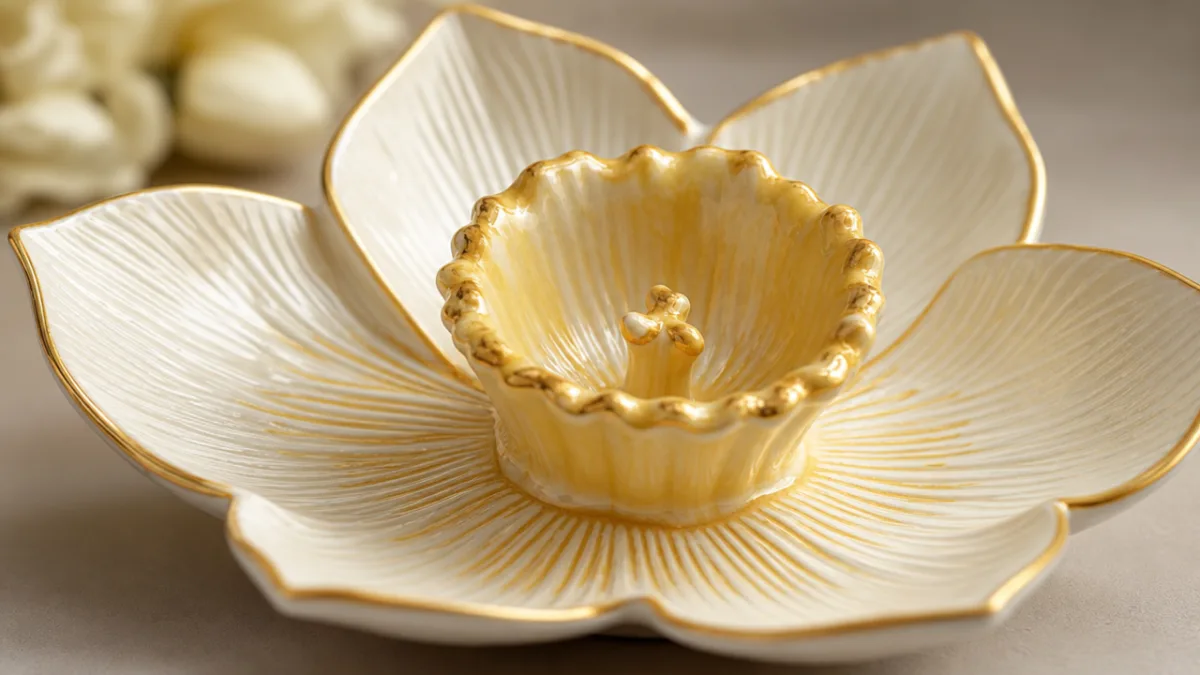
The design of the Narcisse Vide-poches comes directly from looking closely at an actual narcissus flower and figuring out how to honor its structure in functional form. The trumpet-shaped corona at the flower’s center typically becomes the deep well of the dish, while the surrounding petals fan outward to create the broad, gently curved rim. The fidelity to the real flower is often quite striking — you can see the botanical logic in how the whole thing is put together.
Materials make an enormous difference in how the piece feels and reads in a space. The Narcisse Vide-poches shows up in fine ceramics, cast resin, precious metals, and hand-blown glass, and each brings something different to the floral form. Porcelain can capture something close to the delicate translucency of real petals, while brass or gold leaf brings a warm glow that calls to mind sunlight coming through spring blooms. The material you choose fundamentally shapes the mood of the object — whether it reads as serene and contemplative or celebratory and rich.
Color is another big part of what defines the look. The narcissus itself offers a naturally gorgeous palette — creamy whites, pale yellows, warm oranges, deep golds — and many versions of the vide-poches stay close to those botanical tones. Others take more creative liberties, offering the piece in blush pink, sage green, or midnight blue, letting it function as both floral tribute and a bold color moment within a room. Both approaches can be wonderful depending on what you’re going for.
How to Style and Use the Narcisse Vide-poches in Your Home
One of the best things about the Narcisse Vide-poches is how adaptable it is. Unlike larger decorative objects that need careful coordination and a specific spot, the vide-poches is small enough to slip naturally into all kinds of interiors without demanding too much attention. The trick to styling it well is understanding its dual personality — it’s both a practical container and a decorative object — and finding the spot where both sides of that personality can shine.
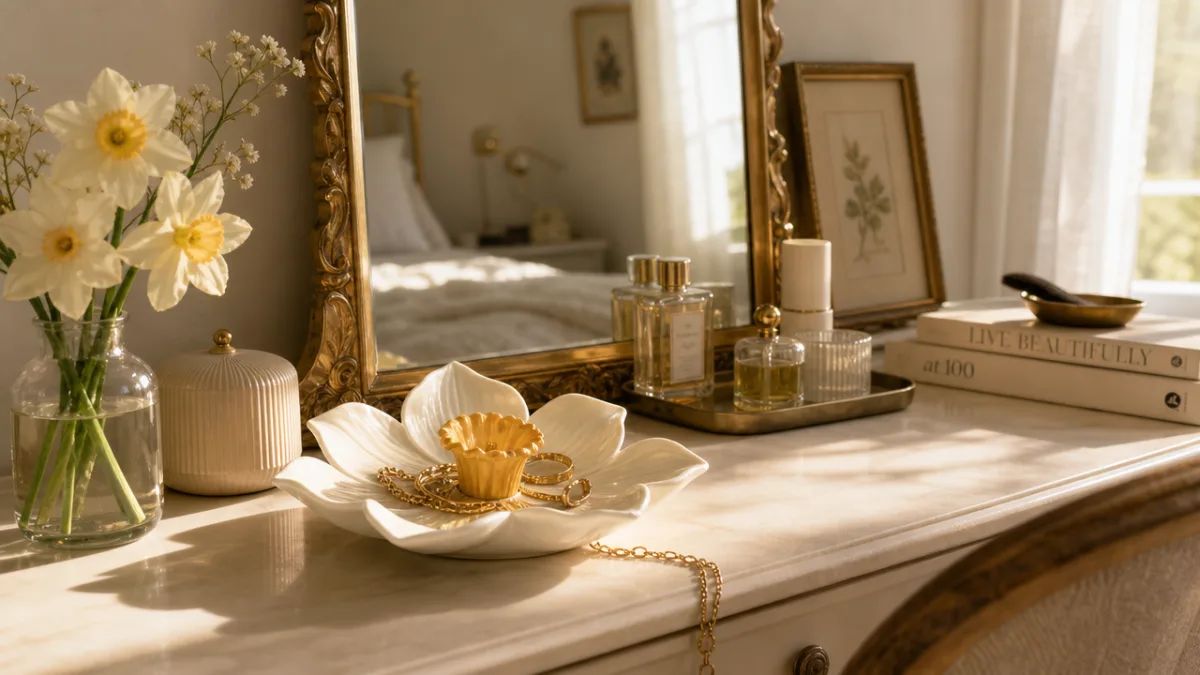
In the entryway, it solves a problem almost every home has: the cluttered key bowl situation. Set on a console table or shelf near the front door, it gives keys, transit cards, and pocket change a designated home while adding something genuinely lovely to what can easily become a forgotten space. The floral form softens what would otherwise be a pretty utilitarian task, turning the act of dropping your keys when you walk in into something that feels a little more intentional.
Beyond the entryway, there are plenty of spots throughout the home where the Narcisse Vide-poches earns its place beautifully. Consider these styling options:
- On a bedroom nightstand to hold jewelry, a watch, or reading glasses before sleep
- On a bathroom vanity as a receptacle for hair pins, earrings, or small cosmetic items
- On a home office desk to corral paper clips, USB drives, and small stationery
- On a dining table as part of a curated tablescape arrangement alongside candles and small vases
- On a coffee table as part of a styled tray grouping with books and botanical accents
- In a guest room to offer visitors a thoughtful place for their personal belongings
When grouping it with other objects, complementary contrast tends to give you the most satisfying result. Because the vide-poches already brings strong botanical energy, pairing it with things that introduce different textures and shapes — a smooth marble object, a geometric brass candleholder, a stack of cloth-bound books — creates a vignette that feels genuinely collected rather than matchy-matchy. The vide-poches becomes an anchor, and everything else arranges itself naturally around it.
The Symbolism of the Narcissus Flower in Art and Design
Few flowers carry as much symbolic weight as the narcissus. In Greek mythology, Narcissus was the beautiful young man who became so transfixed by his own reflection in a pool that he eventually wasted away and became the flower that bears his name. That origin story gave the narcissus its most lasting association — beauty, self-contemplation, and the fine and sometimes dangerous line between admiration and obsession. It’s a rich starting point for any object.
But the symbolism doesn’t stop there. In many European traditions, the narcissus also stands for renewal, hope, and the return of light after a long winter. As one of the first flowers to appear each spring, it’s historically been linked to resurrection, new beginnings, and the natural cycle of regeneration. And in Chinese culture, the narcissus carries a completely different kind of significance — it’s considered an auspicious flower, associated with good fortune, prosperity, and the Lunar New Year. Same flower, very different meanings, all of them resonant.
For the maker who designs a Narcisse Vide-poches, choosing the narcissus as a subject is never a throwaway decision. It brings all of that layered meaning to bear on a small, intimate object — and a vide-poches is an inherently intimate thing. It holds your rings, your keys, your coins, the little daily talismans you carry with you. Something that holds all of that deserves a form that takes it seriously. The narcissus, with its beauty and its centuries of meaning, turns out to be a near-perfect choice.
Caring for and Preserving Your Narcisse Vide-poches
A well-made Narcisse Vide-poches can last for generations if you treat it thoughtfully. The specifics depend on what it’s made of, but a few general habits apply across the board. Regular, gentle cleaning is the most important one — the shallow bowl shape and textured petal surfaces have a tendency to collect dust and fine debris, and if you let that build up over time, it can start to dull the finish in ways that are hard to reverse.
For ceramic and porcelain versions, a soft, slightly damp cloth is usually all you need for routine upkeep, followed by a gentle dry buff to bring back the surface’s natural sheen. Steer clear of harsh chemical cleaners or anything abrasive that could scratch a delicate glaze or damage painted details. If your piece has gilded accents — which many versions of the Narcisse Vide-poches do — those areas need extra care, since gold leaf and gold paint finishes are particularly sensitive to moisture and chemicals. A dry, soft brush is usually the safest tool for those spots.
Placement matters for long-term preservation too. Keep these care considerations in mind:
- Avoid placing the vide-poches in direct, prolonged sunlight, which can fade painted details and cause certain materials to become brittle over time
- Keep the piece away from sources of excessive heat or humidity, particularly in the kitchen or bathroom, unless the specific material is rated for such environments
- Use a soft pad or felt liner under the piece to protect both the vide-poches base and the surface it rests upon
- When moving or storing the piece, wrap it in acid-free tissue paper and place it in a padded box to prevent chipping or surface damage
- Inspect the piece periodically for hairline cracks or signs of wear, particularly at the delicate petal edges where breakage is most likely to occur
With good care and a little attention, a quality Narcisse Vide-poches can become something more than a decorative object — it can become a genuine heirloom. The kind of beautiful, useful thing that accumulates meaning over decades of daily life and eventually passes between generations with stories attached. The best examples of this kind of craftsmanship are made with exactly that kind of longevity in mind, their beauty deepening rather than fading as the years go by.
Where to Find and How to Choose the Right Narcisse Vide-poches
The market for decorative vide-poches is genuinely wide, which makes the search exciting but occasionally a bit overwhelming. At the high end, artisanal studios and established luxury houses produce limited-edition pieces in fine porcelain, hand-painted with botanical detail and finished with real gold. These are investment objects — beautiful enough to display prominently and built to last for generations with the right care.
If you’d rather not spend at that level, there’s real quality to be found among independent ceramicists who make handmade vide-poches in botanical forms at much more accessible prices. Platforms dedicated to handmade goods have made it easier than ever to find and buy directly from makers doing genuinely skilled, original work. When you’re evaluating pieces at this level, look for consistent glazing, clean lines at the petal edges, and signs that the maker finished the piece carefully — a well-trimmed foot ring and a smooth base tell you a lot about overall attention to quality.
Antique and vintage markets are another rewarding place to look, especially if you’re drawn to pieces with a bit of history and patina. French flea markets, estate sales, and specialist dealers in decorative arts regularly turn up examples from the late 19th and early 20th centuries — the golden age of botanical decorative design — that offer both genuine artistic quality and the added appeal of authenticity. Just make sure to examine vintage pieces closely for repairs, restorations, or condition issues that might affect their value or integrity.
At the end of the day, the right Narcisse Vide-poches is simply the one that feels right to you — the one that fits your taste and your home and that you’ll actually enjoy living with. Whether your style leans toward the clean lines of modern Scandinavian interiors, the warmth of traditional French rooms, or an eclectic mix of things gathered from all over, there’s a version of this object that will feel completely at home in your space. The narcissus has inspired artists and craftspeople for centuries — and in choosing a Narcisse Vide-poches, you become part of that long, quietly beautiful tradition.








What do you think?
It is nice to know your opinion. Leave a comment.