










20+ Stunning Small Garden Bridge Ideas to Transform Your Outdoor Space
The Timeless Appeal of Garden Bridges in Small Spaces
Garden bridges have captivated landscape designers and homeowners alike for centuries, offering a unique blend of architectural beauty and functional purpose. Even in the most compact outdoor spaces, a well-chosen bridge can serve as an arresting focal point that draws the eye and invites exploration. Whether spanning a dry creek bed, a tiny koi pond, or simply a decorative dip in the landscape, these structures carry an almost magical quality that transforms an ordinary garden into something truly special.
The beauty of incorporating a bridge into a small garden lies in the sense of journey it creates. Even crossing a span of just a few feet can evoke the feeling of moving between two distinct worlds — perhaps from a wilder, more naturalistic planting scheme into a manicured formal space, or from a sunny patio into a shaded woodland corner. This psychological transition is a powerful design tool that experienced gardeners understand intuitively, using the bridge not just as a physical structure but as a narrative device within the landscape story.
Small garden bridges are also surprisingly accessible from a budget and installation standpoint. Unlike grand pergolas or elaborate water features, a modest wooden or stone bridge can be sourced as a kit, built from reclaimed materials, or even crafted as a satisfying weekend DIY project. The range of styles available — from rustic log-and-plank constructions to refined arched designs in painted hardwood — means there is genuinely a perfect option for every aesthetic preference and garden personality, no matter how limited the available square footage.
Choosing the Right Style and Material for Your Garden Bridge
Selecting the ideal bridge style begins with an honest assessment of your garden’s existing character. A contemporary minimalist garden with clean lines and restrained planting will be best served by a flat, low-profile bridge in weathered steel or smooth hardwood with no ornamental railings. Conversely, a cottage garden overflowing with roses and lavender calls for a more romantic arched design, perhaps in painted white timber with simple lattice sides that climbing plants can weave through over time. Matching the bridge to the garden’s spirit, rather than choosing something that stands in stark contrast, is almost always the better long-term decision.
Material choice is arguably the most important practical decision you will make. Pressure-treated pine is the most economical option and, when sealed properly, can last for a decade or more even in wet climates. Cedar and redwood are naturally resistant to rot and insects, carry a warm, honey-toned appearance, and require relatively little maintenance beyond occasional oiling. Hardwoods like teak and ipe are exceptionally durable and beautifully grained but come at a significantly higher price point. For a truly permanent and virtually maintenance-free solution, composite decking materials or even powder-coated steel offer excellent longevity, though they lack the organic warmth of natural timber.
Beyond wood and metal, stone and concrete bridges deserve serious consideration for certain garden styles. Flat stepping-stone designs laid across a shallow feature create an incredibly naturalistic effect, particularly when surrounded by low-growing thyme, chamomile, or moss that softens the edges over time. Pre-cast concrete bridges styled to resemble aged stone are widely available and offer remarkable durability at a moderate price. For the truly ambitious gardener, a genuine mortared stone arch bridge — even a very modest one — represents the pinnacle of permanence and will genuinely look better with every passing decade as mosses and lichens colonize its surface.

Water Features and Dry Creek Beds: Perfect Companions for Small Bridges
Nothing complements a garden bridge more naturally than water, and even the smallest garden can accommodate a water feature scaled to work beautifully with a compact crossing. A half-barrel pond or a pre-formed liner set just below grade can be spanned by a bridge as narrow as three feet, creating a genuinely convincing water garden in a space no larger than a parking space. Stock these tiny ponds with miniature water lilies, oxygenating plants, and even a small collection of goldfish or weather loach, and the combination of bridge and water becomes the undisputed heart of the garden.
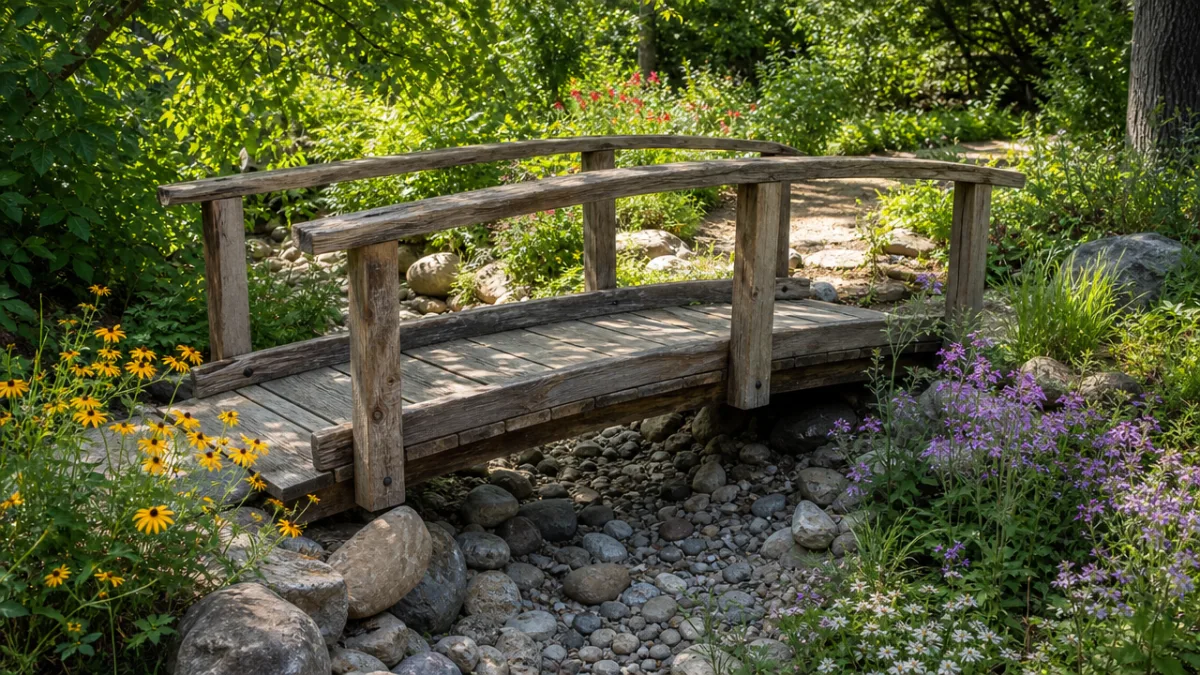
Dry creek beds represent one of the most creative and practical solutions for gardeners who want the aesthetic of a bridge without the commitment or maintenance of standing water. A sinuous channel of graded gravel, smooth river pebbles, and larger boulders can be constructed in an afternoon using landscape fabric and locally sourced stone, and when a simple timber bridge is positioned across its width, the illusion of a genuine stream crossing is remarkably convincing. In rain, these features come alive as genuine drainage channels, directing water away from foundations and low-lying areas — making them both beautiful and functional at once.
For those with slightly more space and budget, a recirculating stream system offers the incomparable sensory pleasure of moving water without requiring a natural water source. A submersible pump hidden beneath a surface of cobblestones at the stream’s origin can move water through a gently winding channel before collecting it in a small reservoir pond at the lower end, from which it is pumped back up to begin its journey again. A bridge positioned at any point along this circuit creates a scene of extraordinary charm, and the gentle sound of trickling water provides a constant backdrop that masks urban noise and invites wildlife, particularly birds, to visit and bathe.
Design Tips for Maximizing Visual Impact in Limited Space
In a small garden, every element must pull double duty, contributing to the space’s visual harmony while also serving a practical function. When planning your bridge placement, consider the sightlines from your most-used outdoor seating area and from key windows inside the house. A bridge that is visible from the kitchen table or living room sofa will deliver year-round pleasure, becoming a changing seasonal picture as snow settles on its railings in winter, cherry blossoms drift across it in spring, and late summer light turns its timber a deep amber gold in the evening hours.
The planting around and beneath your bridge is as important as the structure itself. Ferns, hostas, and astilbes thrive in the damp, partially shaded conditions that often exist near water features, and their lush foliage creates a sense of abundance that makes a small bridge feel embedded in a larger, wilder landscape. On the bridge itself, consider allowing climbing plants like wisteria, roses, or clematis to grow over simple arch supports positioned at each end, gradually framing the crossing in a living canopy of flowers and foliage. This softening of the structure’s hard edges is one of the most effective ways to make a small garden feel genuinely romantic and established.
Scale and proportion are critical considerations that are easy to misjudge. A bridge that is too wide for its crossing will look clumsy and suburban; one that is too narrow will feel precarious and unresolved. As a general rule, a bridge spanning a feature of two to four feet should itself be no wider than three feet, while a crossing of six to eight feet can comfortably accommodate a four-foot-wide bridge. The arc of any arch should not exceed one-third of the bridge’s overall length, as steeper angles quickly become impractical and slightly comical in scale. When in doubt, erect a simple cardboard mock-up at the proposed location and live with it for a few days before committing to construction.
Lighting transforms a garden bridge from a daytime feature into a genuine year-round asset. Low-voltage LED strip lights fitted beneath handrails create a warm, pooling glow that makes the bridge magical on summer evenings. Spotlights aimed upward into any overhanging planting produce dramatic shadow effects that shift with the breeze. Solar-powered post lights at each corner of the bridge offer a practical, no-wiring solution that requires no professional installation, and modern solar technology means these lights are now bright enough and reliable enough to provide genuinely useful illumination rather than merely decorative flicker.

Japanese and Asian-Inspired Bridge Designs for Tranquil Gardens
Among the most enduringly popular garden bridge aesthetics is the Japanese-influenced design tradition, which brings a philosophy of simplicity, asymmetry, and reverence for natural materials that translates beautifully into even the smallest Western garden. The iconic curved red bridge — a feature of traditional Japanese strolling gardens — is actually one of the most achievable styles for home gardeners, since the vermillion lacquer finish can be applied to a straightforward timber arch construction using outdoor paint. When paired with a koi pond, raked gravel, carefully pruned Japanese maple, and a stone lantern, even a modestly sized backyard can achieve a genuinely meditative quality.
The zigzag bridge, known in Japan as the yatsuhashi, offers a fascinating alternative to the conventional single-arc crossing. Rather than spanning a feature directly, the yatsuhashi crosses a pond or marshy area in a series of connected flat platforms set at angles to one another, slowing the visitor’s progress and ensuring that every inch of the water feature is experienced from multiple perspectives. This design is particularly effective in small ponds where a direct crossing would feel abrupt, and it gives marginal aquatic plants — irises, rushes, water forget-me-nots — the opportunity to grow right up through the gaps between the deck boards, blurring the boundary between structure and nature in a deeply satisfying way.
Beyond the purely visual, Asian garden philosophy emphasizes the importance of the sensory journey. A bridge in this tradition is not simply a means of getting from one side to the other; it is a moment of deliberate pause, an invitation to look down into the water, to notice the movement of fish, the reflection of clouds, the way light plays on the surface. Incorporating these principles into your small garden bridge design — by adding a simple bench at the bridge’s midpoint, or by ensuring that the railing height encourages a natural lean and look downward — elevates a basic timber structure into a genuine contemplative feature that rewards daily visits through every season of the year.
DIY Small Garden Bridge Projects: Building Your Own Crossing
Building a small garden bridge from scratch is a genuinely achievable project for anyone with basic woodworking skills, a weekend of free time, and a modest budget. The most common DIY approach uses two parallel lengths of pressure-treated lumber as the main structural beams, with decking boards laid across them at right angles and secured with exterior-grade screws. For a flat bridge spanning up to five feet, four-by-six-inch beams in a length appropriate to your crossing provide more than adequate structural support for normal garden use, and the whole assembly can be completed in a single afternoon once materials are gathered.
For those who want to attempt the more challenging arched design, the key lies in creating the curved side beams using a method called kerf bending or, alternatively, by laminating multiple thin strips of flexible plywood around a temporary jig. Neither technique requires specialist equipment beyond a circular saw and clamps, and there are excellent detailed tutorials available for both approaches. The reward for this extra effort is considerable: an arched bridge carries a visual elegance and a sense of craftsmanship that a flat design simply cannot match, and the curve also provides natural structural strength that can be an advantage for longer spans.
Safety and durability should be the primary considerations in any DIY bridge project, particularly if the structure will be used regularly or by children. All timber should be either naturally rot-resistant or properly treated and sealed before installation. Decking boards should be spaced approximately a quarter-inch apart to allow water to drain freely rather than pooling and accelerating wood decay. Handrails, where fitted, should be set at a minimum height of thirty-six inches and tested to withstand significant lateral force. Finally, the bridge should be positioned so that its weight bears on firm, stable ground at each end — never on soft or waterlogged soil — and should be checked annually for any signs of structural deterioration, with any affected components replaced promptly.
- Essential tools for a DIY garden bridge: circular saw, drill-driver, exterior wood screws, measuring tape, spirit level, clamps, sandpaper, and waterproof wood sealant.
- Best timber choices for longevity: cedar, redwood, teak, ipe, or properly treated pine for budget-conscious projects.
- Key safety checks: structural beam integrity, handrail stability, deck board spacing, secure footing at both ends, and annual inspection for rot or corrosion.
- Optional enhancements: post-mounted lanterns, carved balusters, climbing plant supports at each end, and non-slip grip tape on deck boards.
Seasonal Maintenance and Long-Term Care for Garden Bridges
A garden bridge is an investment that, like any timber outdoor structure, will reward consistent care with decades of beauty and service. The single most important maintenance task is ensuring that water does not pool on the deck surface or collect in joints and end grain, as prolonged moisture contact is the primary cause of timber decay. Applying a high-quality exterior wood oil or sealant every one to two years — more frequently in very wet or humid climates — creates a water-repellent barrier that dramatically extends the life of the timber while preserving its natural color and grain. Always apply these products to clean, dry wood on a warm day for the best penetration and adhesion.
In autumn, fallen leaves should be cleared from the bridge deck promptly, as decomposing leaf matter retains moisture, accelerates mold growth, and can become dangerously slippery underfoot. A stiff brush and a few minutes of attention after each major leaf fall is all that is required to keep the surface clean and safe. At the same time, check the condition of any metal fixings — screws, bolts, and brackets — replacing any that show signs of rust before corrosion has the opportunity to stain the surrounding timber or compromise the joint’s structural integrity. Stainless steel or hot-dipped galvanized fixings are the best choice for new construction, as they are far more resistant to the corrosive damp conditions that garden bridges inevitably encounter.
Beyond the structural, do not neglect the planting that surrounds and adorns your bridge. Cut back any vigorous climbers in late winter before new growth begins, shaping them to keep the bridge itself accessible and to prevent excessive weight accumulating on any support structures you have added. Remove and replace any marginal pond plants that have become overcrowded, as root-bound aquatic plants are far less vigorous and floriferous than those that are regularly divided. With a small investment of time at each changing season, your garden bridge and its surrounding planting will not merely hold their own against the years but will genuinely improve, developing the settled, established character that is the hallmark of a truly loved and well-tended garden.








What do you think?
It is nice to know your opinion. Leave a comment.