










11 Ways to Fill Your Home with Lagom, Hygge’s Trendy Little Sister
What Is Lagom and Why Is Everyone Talking About It?
If you’ve spent any time in wellness or interior design spaces lately, you’ve probably come across the Danish concept of hygge — that warm, candlelit coziness that feels like wrapping your hands around a mug of hot cocoa on a cold night. But Sweden has quietly been offering up its own take on the good life, and it’s called lagom. Deeply rooted in Swedish culture, lagom roughly translates to “just the right amount” — not too much, not too little, but just right. It’s a guiding principle that touches everything from how Swedes approach their workday to how they set up their living rooms.
The word itself is thought to come from the phrase “laget om,” meaning “around the team” — a nod to the old Viking tradition of passing a shared drinking horn and taking just enough so everyone got a fair sip. Whether that etymology holds up completely doesn’t really matter; it captures the communal, balanced spirit of the idea perfectly. Lagom isn’t about deprivation or minimalism for its own sake. It’s about intentionality — making choices that genuinely serve you without tipping into excess or going without. In a world that loves extremes, it’s a quietly radical act of moderation.
Unlike hygge, which is really about creating a specific emotional atmosphere of warmth and togetherness, lagom is more of an all-encompassing life philosophy. In the home, it shows up as spaces that feel neither cluttered nor too bare, neither cold nor suffocatingly cozy. It’s the sweet spot of interior design, and as more people grow tired of both maximalist consumerism and the austerity of strict minimalism, lagom is starting to feel like a real breath of fresh air.
The Core Principles Behind a Lagom Home
Before getting into the specific how-tos, it helps to understand what lagom is actually asking of a space. The first and most important principle is balance — visual, emotional, and practical. A lagom home feels settled, like every object landed exactly where it belongs without trying too hard. That doesn’t mean everything needs to match or be perfectly symmetrical, just that the overall feeling of a room is harmonious rather than haphazard or overwhelming.
Sustainability is also baked into the lagom philosophy. Swedes have long been leaders in sustainable design, and the lagom home reflects that by favoring quality over quantity, natural materials over synthetic ones, and things that last over things that are merely on-trend. Buying less but choosing better is the whole idea. It means saving up for a beautifully crafted wooden side table that’ll be around for decades instead of cycling through three cheap ones that end up in a landfill. Every purchase becomes something you actually think about rather than something you impulse-buy and regret.
The third core principle is functionality. In a lagom home, beauty and purpose aren’t in competition — they work together. Furniture is chosen because it actually fits the space and gets used, not because it photographs well. Storage makes sense. The layout of each room reflects how people genuinely live in it. There’s no room for purely decorative stuff that contributes nothing to daily life, but that’s not a cold or sterile idea — it actually creates spaces that feel alive, because they’re being actively, lovingly used every day.
1 Through 4: Starting with the Foundation of Your Space
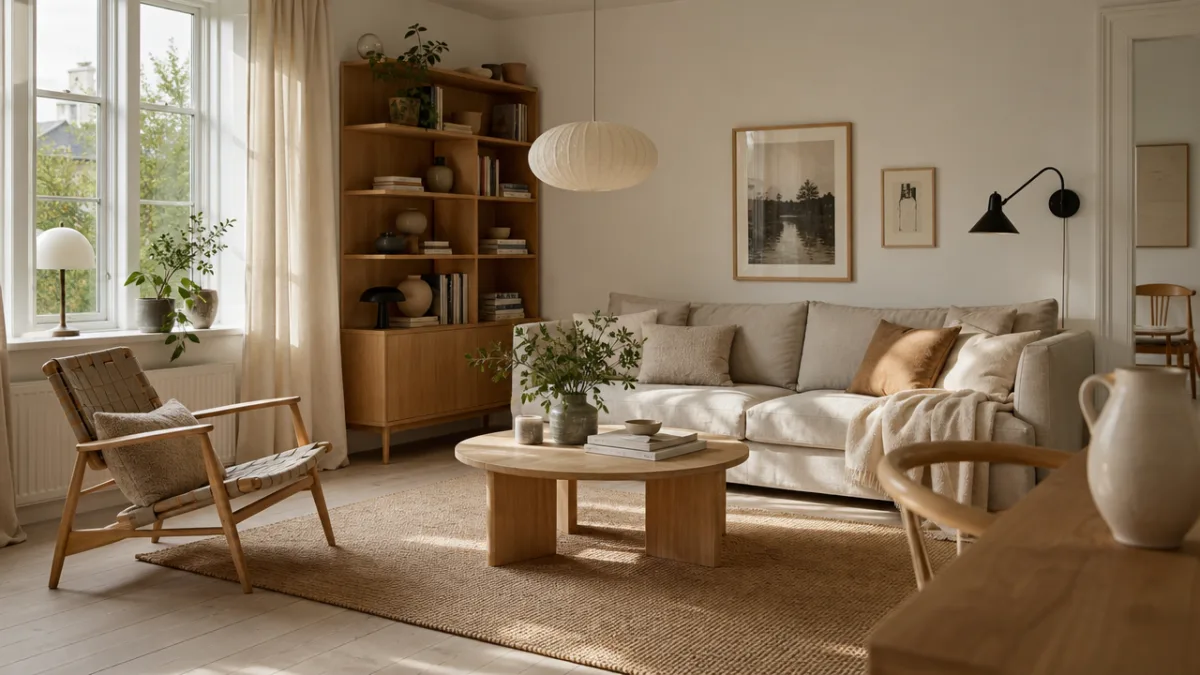
The first four ways to bring lagom into your home all start with the bones of the space — the colors, the furniture, the layout, the light. Start with a restrained, nature-inspired color palette. Lagom interiors tend to lean on warm whites, soft grays, dusty greiges, and earthy tones pulled from the Scandinavian landscape — mossy greens, birch-bark beiges, the pale blue of a Nordic sky. These shades create a backdrop that feels calm and cohesive without tipping into clinical. Accent colors are used sparingly: one terracotta cushion, a deep navy throw, rather than a whole jumble of competing shades fighting for your attention.
Choose furniture that fits your space — not furniture that fills it. One of the most common decorating mistakes is picking pieces that are either way too big and overwhelming, or too small and awkward. Lagom asks you to measure carefully, sit with the empty space for a bit before buying anything, and choose furniture whose scale actually suits the room. One well-proportioned sofa might serve a living room far better than a sectional crammed into every corner. A dining table for six that you genuinely use is far more lagom than a table for twelve that barely leaves room to walk around.
Let natural light do the heavy lifting. Scandinavian design has always understood that light is one of the most powerful elements in any interior — especially in countries where winter days are short and darkness stretches long. In a lagom home, windows are kept clear when possible, sheers are favored over heavy drapes that swallow daylight, and mirrors are placed thoughtfully to bounce light into darker corners. When the sun comes in, you celebrate it rather than block it out. In the evenings, artificial lighting gets layered — overhead fixtures plus table lamps and floor lamps to build warmth and depth as the day winds down.
Embrace thoughtful editing of your belongings. Lagom isn’t about owning as little as possible — it’s about owning exactly what you need and genuinely love. That means taking an honest look at your home now and then and asking whether each object is really earning its place. Does it bring you actual pleasure? Do you use it? Does it contribute something to the room? If the answer to all three is no, it might be time to let it go. This kind of mindful curation isn’t a one-time overhaul — it’s an ongoing practice, a gentle seasonal check-in with your stuff rather than a dramatic purge.
5 Through 8: Layering Texture, Nature, and Meaningful Objects
Layer natural textures generously but with restraint. This might sound like a contradiction, but it really is the heart of lagom decorating: you want enough textural variety that a space feels rich and sensory, but not so much that it tips into chaos. Think linen paired with wool, smooth stone next to rough-hewn wood, matte ceramics alongside the warm glow of aged brass. Each material gets room to breathe rather than competing for your eye. A chunky knit throw over a simple linen sofa, a rattan basket against a white wall — these combinations feel layered without feeling like too much.
Bring the outdoors in with living plants and natural materials. Swedes have a deeply rooted connection to the natural world — the concept of friluftsliv, or open-air living, runs through the culture — and the lagom home keeps that connection alive indoors. This doesn’t mean turning your apartment into a jungle (unless that genuinely brings you joy), but rather choosing a few plants that actually suit your light conditions and your capacity to keep things alive. A single fiddle-leaf fig in a terracotta pot, a cluster of succulents on a windowsill, a few fresh-cut branches in a simple vase — each brings life in without demanding too much back.
Decorate with objects that carry personal meaning. A lagom home isn’t an anonymous, catalog-perfect showroom. It’s personal and rooted in real life. The objects that belong here are the ones that tell your story — a piece of pottery from a memorable trip, a print by an artist you actually love, a wooden bowl that belonged to your grandmother. These things don’t need to match perfectly or track with any trend. Their value is in their authenticity and in the warmth they bring simply by being genuinely yours. Curation in a lagom home is guided by meaning, not by what’s on the front page of a design blog.
Invest in quality over quantity in every category. This goes beyond just furniture — it applies to linens, kitchenware, lighting, art, all of it. Lagom nudges you to save up for well-made cotton sheets instead of cycling through three cheap sets that pill and fade. To choose one beautiful handmade ceramic mug you look forward to using every morning over six mass-produced ones that leave you feeling nothing. Shifting from accumulation to appreciation is one of the most genuinely transformative things about the lagom philosophy, and over time it saves you both money and a surprising amount of environmental guilt.

9 Through 11: Creating Ritual, Flow, and a Lagom Life Beyond Decor
Design spaces that support daily rituals. The ninth way to bring lagom into your home is to think carefully about how you actually move through your day — and then arrange your space so it supports the habits and routines that matter to you. A lagom home makes the morning coffee ritual something to look forward to: a small, dedicated corner of the kitchen with everything you need for a slow, unhurried cup. It makes reading in the evening easy — a comfortable chair with good light, next to a small shelf of whatever you’re working through right now. It makes cooking feel like a pleasure rather than a scramble, because the tools you actually use are within reach and the counters are clear enough to work on.
Think about creating what designers sometimes call “activity zones” — dedicated little pockets of the home, however small, that support specific rituals and ways of being. You don’t need a big house or a renovation for this. Even in a small apartment, a particular armchair turned toward a window becomes a reading nook. A corner of the dining table cleared and set up with a lamp and a notebook becomes a writing spot. A bathroom shelf with a candle, a good bath oil, and a small plant becomes its own little retreat. These intentional arrangements send a quiet signal to your brain that certain behaviors are welcomed and supported here.
Create flow between indoor and outdoor spaces. Even without a garden or a big balcony, lagom encourages you to soften the boundary between inside and outside wherever you can. Position a chair near a window where you can watch the light and weather change through the day. Use outdoor materials — stone, rattan, raw wood — inside to create a sense of continuity. If you do have an outdoor space, even a modest one, furnish it thoughtfully so it genuinely becomes an extension of your living area. Two chairs and a small table on a tiny balcony can become one of the most-loved corners of a home when someone has actually thought about it.
Embrace the art of enough in your ongoing relationship with your home. The eleventh and maybe most important principle is cultivating a practice of sufficiency — learning to recognize when your home genuinely feels right and resisting the constant cultural pressure to improve, upgrade, refresh, or add to it. This is probably the most radical thing about lagom in a consumer culture built on perpetual dissatisfaction. When a room feels balanced, lived-in, and genuinely comfortable, the lagom response is to appreciate that feeling rather than immediately reaching for a new trend or a new purchase to chase the next version of happiness.
Why Lagom Might Be Exactly What Your Home — and Life — Needs Right Now
We live in a time of extremes: extreme minimalism and extreme maximalism, extreme busyness and extreme productivity culture, extreme consumption and extreme decluttering. Lagom offers something genuinely different from all of that — not a rejection of comfort or beauty or abundance, but a recalibration of our relationship with all those things. It’s an invitation to step off the pendulum and find the still point in the middle where life actually feels sustainable, satisfying, and real. For a lot of people, that idea lands with something close to relief.
What’s lovely about lagom as a home philosophy is that it doesn’t prescribe a specific look with rigid rules you have to follow. Unlike some design movements that require a particular aesthetic to achieve their effect, lagom is ultimately about your relationship with your space — whether it genuinely serves you, whether it feels balanced to you, whether it reflects your actual life rather than an aspirational version of someone else’s. That means lagom can look completely different from home to home, family to family, and still be entirely true to itself. It’s personal in a way no catalog or mood board can fully capture.
Ultimately, filling your home with lagom means filling it with intentionality, care, and a deeply honest sense of what “enough” means to you. It means choosing well, living fully within those choices, and finding real satisfaction in the home you’ve already created rather than constantly looking ahead to the one you might someday have. In a culture that keeps insisting on more, more, more, lagom is a quiet, powerful, and very Swedish act of resistance — a gentle reminder that the most beautiful life is often the one that’s just right.
Here’s a quick summary of all eleven lagom principles to carry with you:
- Use a nature-inspired, restrained color palette that soothes rather than stimulates.
- Choose furniture scaled appropriately to your actual space and needs.
- Prioritize natural light and layer artificial lighting warmly and thoughtfully.
- Edit your belongings regularly and honestly, keeping only what you use and love.
- Layer natural textures generously but with compositional restraint and care.
- Bring nature indoors through plants, natural materials, and organic forms.
- Decorate with personally meaningful objects rather than trend-driven purchases.
- Invest in quality and longevity over quantity and disposability at every opportunity.
- Design your space to actively support your most important daily rituals.
- Create thoughtful flow and connection between your indoor and outdoor environments.
- Practice the art of enough — learn to recognize and rest in sufficiency.








What do you think?
It is nice to know your opinion. Leave a comment.