










37+ Cheap & Easy Lawn Edging Ideas to Transform Your Yard
Why Lawn Edging Makes Such a Big Difference
There is something almost magical about a well-edged lawn. Even if the grass itself is a little patchy or the garden beds are still a work in progress, clean, defined edges instantly make the entire yard look more intentional, more polished, and more cared for. Edging creates a visual boundary between your lawn and surrounding areas that signals to any observer that someone takes pride in this space. It is one of the most powerful and affordable upgrades any homeowner can make.
The practical benefits of lawn edging extend well beyond appearances. Without a defined border, grass naturally creeps into flower beds, gravel pathways, and vegetable gardens, competing with your plants for water and nutrients. A proper edge acts as a physical barrier that slows or stops this lateral growth, reducing the amount of time you spend hand-pulling grass runners from your carefully tended beds. Over a single growing season, this time savings can be substantial, making edging one of the best investments of effort in your yard.
What surprises many homeowners is just how affordable edging can be. Some of the most attractive and durable edging solutions cost almost nothing to install, relying on reclaimed materials, natural stone gathered from your own property, or inexpensive supplies from the hardware store. Others require only a few hours of labor and a bit of creativity. Whether you have a tight budget or simply enjoy DIY projects, there is an edging idea on this list that will suit your yard, your aesthetic, and your wallet perfectly.
Natural and Stone Edging Ideas
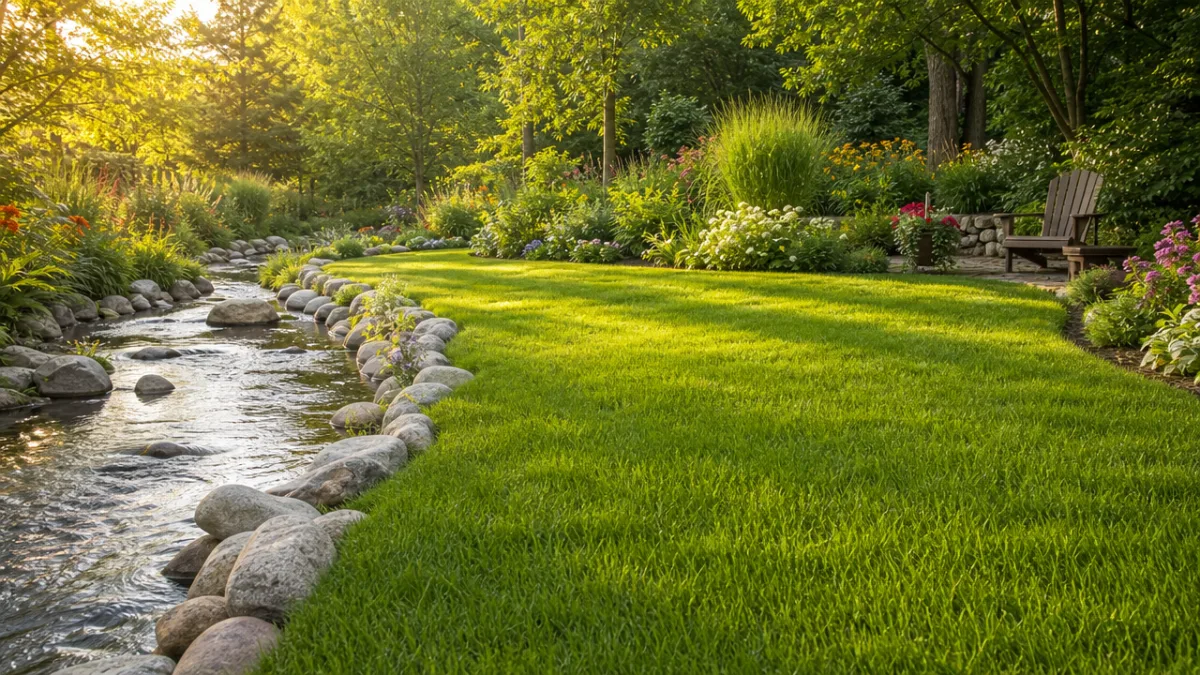
Natural stone edging is one of the oldest and most timeless approaches to defining lawn borders. River rocks, fieldstones, flagstones, and even broken concrete pavers can be arranged along the edge of a lawn to create a border that looks like it has always belonged there. The beauty of natural stone is that it weathers gracefully, developing a patina over time that only improves its appearance. You can often find usable stones on your own property when digging garden beds, making this a truly zero-cost solution in many cases.
For a more formal and structured look, consider using uniform flat stones set slightly below grade to create what landscapers call a mowing strip. When the stones are set at just the right height, your lawn mower can ride over the edge with one wheel, trimming the grass right to the border without any additional hand work. This dramatically reduces the maintenance burden and keeps the edge crisp throughout the entire mowing season. Bluestone, granite, and limestone all work beautifully for this application and can be purchased in bulk from landscape supply yards at reasonable prices.
If you want a softer, more cottage-garden feel, try a loose arrangement of rounded cobblestones or pea gravel contained by a simple border. Stack two or three layers of rounded stones in a gentle curve and pack the gaps with soil to stabilize them. This approach works especially well in informal garden settings where a perfectly straight line would look out of place. You can vary the size and color of the stones to match your home’s exterior palette, creating a cohesive look that ties the entire property together visually.
- River rocks and fieldstones gathered on-site for zero cost
- Flat flagstone mowing strips for reduced maintenance
- Stacked cobblestone borders for cottage-garden charm
- Crushed gravel edging contained by a simple timber rail
- Broken slate pieces set vertically for a jagged, artistic edge
Recycled and Upcycled Edging Solutions
One of the most rewarding categories of cheap lawn edging involves materials that would otherwise end up in the landfill. Old wine bottles, broken terracotta pots, salvaged bricks, reclaimed timber, and even large pinecones have all been used creatively by resourceful gardeners to define lawn boundaries. Not only does this approach cost little or nothing, but it also gives your garden a unique, handcrafted character that mass-produced plastic edging can never replicate. Your neighbors will ask where you found such interesting borders, and you will have a great story to tell.
Wine bottle edging has become particularly popular in recent years, partly because of the striking visual effect and partly because of its utter practicality. You collect empty bottles, dig a shallow trench along your lawn edge, and bury the bottles neck-down at a consistent angle, leaving just the rounded base exposed above the soil line. Green, brown, and clear bottles can be mixed for a rainbow effect, or you can keep to a single color for a more refined look. The glass is surprisingly durable outdoors and will last for many years without fading or degrading.
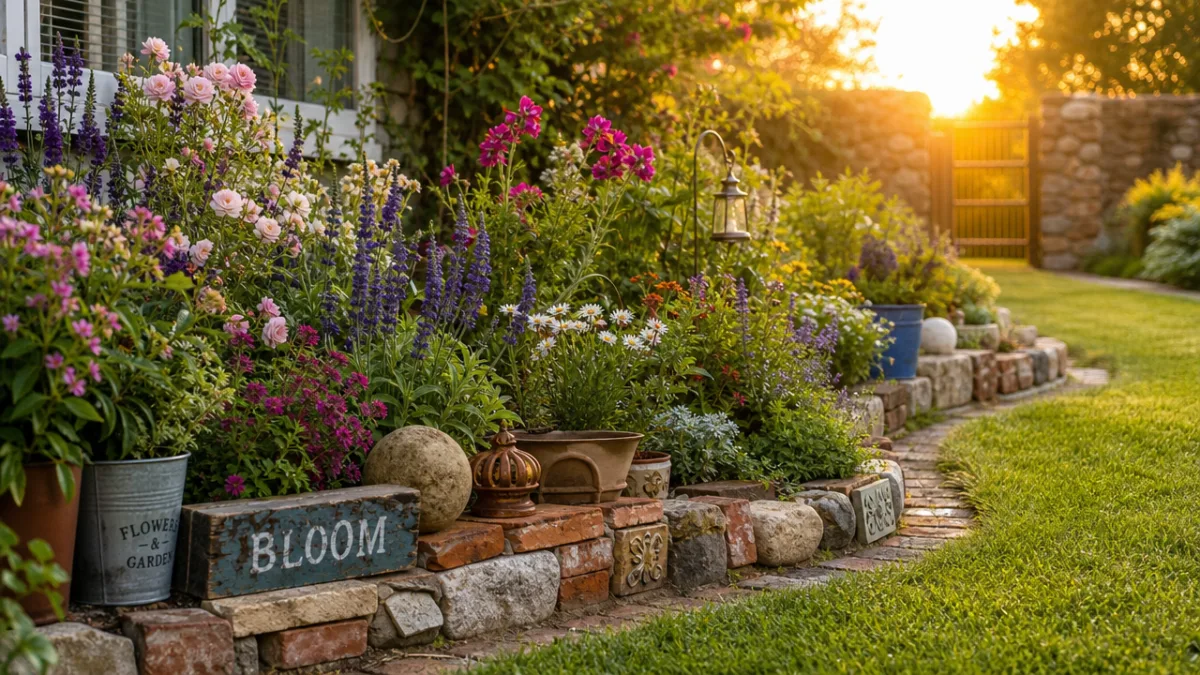
Reclaimed brick is another outstanding upcycled edging material that is both beautiful and long-lasting. Old bricks can often be sourced for free or nearly free from demolition sites, online marketplaces, and neighbors doing renovations. They can be set flat to create a flush mowing edge, stood on end in a soldier course for a taller border, or arranged diagonally in a classic sawtooth pattern that has graced English cottage gardens for centuries. Each of these arrangements has a slightly different visual character, so the same material can be adapted to fit formal, informal, rustic, or contemporary landscapes.
Salvaged timber, including old fence palings, railway sleepers, and driftwood, can be used to create warm, organic edging that blends naturally into a planted landscape. Lay timbers end to end along a curved bed edge, securing them with wooden stakes driven into the soil behind them. For a more rustic look, leave the wood untreated and allow it to weather to a silver-gray that complements almost any planting palette. Treated timbers will last considerably longer but should not be used adjacent to vegetable beds where chemical leaching could be a concern.
Metal and Modern Edging Approaches
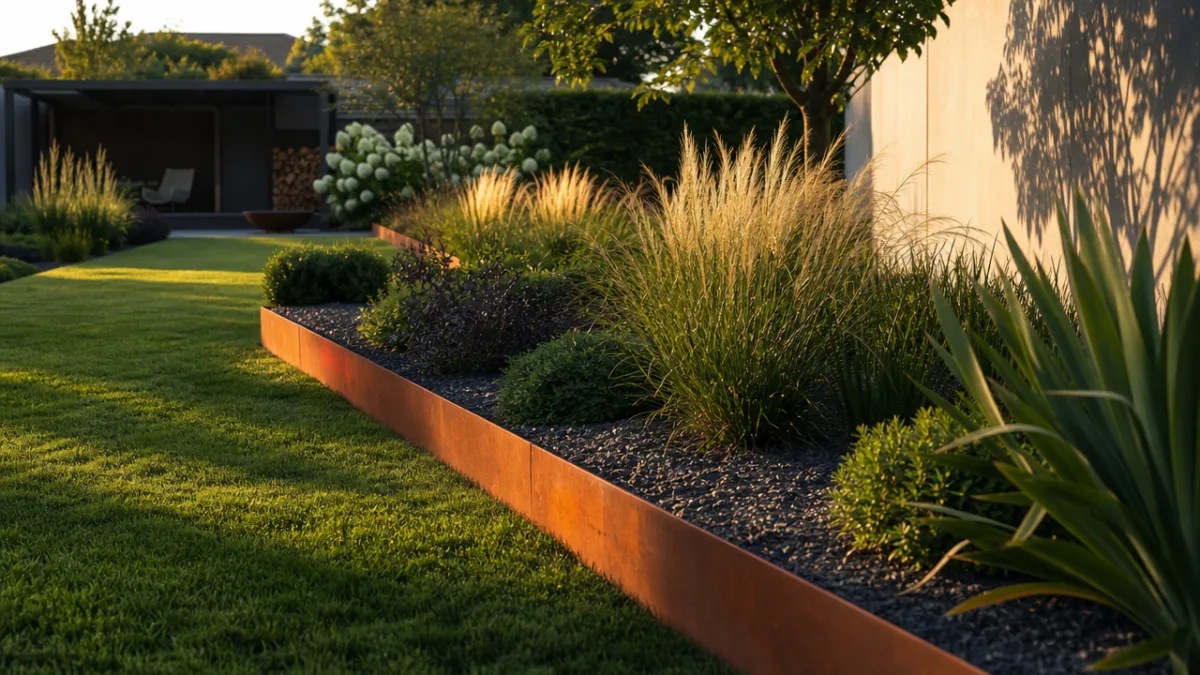
Thin steel and aluminum edging strips have become enormously popular with homeowners who admire the clean, minimalist aesthetic seen in contemporary landscape design. A narrow strip of Corten weathering steel or powder-coated aluminum creates an almost invisible edge that separates lawn from bed without drawing attention to itself. The visual result is a garden that looks architecturally intentional, with grass and planting areas defined by the most elegant possible line. This look has moved from high-end landscape projects into the mainstream, and the materials are now widely available at very reasonable prices.
Corten steel deserves special mention because of the way it develops its famous rust-orange patina over the first few seasons. This oxidized surface layer actually protects the underlying metal from further corrosion, meaning the edging essentially becomes more beautiful and more durable simultaneously as it ages. The warm earthy tones of weathered Corten complement both warm-toned plantings like ornamental grasses and rudbeckia and cool-toned schemes featuring lavender and Russian sage. A single strip of Corten edging can transform the apparent design intent of an entire garden bed.
For an even more affordable metal option, consider repurposing galvanized steel roofing sheets or corrugated iron panels as edging material. These can be cut with tin snips or an angle grinder into strips of the desired height and set into a trench along your lawn edge. The corrugated texture adds visual interest and the galvanized coating provides excellent weather resistance. When left to weather naturally, corrugated iron develops a mottled patina of grays, silvers, and occasional rust tones that suits a relaxed, eclectic garden beautifully. Safety note: be sure to file or fold down any sharp cut edges before installation.
- Corten weathering steel strips for a modern, architectural look
- Powder-coated aluminum edging in black or bronze finishes
- Corrugated galvanized roofing panels cut into edging strips
- Repurposed metal roofing tiles set vertically along bed edges
- Decorative wrought iron border fencing for period properties
- Rolled aluminum flashing from the plumbing supply store
Timber and Landscape Timber Ideas
Timber edging is perhaps the most versatile of all the options available to the budget-conscious homeowner. From basic pressure-treated pine stakes to beautiful hardwood sleepers, wood offers a warmth and naturalism that no other material quite matches. It can be shaped, curved, stained, painted, routed, and carved to suit almost any garden style, and it is widely available at every price point imaginable. With a modest collection of basic woodworking tools, you can create timber edging that looks custom-designed for your specific garden layout.
Landscape timbers, which are typically four-by-four or six-by-six pressure-treated pine sold at home improvement stores, are among the most affordable and practical edging materials available. They can be laid end to end along straight bed edges and secured with rebar stakes driven through pre-drilled holes directly into the ground. For curves, it is better to use a series of shorter timber sections, each angled slightly, to approximate the desired arc. This technique is used by professional landscapers and requires only basic tools and a little patience to achieve a clean, satisfying result.
For a softer, more natural-looking timber edge, consider using split logs or half-rounds. These can often be sourced cheaply or free from tree surgeons and arborists who need to dispose of timber from felled or pruned trees. Set half-rounds vertically in a shallow trench with the flat face pointing toward the lawn, and backfill around them to hold them upright. The curved, natural surface of the log is remarkably attractive, and no two sections are ever exactly alike, giving the edge a handmade quality that manufactured products simply cannot replicate.
Wooden pallet wood is another underutilized edging resource. Pallets are frequently available for free outside warehouses, garden centers, and hardware stores, and their timber, while not the finest grade, is perfectly serviceable for low landscape uses. Disassemble the pallets carefully, remove any protruding nails, and use the planks to create a simple horizontal timber border. Pre-drill the planks to avoid splitting, and connect them with short sections of thicker lumber acting as stakes. A coat of outdoor wood stain in a warm brown or charcoal gray will elevate the look considerably and extend the life of the wood.
Creative and Decorative Edging Concepts
Beyond the practical categories of stone, metal, and timber, there is an entire world of more playful and imaginative lawn edging ideas that reflect the personality and interests of the gardener. Decorative ceramic tiles set vertically, colorful glass insulators strung along a wire, bamboo canes bundled together, terracotta drainage pipes stood on end, and even upturned clay pots have all been used successfully as garden edging. These whimsical approaches work best in cottage gardens, children’s gardens, and informal spaces where a sense of fun and individuality is part of the overall design intent.
Bamboo edging is particularly worth exploring because bamboo is fast-growing, renewable, and extraordinarily strong for its weight. Bundles of bamboo canes can be wired together and set vertically in a trench to create an Asian-inspired border that suits zen gardens, contemporary landscapes, and tropical planting schemes equally well. Alternatively, individual bamboo canes can be pushed into the soil at regular intervals and connected at the top with a length of natural twine, creating a delicate, airy edging that is especially beautiful in evening light when it casts long shadows across the lawn.
Gabion edging, which involves filling wire mesh cages with stones, gravel, or even recycled glass, is a technique borrowed from civil engineering that has found a new life in domestic garden design. Small, low gabion baskets make excellent raised bed edging and can be filled with almost any attractive aggregate material. The wire mesh is relatively inexpensive, and the fill material can be sourced cheaply from landscape suppliers or even gathered from your own property. The result is a chunky, textural border with an industrial edge that looks sophisticated in the right setting and is virtually maintenance-free once installed.
Finally, do not overlook the simple beauty of a well-cut turf edge maintained with a half-moon edging tool. Sometimes the cheapest solution is the best one. A single pass with a sharp edging iron creates a crisp vertical cut that defines the lawn boundary with absolute precision. Pair this with a v-shaped channel that prevents soil from washing back onto the lawn surface, and you have an edging solution that costs only the price of one tool and a bit of weekend effort. Regular maintenance three or four times per season will keep the edge looking sharp, and the cut turf can be composted or used to patch bare spots elsewhere in the lawn.
- Decorative ceramic tiles set on edge for a Mediterranean feel
- Bundled bamboo canes wired together in a Japanese-inspired border
- Low gabion baskets filled with colored gravel or recycled glass
- Terracotta drainage pipes stood vertically as a quirky border
- Hand-cut turf edge maintained with a half-moon edging iron
- Upturned colored bottles arranged mouth-down in a sandy trench
- Woven willow or hazel hurdles as flexible curved edging
Installation Tips and Long-Term Maintenance
No matter which edging material you choose, the quality of your installation will determine how long it lasts and how good it looks over time. Begin by marking out your desired edge line using a garden hose for curves or a taut string line for straight sections. Walk around the layout and view it from multiple angles before committing to digging, because edges that look right from one vantage point can appear awkward from another. Taking ten extra minutes at this planning stage will save you from having to redo work later and ensures you end up with an edge line that flows naturally through your garden.
Digging the installation trench is the most physically demanding part of the job, but the effort is well worth it. A flat spade or edging spade is ideal for cutting a clean vertical wall in the soil. For most edging materials, a trench depth of four to six inches is sufficient to anchor them securely and prevent movement over winter freeze-thaw cycles. Line the trench with landscape fabric if you are concerned about weeds migrating under the edging, and always backfill firmly, tamping the soil down in layers rather than all at once to avoid air pockets that cause settling.
Once your edging is installed, a consistent maintenance routine will keep it looking its best season after season. Inspect the entire edge at the beginning of each growing season for sections that have heaved out of the ground, tilted, or been displaced by tree roots. Most minor shifts can be corrected easily with a rubber mallet and a bit of additional backfill. Trim grass growing over the edge regularly using either a rotary edge trimmer or a pair of long-handled edging shears, and clear away any accumulated soil or mulch that begins to bury the edging material. With this modest level of attention, even the most budget-friendly edging will remain attractive and functional for many years.
Seasonal mulching is another practice that both complements your lawn edging and reduces the overall maintenance burden of your garden. A two-to-three inch layer of organic mulch applied inside the edging each spring suppresses weed growth, retains soil moisture, moderates soil temperature, and gives garden beds a clean, finished appearance that makes the edging look even more intentional and polished. As the mulch breaks down over the season, it adds organic matter to the soil and improves its structure, benefiting the plants growing in the bed. Bark chips, shredded leaves, and composted wood chips are all excellent and inexpensive mulch choices that can be sourced locally at very low cost.








What do you think?
It is nice to know your opinion. Leave a comment.