










Hexagon Crochet Cardigan Pattern: Your Complete Guide to the Oversized Boho Granny Square Sweater
There is something undeniably magical about a garment that starts as a collection of small, geometric motifs and slowly transforms into a wearable piece of art. The hexagon crochet cardigan is exactly that kind of project — a deeply satisfying, meditative craft experience that rewards patience and creativity with a stunning, oversized boho sweater you will reach for season after season. Whether you are a seasoned crocheter looking for your next meaningful project or an intermediate maker ready to level up your skills, this pattern offers the perfect blend of structure and creative freedom.
Rooted in the beloved granny square tradition but elevated through its hexagonal geometry, this cardigan has become one of the most sought-after patterns in the modern crochet community. It bridges the gap between vintage handcraft aesthetics and contemporary fashion sensibilities, producing a garment that feels both nostalgic and entirely current. The flowing silhouette, the rich texture of joined motifs, and the infinite possibilities for color play make it a project that truly reflects its maker’s personality and vision.
This comprehensive guide will walk you through every aspect of the hexagon crochet cardigan pattern — from understanding the materials you need, to mastering the hexagon motif itself, to joining your pieces and finishing your sweater with professional polish. By the time you finish reading, you will have all the knowledge you need to download your PDF pattern and cast on your hook with confidence.
Understanding the Hexagon Motif: The Heart of the Design
The hexagon is one of nature’s most efficient shapes, appearing in honeycomb structures, snowflakes, and organic cell formations. In crochet, it offers a uniquely satisfying geometry that tiles together with elegant precision, creating flat, even fabric when motifs are joined correctly. Unlike the traditional granny square, the hexagon’s six sides allow for more organic, rounded seaming that drapes beautifully across the body, making it an ideal foundation for a flowing cardigan silhouette. Understanding why this shape works so well is the first step toward appreciating the pattern’s clever construction.
Each individual hexagon in this cardigan pattern is worked in rounds from the center out, much like a classic granny square. The center typically begins with a magic ring or a small chain loop, from which the first round of stitches radiates outward. Subsequent rounds build on this foundation, adding increases at each of the six corners to maintain the flat, hexagonal shape. Depending on the yarn weight and hook size you choose, each finished motif might measure anywhere from three to five inches across, and the number of motifs required for a complete cardigan ranges from approximately forty to over one hundred, depending on your desired size.
What makes the hexagon particularly compelling as a design element is its versatility. You can work every single motif in the same yarn colorway for a tonal, textural effect, or you can embrace the full boho spirit and use a scrappy, stash-busting approach that incorporates dozens of different colors and fiber types. The geometry holds the design together even when the color palette is wildly varied, giving you visual coherence without sacrificing creative expression. Many makers find that planning their color layout in advance — even loosely — helps them achieve a balanced, harmonious finished garment.
Materials and Tools: Setting Yourself Up for Success
Choosing the right materials for your hexagon cardigan is one of the most important decisions you will make, and it is worth spending some time thinking through your options before you begin. The yarn you select will dramatically influence the drape, warmth, and overall feel of the finished garment. For an oversized boho cardigan intended for three-season wear, a medium-weight worsted or DK yarn in a natural fiber blend tends to produce the best results. Wool, cotton-wool blends, and alpaca-acrylic combinations all have excellent stitch definition and create motifs with crisp, well-defined edges that join cleanly.
Your hook size should correspond to your yarn weight and your personal tension. Most worsted-weight patterns for this style of cardigan call for a 5mm or 5.5mm hook, though some makers prefer to go up a half size to achieve a more relaxed, open fabric with beautiful drape. It is always worth crocheting a gauge swatch before beginning — not just to check your stitch count, but to evaluate how the fabric feels in your hands and whether the drape meets your expectations. A hexagon motif makes an ideal gauge swatch because you can measure it directly and compare it to the pattern’s stated dimensions.
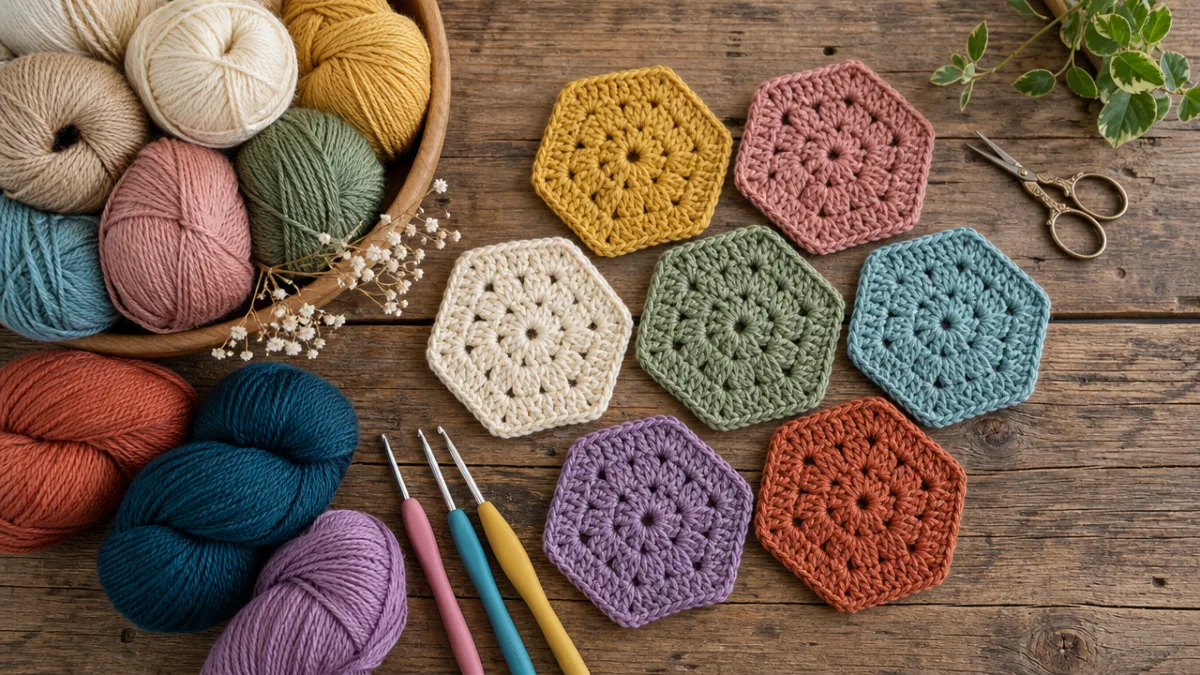
Beyond yarn and hook, you will want to gather a few essential tools before starting your project. A set of locking stitch markers will help you keep track of your rounds and corners as you work each motif. A large-eyed blunt tapestry needle is indispensable for weaving in the many ends that come with a multi-motif project — and trust that there will be many ends. Scissors, a tape measure, and blocking mats or foam squares complete your toolkit. Blocking is especially important for hexagon motifs; a thorough wet block after joining can transform slightly uneven, curling pieces into perfectly flat, professional-looking fabric.
- Yarn: Worsted or DK weight in wool, cotton blend, or alpaca-acrylic; approximately 800–1400 yards depending on size
- Hook: 5mm or 5.5mm crochet hook (or as needed to match gauge)
- Tapestry needle: Large-eyed blunt needle for seaming and weaving ends
- Stitch markers: Locking type, at least 12 for tracking corners and rounds
- Blocking supplies: Foam mats, rust-proof pins, and a spray bottle or basin for wet blocking
- Scissors and tape measure: For regular use throughout the project
Reading the Pattern: Construction Methods and Sizing
One of the most appealing things about the hexagon crochet cardigan pattern is its modular construction, which means the sweater is built motif by motif rather than worked in one continuous piece. This approach has several significant advantages for the maker. First, it makes the project highly portable — you can work on individual hexagons anywhere, from your living room couch to a long commute, without carrying the entire garment in progress. Second, it allows you to lay out completed motifs before joining and adjust your design on the fly, ensuring you are happy with the color placement before committing to permanent seams.
The PDF pattern typically includes multiple sizing options, ranging from small to 5XL, making it genuinely size-inclusive. Sizing in a modular garment like this is achieved by adjusting the number of hexagons used and their arrangement, rather than by changing stitch counts within individual motifs. The pattern will provide a schematic diagram showing how the hexagons are arranged for each size, along with the total motif count required. Taking your own body measurements — particularly your bust, hip, and desired length — and comparing them to the finished garment measurements in the pattern is the most reliable way to choose your size.
There are also typically two or three methods available for joining your hexagons, and the pattern will explain each one clearly. The flat slip-stitch join and the join-as-you-go method are both popular choices. The slip-stitch join creates a visible ridge on the right or wrong side of the fabric, depending on how you orient your work, and many makers consider this ridge a desirable decorative detail. The join-as-you-go method attaches each new motif to its neighbors while the final round is still being worked, eliminating the need for a separate seaming stage entirely and saving a significant amount of time on large projects.
Step-by-Step: Working Your Hexagon Motifs
Working your first hexagon motif is a revelatory experience, especially if you have primarily worked in rows or seamless rounds before. Begin by making a magic ring — or, if you prefer a closed center, a chain-four loop joined into a ring. The first round establishes the six-sided structure by working a set number of stitches into the ring, typically twelve double crochets or a combination of chains and double crochets that creates six distinct anchor points for the corners. This first round is the smallest and the most important because it sets the geometry for every subsequent round.
Each following round increases the motif’s diameter by working additional stitches into the sides between corners and corner increases at each of the six points. A classic corner increase in a hexagon motif usually consists of two double crochets, a chain two, and two more double crochets — the chain-two space creates a visible corner angle and provides the joining point when motifs are seamed together. Rounds three and four continue this expansion, with the sides growing longer between corners while the overall hexagonal shape remains crisp and geometric. By the time you complete your fourth round, you will have a satisfying, well-defined hexagon ready to block and join.
Finishing each motif well before moving on is a habit that will serve you throughout the project. Weave in your ends as you go rather than leaving them all until the end — this distributes the tedious task across the entire project timeline and prevents an overwhelming pile of loose ends at the finish line. If you are working in multiple colors, consider the order in which you introduce each color within a motif, as this affects both the visual result and the number of ends you will need to manage. Some makers use a principle of no more than three colors per hexagon to keep the design readable and the end-weaving manageable.
- Make a magic ring or foundation chain loop to begin the center of your hexagon.
- Work Round 1 to establish the six anchor points of the hexagonal structure.
- Complete Rounds 2–4, working corner increases and side stitches as instructed.
- Fasten off and weave in all ends securely before blocking the motif flat.
- Wet block each motif by pinning it to measurements on foam mats and allowing it to dry completely.
- Repeat until you have the full quantity of motifs required for your chosen size.
Joining and Assembly: Bringing the Cardigan Together
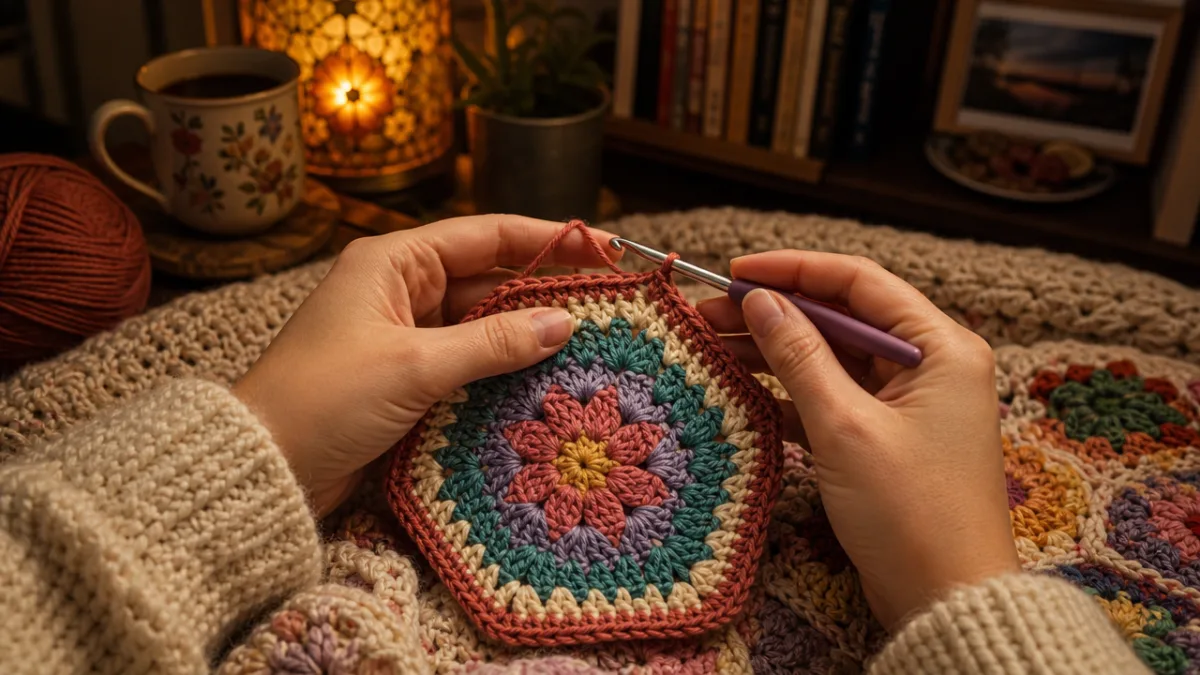
The assembly stage is where your collection of individual hexagons transforms into a recognizable garment, and it is a moment of genuine excitement in the project. Before you begin joining, lay all of your completed, blocked motifs out on a flat surface and arrange them according to the schematic provided in your PDF pattern. Take time at this stage to finalize your color arrangement, move motifs around until you are satisfied with the visual balance, and photograph the layout so you have a reference point as you work through the joining process. This preparation pays dividends in a more cohesive finished design.
The cardigan’s body is typically constructed by joining a rectangular or slightly shaped field of hexagons for the back, then two smaller panels for the fronts, and finally rectangular strips or additional hexagon rows for the sleeves. The pattern will specify the exact number of motifs across and down for each section, as well as how the sections are assembled relative to each other. Some patterns join all the body hexagons first and then pick up stitches or add hexagon rows for the sleeves; others have you work the sleeve tubes separately and seam them into armhole openings created within the body layout.
Once all your sections are joined, the finishing details elevate the cardigan from homemade to handcrafted. A neat border worked around the front edges and hem in single crochet or reverse single crochet stabilizes the edges and provides a polished frame for the garment. Sleeve cuffs can be finished with ribbing worked in rows or rounds, adding a touch of structure that contrasts pleasingly with the organic texture of the hexagon body. Button bands, if your version of the pattern includes them, are typically worked along the front opening edges, and the pattern will specify button spacing and the number and size of buttons required.
Styling and Wearing Your Hexagon Cardigan
One of the great joys of completing a handmade garment is discovering the many ways it can be worn and integrated into your existing wardrobe. The oversized boho hexagon cardigan is extraordinarily versatile — its relaxed silhouette and textural richness make it a statement piece that can be dressed up or down depending on context. For a casual weekend look, layer it open over a simple fitted tee and high-waisted denim jeans, allowing the cardigan’s length and the visual interest of the hexagon patterning to take center stage against a neutral backdrop.
For cooler weather, the cardigan works beautifully as an outer layer over lightweight sweaters or long-sleeved tops, adding warmth without bulk thanks to the open structure of the crocheted fabric. Belting the cardigan at the waist with a wide leather or fabric belt creates an entirely different silhouette — more defined and intentional — that works especially well for transitional autumn days when you want the look of a coat without full outerwear weight. Wearing it closed with a single large button or a decorative pin at the neckline is another elegant option that softens the bohemian aesthetic toward something more polished.
Color choice plays a crucial role in how your finished cardigan will style. A cardigan worked in earthy, muted tones — terracotta, sage, cream, and rust — will feel deeply bohemian and organic, pairing naturally with linen, denim, and natural leather. A version made in jewel tones — sapphire, emerald, and plum — takes on a more vibrant, eclectic character that can be the centerpiece of a maximalist outfit. And a tonal, single-color cardigan in a neutral like camel, oatmeal, or slate reads as surprisingly modern and minimalist, despite the handcrafted nature of the construction. The pattern is truly a blank canvas.
- Style open over a fitted tee and wide-leg trousers for an effortless daytime look
- Belt at the waist to create definition and a more structured silhouette
- Layer over a turtleneck in autumn for warmth with bohemian texture
- Pair with maxi skirts or flowy dresses for a festival-inspired ensemble
- Wear as a beach cover-up over a swimsuit during warm evenings
- Close with a large decorative pin or vintage brooch for a polished finish

Tips for Customizing Your Pattern and Troubleshooting Common Issues
One of the most satisfying aspects of working from a PDF hexagon cardigan pattern is the creative latitude it offers for customization. While the pattern provides a complete, tested design with specific stitch counts and motif arrangements, experienced crocheters will recognize the many points at which personal choices can personalize the outcome. The most obvious customization opportunity is color — whether you choose a strictly planned palette with precise color placement or a spontaneous scrap-yarn approach, your color decisions will make the garment uniquely yours. Spending time with a digital color palette tool or simply laying physical yarn skeins together before beginning can help you visualize the finished result.
Beyond color, you can customize the texture of your motifs by choosing different stitch patterns for the rounds. Replacing standard double crochets with half double crochets creates a slightly denser, warmer fabric. Adding a round of shell stitches or puff stitches to the border of each hexagon before joining creates a more elaborate, ornate look. Some makers replace the final round of each hexagon with a different yarn — perhaps a coordinating metallic thread or a contrasting solid color — to create defined outlines around each motif that emphasize the geometric pattern from a distance.
Troubleshooting is an inevitable part of any substantial crochet project, and it is helpful to anticipate the most common issues before they arise. Motifs that cup or dome rather than lying flat are usually caused by working with too tight a tension or using too small a hook — try going up half a hook size and reworking your swatch. Gaps or holes at joining points can result from inconsistent tension during seaming; practicing your join method on a few spare motifs before working on your actual garment pieces will help you find a consistent rhythm. If your finished cardigan seems shorter than expected, recheck your motif dimensions against the pattern’s stated measurements and remember that proper blocking can add as much as half an inch to each motif’s diameter.
Finally, remember that the PDF pattern format has distinct advantages over printed patterns that are worth leveraging fully. Zoom in on schematic diagrams to study the assembly layout in detail. Print multiple copies of pages you will refer to frequently and annotate them with your own notes, stitch counts, and color codes. Many PDF patterns include hyperlinks to video tutorials for specific techniques — take advantage of these resources, particularly for the join-as-you-go method or any special stitch patterns that are new to you. The investment in truly understanding your pattern before you begin will save you significant time and frustration throughout the project and will help ensure that your hexagon crochet cardigan becomes the gorgeous, wearable heirloom piece it is meant to be.








What do you think?
It is nice to know your opinion. Leave a comment.