










15+ Best Shrubs To Plant In Fall For Winter Color
Why Fall Is the Ideal Time to Plant Shrubs for Winter Interest
Most gardeners think of fall as a time to wind down and put the garden to bed, but seasoned horticulturalists know it is one of the best planting windows of the entire year. When you plant shrubs in fall, the soil is still warm from summer’s heat, which encourages root development even as air temperatures begin to cool. This head start means your shrubs will be far better established by the time winter arrives, giving them the strength and resilience to survive cold snaps and produce their best winter display.
Another compelling reason to plant in fall is reduced transplant stress. Summer heat is brutal on newly installed plants, forcing them to juggle root establishment while simultaneously trying to survive scorching temperatures and rapid soil moisture loss. In fall, cooler air temperatures dramatically reduce water demands on foliage, allowing the plant’s energy to be directed entirely underground where it matters most. You will spend less time watering, lose fewer plants to transplant shock, and enjoy healthier results with far less effort.
Beyond the practical benefits, planting shrubs in fall with winter color in mind is a form of garden design that rewards patience and thoughtfulness. A well-planned winter garden featuring shrubs with colorful bark, persistent berries, fragrant blooms, or striking evergreen foliage transforms what many consider a dead season into a vivid, living landscape. When neighbors walk past your home in January and February, your garden can still be a source of beauty and interest rather than a gray, forgotten space waiting for spring.
Shrubs With Brilliant Winter Berries
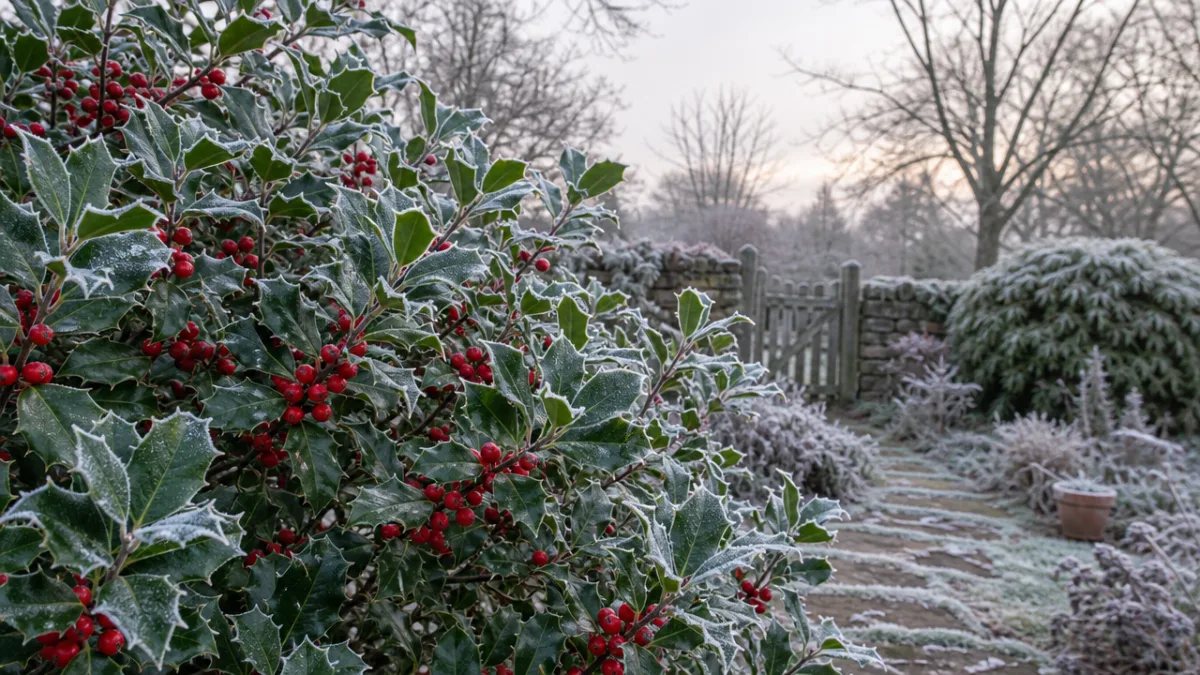
Few garden features capture the magic of winter quite like a shrub laden with colorful berries set against a backdrop of snow or frost. Holly, perhaps the most iconic of all winter berry shrubs, comes in dozens of varieties suited to nearly every climate zone. American holly (Ilex opaca) and inkberry holly (Ilex glabra) both offer glossy green foliage year-round and produce striking red or black berries that persist well into winter, providing essential food for birds and visual drama for gardeners.
Winterberry holly (Ilex verticillata) deserves special recognition because it is deciduous, which means the branches are completely bare in winter, leaving only a spectacular coating of brilliant red or orange berries on every twig. Planted in groups or used as a bold focal point, winterberry can stop passersby in their tracks. Varieties like ‘Winter Red,’ ‘Sparkleberry,’ and ‘Maryland Beauty’ are especially prolific producers. Remember that most hollies require both male and female plants to produce fruit, so always plant at least one male pollinator nearby.
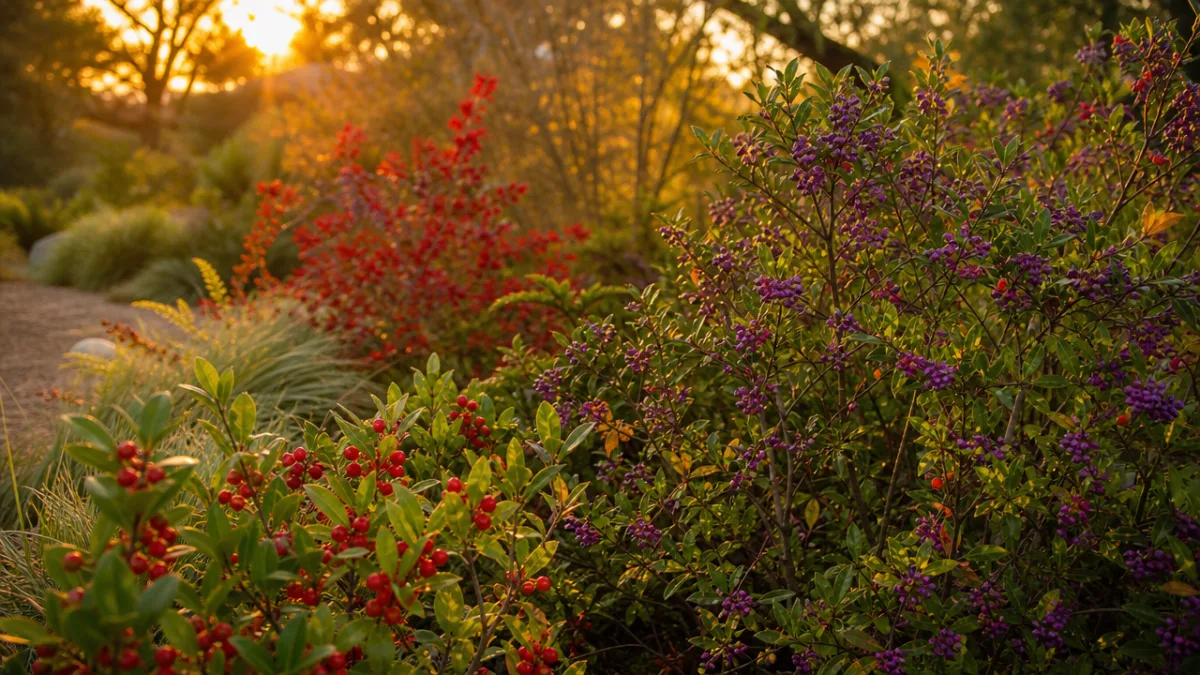
Beautyberry (Callicarpa) is another outstanding choice, producing clusters of vivid purple or white berries that hug the arching stems in a way that looks almost artificial in its brilliance. American beautyberry (Callicarpa americana) is native, vigorous, and surprisingly cold-hardy. Nandina, sometimes called heavenly bamboo, rounds out this category beautifully, offering bright red berry clusters that glow against its fine-textured, semi-evergreen foliage. Many newer nandina cultivars are compact and non-invasive, making them excellent choices for modern landscapes.
Shrubs With Colorful Winter Bark and Stems
When leaves fall and berries have been eaten by hungry birds, the structural bones of the garden come into sharp focus. This is the moment when shrubs with colorful bark truly shine, painting the winter landscape with warm reds, vivid yellows, brilliant oranges, and ghostly whites. Planting these types of shrubs in fall means they will be well-rooted by winter, ready to put on their most vibrant display during the coldest and darkest months of the year.
Red-twig dogwood (Cornus sericea) is arguably the most popular shrub for winter stem color, and for very good reason. Its young stems glow a deep, saturated crimson that intensifies in cold weather and looks spectacular against snow. The key to maximizing color is aggressive pruning in late winter or early spring, since the most vibrant color always appears on new growth. Varieties like ‘Cardinal,’ ‘Baileyi,’ and ‘Artic Fire’ offer varying shades from brick red to deep scarlet. Yellow-twig dogwood (Cornus sericea ‘Flaviramea’) provides a glowing golden complement that pairs beautifully with its red cousin.
Siberian dogwood (Cornus alba) offers some of the most electric stem color available, with varieties like ‘Sibirica’ producing stems so intensely red they appear almost to be lit from within. For something more unusual, consider the paperbark maple or the ornamental brambles in the genus Rubus, which produce white or ghost-blue stems covered in a powdery waxy bloom. Shrub willows like Salix alba ‘Britzensis’ offer orange-red stems that are especially dramatic in mass plantings along water features or in rain gardens where moisture-loving habits are a benefit rather than a liability.
Evergreen Shrubs for Winter Structure and Color
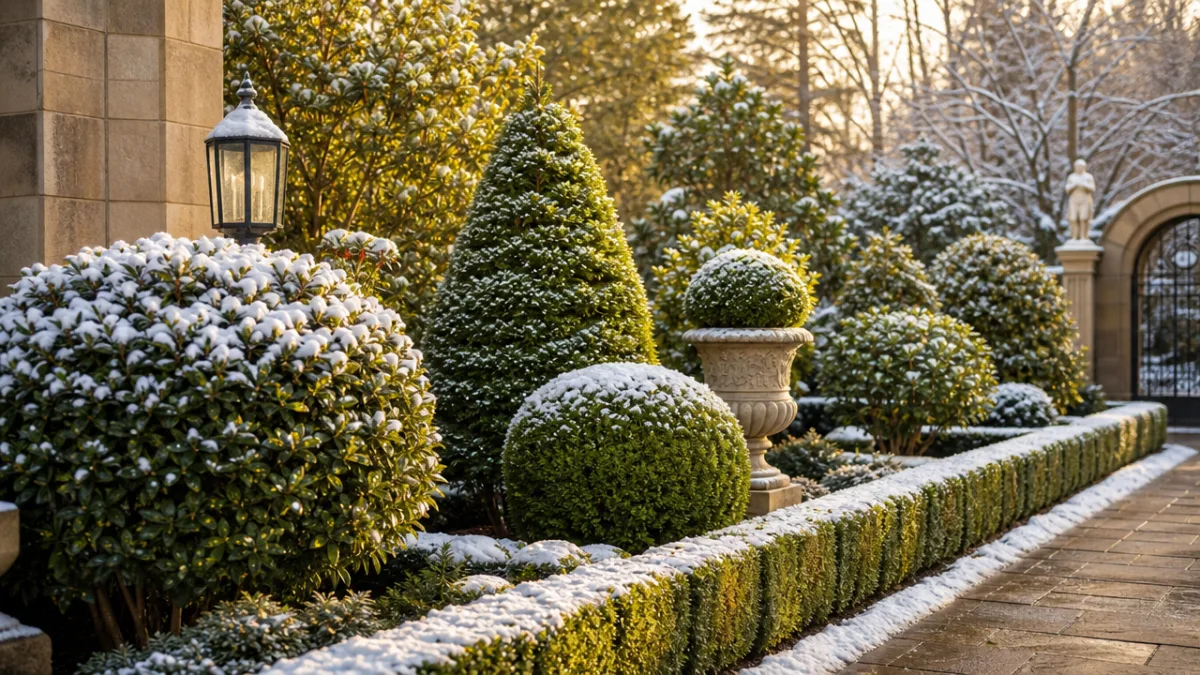
Evergreen shrubs are the backbone of any successful winter garden. They provide year-round structure, privacy, and greenery that anchors the landscape when everything else has gone dormant. Planted in fall, evergreens have the entire winter to quietly establish their root systems, emerging in spring ready to grow vigorously. The range of textures, colors, and forms available in evergreen shrubs is truly remarkable, from the fine needle-like foliage of junipers to the broad, glossy leaves of mountain laurels.
Leucothoe, particularly the variety ‘Scarletta’ or ‘Rainbow,’ is a shade-tolerant evergreen whose foliage undergoes a dramatic transformation in cold weather, shifting from deep green to rich burgundy, bronze, and red-purple tones that deepen throughout winter. It is an outstanding choice for shaded gardens where other colorful plants struggle to survive. Oregon grape holly (Mahonia aquifolium) is another exceptional performer, offering bold, holly-like foliage that bronzes beautifully in winter and produces fragrant yellow flowers even in the coldest months, followed by blue-black berries in spring.
Pieris japonica, boxwood, and broadleaf evergreens like cherry laurel and aucuba provide essential structural greenery, but for truly standout winter color, look to variegated and gold-foliaged forms. Aucuba japonica ‘Picturata’ or ‘Gold Dust’ offers glossy green foliage heavily spotted with gold that lights up shady corners even on the dullest winter days. Dwarf mugo pine and compact Alberta spruce provide year-round interest with minimal maintenance, while ornamental grasses, though technically not shrubs, can serve as excellent companions that add movement and warmth in tawny golds and wheats.
Winter-Blooming Shrubs That Defy the Cold
The idea of a shrub blooming in winter seems almost magical, yet several remarkable species do exactly that, pushing out fragrant or colorful flowers during the coldest and most inhospitable months of the year. These winter bloomers represent some of the most rewarding plants a gardener can add to their landscape, because their flowers arrive when we least expect them and provide a psychological lift that no summer bloomer can quite replicate. Planting them in fall gives them the best possible start before their extraordinary winter performance begins.
Witch hazel (Hamamelis) is perhaps the most celebrated of all winter-blooming shrubs. Its spidery, ribbon-like flowers in shades of yellow, orange, copper, and red emerge on bare branches from January through March, depending on variety and climate, often pushing through snow and ice without damage. The fragrance of witch hazel in winter is intoxicating and carries surprising distances on cold, still air. Varieties like ‘Jelena,’ ‘Arnold Promise,’ and ‘Diane’ are especially acclaimed for their rich color and outstanding fall foliage, making them genuinely four-season plants of extraordinary garden value.
Wintersweet (Chimonanthus praecox) produces pale yellow, waxy flowers on bare stems with a perfume so intense that a single shrub can scent an entire garden. It requires a warm, sheltered wall to perform at its best in colder climates but rewards patient gardeners handsomely. Daphne (Daphne odora or Daphne bholua) is another treasure, blooming from midwinter into early spring with clusters of pink or white flowers whose fragrance is legendary among plant enthusiasts. While daphnes have a reputation for occasional sudden death, the right site — well-drained, slightly alkaline soil in a sheltered but not overly hot location — produces reliable, long-lived specimens of breathtaking beauty.
Native Shrubs for Winter Wildlife and Color
Choosing native shrubs for winter color delivers a double benefit: you get the visual rewards of colorful berries, bark, and structure while simultaneously providing critical habitat and food sources for birds, small mammals, and overwintering insects. Natives are inherently adapted to local climate conditions, meaning they require less water, fewer inputs, and far less maintenance than exotic alternatives. Planted in fall, they establish quickly and begin contributing to the local ecosystem almost immediately, making them both a garden investment and an ecological one.
Spicebush (Lindera benzoin) is a wonderful native shrub that produces brilliant scarlet berries in fall that birds adore, glossy aromatic leaves that turn golden yellow in autumn, and attractive yellow flowers in very early spring. It is the host plant for the spicebush swallowtail butterfly, adding another layer of wildlife value. Possumhaw (Ilex decidua) is a deciduous native holly whose branches drip with orange or red berries that persist through winter, providing emergency food for fruit-eating birds like cedar waxwings, mockingbirds, and robins during the leanest months of the year.
Buttonbush (Cephalanthus occidentalis) and native viburnums like blackhaw (Viburnum prunifolium) and arrowwood (Viburnum dentatum) round out an excellent native palette for winter interest. Viburnums produce clusters of blue-black or red fruit that persist well into winter while their foliage turns stunning shades of burgundy, maroon, and deep red in autumn. For a comprehensive winter garden that supports both human appreciation and wildlife needs, incorporating a thoughtful selection of native shrubs is not merely a good idea — it is a responsibility that pays dividends for decades to come.
Planting Tips and Care for Fall-Installed Shrubs
Success with fall-planted shrubs begins with proper site preparation and planting technique. Dig a hole that is two to three times as wide as the root ball but no deeper than its height — planting too deep is one of the most common and damaging mistakes gardeners make. The extra width encourages roots to spread outward into loosened soil, establishing faster and more efficiently than they would in a narrow, deep hole. Always check that the root flare, the point where the trunk begins to widen at its base, sits at or slightly above the surrounding soil grade.
Mulching is particularly important for fall-planted shrubs, as it moderates soil temperature fluctuations that can heave roots out of the ground during freeze-thaw cycles. Apply two to three inches of organic mulch such as shredded bark, wood chips, or pine needles in a wide circle around each shrub, keeping mulch pulled a few inches away from the stems to prevent rot and rodent damage. This layer of insulation will maintain more consistent soil temperatures, conserve moisture, and slowly improve soil structure as it decomposes over the coming months and years.
Watering newly planted shrubs through fall is essential even as temperatures cool, since roots need adequate moisture to grow and establish before the ground freezes. Water deeply and infrequently rather than shallowly and often, encouraging roots to follow moisture downward into the soil profile rather than staying near the surface. In most regions, fall rains will reduce the need for supplemental irrigation, but during dry spells, continue watering until the ground is consistently frozen. A good rule of thumb is to water until the first hard freeze that keeps the ground solidly frozen overnight, then let winter take over.
- Plant during mild, overcast days to minimize transplant stress and moisture loss through foliage.
- Test soil drainage before planting by filling the hole with water and watching how quickly it drains — most shrubs require water to drain within an hour.
- Avoid heavy fertilization in fall as this encourages tender new growth that will be damaged by frost; wait until spring for any significant feeding.
- Stake only if absolutely necessary in very windy sites, and remove stakes after the first growing season to allow natural trunk development and root anchorage.
- Choose the right plant for the right place by matching the mature size, light requirements, and moisture needs of each shrub to its intended location before planting.
One final consideration when planting shrubs for winter color is to think in combinations rather than single specimens. A planting scheme that layers red-berried hollies behind golden witch hazel in front of a backdrop of dark evergreen boxwood creates depth, contrast, and sustained visual interest throughout the winter months. Adding a clump of red-twig dogwood in the foreground and a groundcover of spreading junipers at its feet turns a simple shrub bed into a winter garden of genuine sophistication. Fall is the perfect time to think ahead and plant with intention, knowing that the quiet months of root establishment will be rewarded with a winter landscape that genuinely thrives.








What do you think?
It is nice to know your opinion. Leave a comment.