










DIY Pallet Furniture: 9 Patio Projects That Look Store-Bought
Why Pallets Are the Ultimate Patio Building Material
If you’ve ever browsed outdoor furniture and nearly choked at the price tags, you know the feeling. A single patio sectional can easily run $800 to several thousand dollars — and that’s before you add cushions, side tables, or a coffee table. Wooden pallets are a genuinely great alternative. They’re easy to find, often free or close to it, and surprisingly capable when you know what to do with them.
Here’s something most people don’t realize: pallets are actually built tough. They’re engineered to haul heavy loads through warehouses and shipping yards, which means the wood is dense, solid, and made to take a beating. When you sand, seal, and style one, you’re not just slapping scrap wood together — you’re turning a piece of industrial equipment into something that could genuinely turn heads in a magazine spread.
There’s also something personally satisfying about building your own outdoor space. Furniture you made yourself tells a story. It reflects your taste and your creativity in a way that nothing off a showroom floor ever will. Whenever guests find out that comfortable sofa they’re sitting on was built from salvaged pallets, the reaction is almost always the same — genuine surprise and admiration. The projects in this article are designed to look polished and intentional, because with a little care and patience, they really are.
Sourcing and Preparing Your Pallets the Right Way
Before you pick up a single tool, you need to find the right pallets — and this part actually matters for your health. Not all pallets are safe to use at home. Look for ones stamped with “HT,” which stands for heat-treated. That means they were sanitized with heat, not chemicals. What you want to avoid is anything stamped “MB,” which indicates methyl bromide treatment. That’s a pesticide, and it’s not something you want anywhere near your family or your living space.
Hardware stores, garden centers, furniture retailers, and grocery distribution warehouses are all solid places to look. A lot of businesses actually pay to have pallets hauled away, so they’re often thrilled when someone offers to take them for free. Craigslist and Facebook Marketplace are great too — you can often find people offloading large quantities at once. When you’re picking pallets, look for ones that are dry, structurally sound, and free of oil stains, paint, or anything questionable. The cleaner the pallet going in, the smoother your project will go.
Once you’ve got your pallets home, preparation is everything. Sand every surface — start with 60 or 80 grit to knock out splinters and rough patches, move up to 120 grit for smoothness, then finish with 220 for a near-polished feel. After sanding, wipe everything down with a damp cloth and let it dry completely before applying a good outdoor wood sealer or stain. This is the step most beginners skip, and it’s the one that makes all the difference. Done right, it’s what takes your project from “lasts a season” to “lasts a decade.”

Project 1 through 3: Seating Solutions That Anchor Your Space
Every great patio starts with seating, and pallets are a natural fit for the kind of low, modular furniture that’s been everywhere in outdoor design lately. The first project to try is a basic pallet sofa base. Stack two pallets, screw them together, add hairpin legs or simple wooden block feet, and top it with a foam cushion wrapped in outdoor fabric. The finished product looks remarkably close to something from a Pottery Barn catalog — at a tiny fraction of the cost.
For a second seating option, try building a pallet armchair. You’ll cut one pallet down into a back panel and two narrower arm pieces, then use a second pallet as the seat. The joinery is simple — pocket screws and wood glue handle it easily — but the finished shape is genuinely furniture-quality. Paint it something bold like navy or forest green, add a plump cushion, and you’ve got an outdoor accent chair that looks completely intentional.
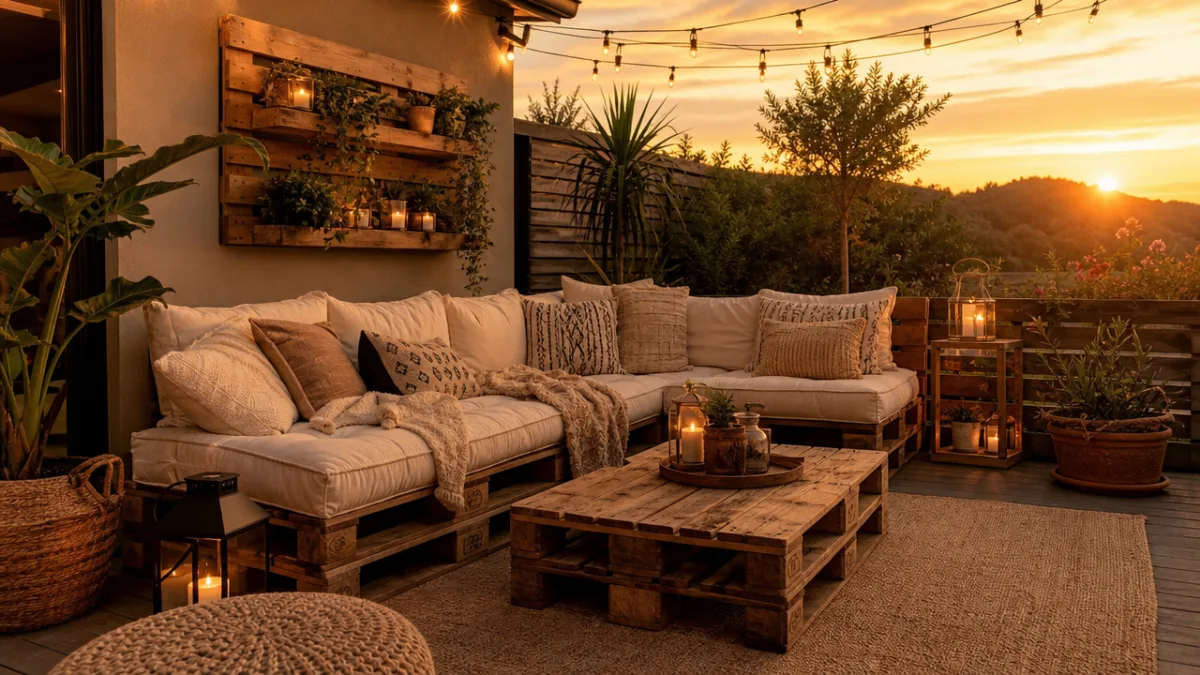
The third project is a pallet sectional, which is honestly the most impressive thing you can build for the money. The idea is to construct individual seat modules — each roughly 40 inches square — that you can arrange and rearrange however your patio layout calls for. Add corner pieces, an ottoman module, and a cohesive cushion setup, and you’ve got a fully custom outdoor sectional. Designers charge thousands for arrangements like this. You can build a four-piece version for under $150 in materials, not counting cushions.
Project 4 through 6: Tables and Surfaces That Do the Heavy Lifting
Every seating area needs somewhere to set a drink, a book, or a candle. Pallets work incredibly well for tables — their flat surface is basically already halfway there, and the slatted structure can be filled in or left open depending on the look you’re going for. A pallet coffee table is one of the easiest beginner builds out there: attach four short hairpin legs, sand and seal the top, and optionally add a piece of cut-to-size tempered glass for a more polished finish. You can knock it out in an afternoon.
A raised pallet dining table is a bit more involved but very doable. You’ll want to start with a double-layered pallet top — two pallets side by side with the gaps filled in using cut boards — then mount the whole thing on sturdy 4×4 posts cut to dining height, which is typically 29 to 30 inches. Sand everything smooth, stain it in a warm walnut or gray-washed tone, and seal with exterior polyurethane. Pair it with mismatched thrift store chairs painted in complementary colors and the whole setup reads as artfully eclectic rather than budget-built.
The sixth project is a pallet bar cart or beverage station, and if you entertain at all, this one’s a must. Disassemble one pallet and use the boards to build a narrow wheeled cart with a serving surface on top and bottle storage below. Add industrial pipe handles, caster wheels from the hardware store, and a coat of matte black exterior paint, and the result fits right into any well-styled outdoor space. This is consistently one of the pieces that gets the most comments.
- Pallet coffee table with optional glass top — beginner level, one to two hours of active build time
- Raised pallet dining table — intermediate level, one full day including drying time for finish
- Pallet bar cart or beverage station — intermediate level, half day build with one overnight dry for paint or stain
Project 7 through 9: Vertical and Accent Pieces That Elevate the Whole Space
Once your seating and tables are sorted, the accent pieces are what take a patio from functional to genuinely beautiful. Vertical pallet projects are some of the most visually striking things you can add to an outdoor space. A vertical pallet garden — where the slats are turned sideways and the gaps are lined with landscape fabric and filled with soil — lets you grow herbs, succulents, trailing vines, or flowers directly on a wall or fence. It’s living art, and it brings a lushness to even a small urban patio that’s hard to achieve any other way.
The eighth project is a wall-mounted pallet bar or buffet surface. Stand a pallet upright against a wall or fence, attach fold-down brackets, and you’ve got a surface that lies flat when you don’t need it and flips open as a bar top, potting bench, or serving station when you do. Hang hooks from the slats for tools, lanterns, or decorative pieces. This one is especially clever for small patios where you want the function of a dedicated serving area without permanently eating up floor space.
The ninth and final project is a pallet daybed or lounge — and it’s genuinely a showstopper. Arrange three or four pallets in a straight line or L-shape with a raised back panel, add a thick outdoor mattress pad or foam covered in weather-resistant fabric, pile on some throw pillows, and hang a canopy or string lights overhead. The finished result looks like something out of a professionally styled photo shoot, and it costs less than a single decent store-bought lounger. It’s the kind of piece that makes people stop and ask who designed your patio.
Finishing Touches: Styling Your Pallet Patio Like a Pro
Building the furniture is really only half of it. How you style and accessorize the space is what determines whether it looks like a finished outdoor room or a work in progress. The single highest-impact upgrade you can make is investing in good cushions. Look for Sunbrella or similarly rated outdoor fabrics — they resist fading, moisture, and mildew, and they hold up through seasons of real use. A neutral base like gray, cream, or taupe gives you flexibility to layer in color through throw pillows, which you can swap out easily when you want a fresh look.
Lighting is the other thing that transforms a patio more dramatically than almost anything else. String lights hung overhead in a canopy arrangement — or woven through pallet slats — create instant warmth and intimacy. Layering in solar lanterns at different heights, from ground level to table height to overhead, adds depth that a single light source can’t match. If you have a wall or fence as a backdrop, battery-powered sconces or wall lanterns give the whole space a polished, finished feel after dark. The goal is a space that’s just as inviting at 9 p.m. as it is at noon.
Plants, rugs, and textiles do the rest of the work. An outdoor rug — even an inexpensive one — defines your seating area and immediately makes the space feel designed rather than assembled. Potted plants at varying heights bring in greenery without the permanence of in-ground planting. A throw blanket over the arm of the sofa, a tray with a few candles on the coffee table, a couple of well-chosen objects — these small things are what separate a space that looks put-together from one that looks curated. And that’s really the secret of DIY pallet furniture that looks store-bought: it’s not just the building. It’s the vision you bring to all of it.
- Choose a cohesive color palette for cushions and accessories before you begin building so everything feels intentional.
- Invest in a quality exterior sealant or stain — it’s the single step that most determines how long your furniture lasts.
- Add an outdoor rug to define your seating zone and immediately elevate the overall design.
- Use string lights or lanterns to make the space functional and beautiful after dark.
- Incorporate plants at multiple heights to add life, texture, and color to the finished space.
Making It Last: Maintenance and Seasonal Care for Pallet Furniture
The most common worry people have about DIY pallet furniture is whether it’ll actually hold up. The honest answer is yes — if you prepped it properly and stay on top of basic seasonal maintenance. At the start of each outdoor season, go around and check every piece for weathering, rough patches, or loose joints. Sand down anything that’s gotten splintery, hit worn areas with a fresh coat of exterior sealant or stain, and tighten any screws that have worked loose over the winter. It takes an afternoon, and it genuinely adds years to everything you’ve built.
During the off-season or extended rainy stretches, furniture covers are worth every penny. A good set of waterproof covers costs far less than replacing a piece, and they make a real difference in how pallet wood holds up over time. If you have any storage space at all — a covered porch, a shed, even a garage corner — bringing cushions inside during the winter is worth doing too. Even quality outdoor fabrics benefit from not sitting through the harshest months of the year.
What makes pallet furniture genuinely special, beyond the cost savings and the looks, is how adaptable it is. If a slat breaks, you replace it. If you get tired of a color, you repaint it. If your space changes or your needs shift, you disassemble, reconfigure, and rebuild. That’s something no store-bought piece will ever offer you. Pallet patio furniture doesn’t just save you money — it gives you an outdoor space that can actually grow and change right alongside your life.








What do you think?
It is nice to know your opinion. Leave a comment.