










10 New Home Splurges You Need: Elevating Your Living Space with Intentional Luxury
Your home is more than a place to sleep — it’s the backdrop of your entire life. The rooms you move through each morning, the corners where you unwind each evening, the surfaces you touch a hundred times a day: all of it shapes how you feel, how you think, and how well you live. Yet so many of us settle for “good enough” when it comes to our surroundings, holding back on investments that would genuinely transform our daily experience. This article makes the case that certain home upgrades aren’t indulgences — they’re necessities dressed in luxury clothing.
The idea of “splurging” carries a slightly guilty connotation, as if spending meaningfully on your home were somehow irresponsible. But consider the math: you spend more time in your home than almost anywhere else. A high-quality mattress, a better shower system, or a truly excellent sofa will pay dividends in comfort, mood, and wellbeing every single day for years. These aren’t impulse purchases — they’re long-term investments in quality of life, and they deserve to be treated as such.
What follows is a curated guide to ten home splurges that interior designers, lifestyle editors, and devoted homeowners consistently point to as genuinely life-changing. These aren’t trendy gadgets destined for a garage sale. They are foundational upgrades — pieces and systems that settle into your home and quietly make everything better. Read on, and consider which ones your space has been quietly begging you to bring home.
1. A Premium Mattress and Bedding System
Sleep is the single most powerful tool for human health and wellbeing, and yet the average person’s mattress is years overdue for replacement. A premium mattress — one that properly supports your spine, regulates your body temperature, and suits your sleep position — is arguably the highest-return investment you can make in your home. Brands like Saatva, Purple, and Tempur-Pedic have spent decades refining their technology, and the difference between sleeping on a quality mattress and a budget option is not subtle. It is profound, measurable in energy levels, mood stability, and even cognitive performance the next day.
But a great mattress is only the beginning of a complete bedding system. High-thread-count percale or silky sateen sheets, a properly weighted duvet, and pillows that match your sleep style (back, side, or stomach) all contribute to what sleep scientists call “sleep architecture” — the quality of the cycles your body moves through each night. Linen sheets from brands like Brooklinen or Parachute feel better the more they’re washed, making them a true long-term investment that rewards you nightly. Spending on bedding isn’t vanity; it’s physiology.
Consider layering your bed the way a luxury hotel does: a fitted sheet, a flat sheet, a duvet insert inside a duvet cover, and a throw blanket folded across the foot of the bed. This system lets you regulate temperature throughout the night without disrupting your sleep, and it makes the act of climbing into bed feel genuinely special. When your bedroom becomes a sanctuary rather than just a room with a bed in it, you’ll understand why this splurge consistently tops every list of worthwhile home investments.
2. A Statement Sofa That Actually Fits Your Life
The sofa is the emotional center of your home. It’s where you collapse after a long day, where guests gather, where you read and watch films and have difficult conversations and lazy Sunday mornings. Despite all of this, most people buy a sofa based primarily on price, settling for something that looks acceptable in the showroom but turns out to be uncomfortable, poorly made, or simply wrong for the space. A truly great sofa — one built with a hardwood frame, high-density foam cushions, and premium upholstery — can last fifteen to twenty years and change the way you experience your entire living room.
When shopping for a statement sofa, prioritize structure and comfort over aesthetics alone. Sit in it for at least ten minutes in the showroom. Check that the cushions have zippers so they can be restuffed over time. Look for eight-way hand-tied spring construction in the base, which is the hallmark of truly durable upholstery work. Brands like Restoration Hardware, Article, and Benchmade Modern offer options at various price points, but even a mid-range sofa chosen with care will outperform a cheap one that’s been selected hastily.
The fabric matters enormously, too. Performance fabrics like those treated with Crypton technology or made from solution-dyed acrylic can withstand spills, pets, and years of daily use while remaining beautiful. Bouclé and velvet create incredible texture and visual depth, making a sofa feel sculptural as well as functional. Whatever fabric you choose, treat it as you would a piece of clothing you intend to wear for decades — because that’s essentially what it is. A great sofa is one of those rare purchases that you stop noticing after a while, not because it’s boring, but because it’s simply perfect.

3. A Truly Excellent Kitchen Faucet
Nobody ever lies awake at night dreaming of a faucet, and yet the kitchen faucet is one of the most-used fixtures in any home — touched dozens of times every single day, called upon for everything from filling a pasta pot to rinsing delicate herbs. A high-quality faucet from a brand like Kohler, Brizo, or Rohl transforms one of the most repetitive daily tasks into something that feels smooth and even pleasurable. The difference in weight, water pressure control, spray patterns, and finish durability between a budget faucet and a premium one is enormous and immediately noticeable.
Look for a pull-down or pull-out spray head with multiple settings — a powerful jet for rinsing, a wider spray for filling pots, and ideally a pause function. Touchless models have become increasingly refined and offer genuine convenience when your hands are covered in raw chicken or bread dough. Finishes like matte black, brushed gold, and polished nickel have extraordinary staying power aesthetically, and high-quality finishes won’t chip, tarnish, or discolor the way cheaper alternatives do within a few years.
Beyond function, a beautiful faucet anchors the visual composition of your kitchen. It sits at roughly eye level when you’re working at the sink, making it one of the most visually prominent fixtures in the room. A sculptural, well-proportioned faucet with thoughtful detailing elevates the entire kitchen’s aesthetic in a way that’s disproportionate to its footprint. For the price of a kitchen faucet upgrade — often between three hundred and eight hundred dollars — you gain years of daily tactile pleasure and a genuinely more beautiful kitchen. Few upgrades deliver that ratio of impact to investment.
4. Layered Lighting with Dimmers Throughout
Lighting is the single most underestimated element in home design. Most homes rely on a single overhead fixture per room — functional, yes, but utterly incapable of creating atmosphere, warmth, or visual depth. Professional interior designers will tell you without hesitation that layered lighting transforms a space more dramatically than almost any other change, including paint color, furniture, or décor. The principle is simple: every room needs at least three light sources at different heights — ambient (overhead), task (focused), and accent (decorative) — each controlled independently and, ideally, dimmable.
Investing in dimmer switches throughout your home is one of the most affordable high-impact upgrades you can make. Smart dimmers from Lutron or Leviton allow you to set lighting scenes — a bright energizing setting for morning, a warm reduced glow for evenings, a candlelike minimum for late nights — and activate them with your voice or a tap on your phone. Pair these with warm-white LED bulbs in the 2700K to 3000K range, and your home will feel immediately cozier, more intentional, and more like a place that was thoughtfully designed rather than simply inhabited.
Beyond dimmers, consider the fixtures themselves. A beautiful pendant light over a kitchen island, a sculptural floor lamp in a reading corner, or a pair of well-chosen bedside sconces can function as art as much as illumination. Lighting companies like Visual Comfort, Rejuvenation, and Arteriors produce fixtures that are genuinely beautiful objects, worth investing in for their aesthetic presence alone. When you combine beautifully designed fixtures with smart, layered control, you stop living in a house lit by a single overhead bulb and start living in a space that actively flatters everything — and everyone — in it.

5. A Spa-Quality Shower Experience
The shower is where most people begin and end their days. It is a ritual space — one of the few moments of genuine solitude and sensory reset in an otherwise busy life. And yet the average shower is a purely functional experience: a showerhead bolted to the wall, water of acceptable temperature, and a bar of soap. Upgrading your shower into something that genuinely feels like a spa experience requires only a few targeted investments, and the daily return is extraordinary. A rain shower head, a handheld attachment, and a pressure-balancing valve with thermostatic control will change your relationship with your bathroom entirely.
A thermostatic shower valve — available from brands like Grohe, Hansgrohe, or Kohler — allows you to set your exact preferred water temperature and have it reach that temperature instantly, every time, without the ritual of running the water and waiting. This eliminates wasted water and the unpleasant dance of adjusting temperature each morning. Pair it with a large-format rain shower head mounted overhead and a separate body spray system, and you have created something that genuinely rivals a five-star hotel bathroom. These systems require a plumber to install, but the installation cost is modest relative to the transformation they deliver.
Don’t overlook the sensory details that complete the experience: a teak shower bench, quality eucalyptus or cedar shower accessories, heated towel rails (a relatively affordable addition with outsized comfort impact), and even a small waterproof Bluetooth speaker. The goal is to make your shower feel like something you actively look forward to rather than something you rush through. When your morning ritual begins in a space that feels genuinely restorative, it sets a tone for the entire day — and that is worth every penny of the investment.
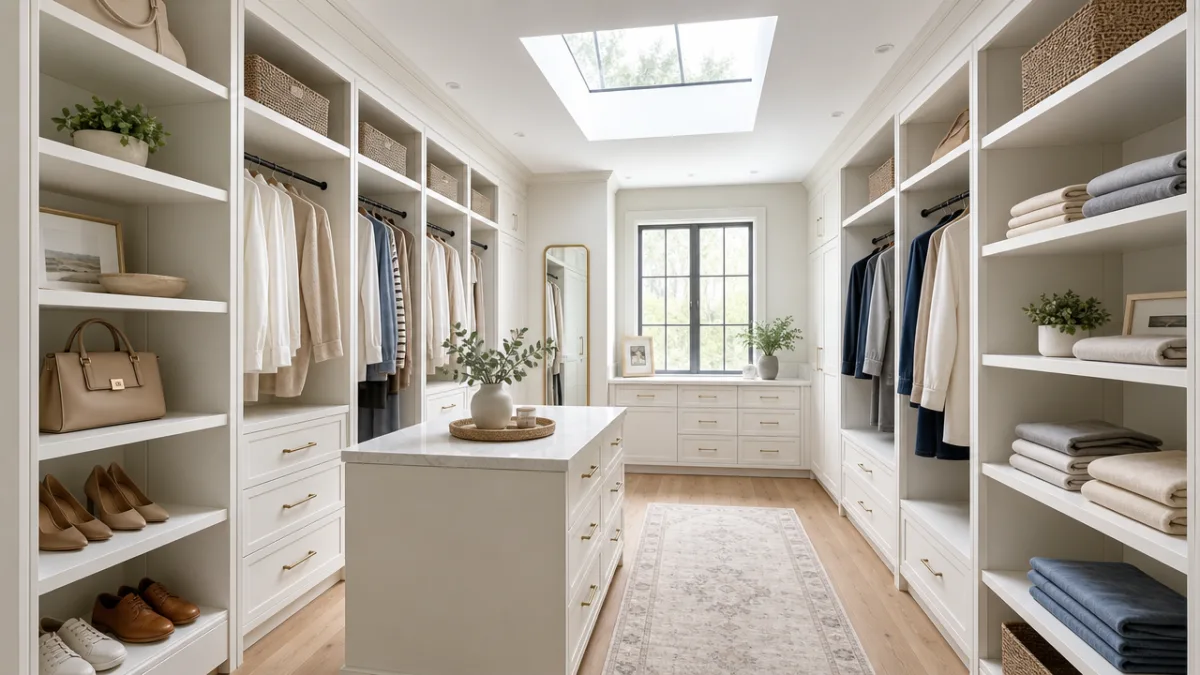
6. Built-In Storage and Custom Closets
Clutter is one of the most reliably documented sources of low-grade chronic stress. When your home lacks adequate organized storage, every surface becomes a landing zone for objects that have nowhere better to go, and the visual noise accumulates until your home feels chaotic even when it’s technically clean. Custom built-in storage — whether that means a custom closet system, built-in bookshelves flanking a fireplace, or a mudroom with dedicated cubbies and hooks — addresses this at the structural level, creating homes for everything so that nothing is ever lost or out of place.
The closet is the most common and arguably most impactful place to start. A custom closet system from companies like California Closets, Modular Closets, or even a well-planned IKEA PAX build can double your effective storage while dramatically reducing the time it takes to get dressed in the morning. Dedicated spots for shoes, bags, folded items, and hanging clothes mean you can see everything you own at a glance, which reduces decision fatigue and eliminates the “I have nothing to wear” feeling that comes from a disorganized closet that’s actually full of clothes.
Built-in bookshelves, window seats with storage beneath, and kitchen pantry systems offer similar benefits in shared living spaces. The visual effect of built-ins is also significant: they make a home feel custom-designed and architecturally intentional in a way that freestanding furniture rarely achieves. Built-ins look like they belong — because they do. They integrate with the walls and proportions of the room in a way that creates genuine architectural character. As a bonus, they consistently add measurable resale value to a home, making them one of the rare splurges that pays back financially as well as experientially.
7. High-Performance Window Treatments
Windows are a home’s connection to the outside world — sources of natural light, ventilation, and view. But untreated or poorly treated windows also allow heat to escape in winter, let glaring sun in during summer, and offer minimal privacy after dark. High-quality window treatments — motorized cellular shades, linen or velvet drapes on ceiling-mounted hardware, or woven wood blinds — address all of these functional concerns while simultaneously contributing some of the most significant decorative impact a room can receive. Drapes that extend from ceiling to floor make rooms feel taller; wide shades that disappear into a pocket when opened maximize your view and your light.
Motorized blinds and shades have come down significantly in price over the past decade and represent one of the most genuinely useful smart-home investments available. Systems like Lutron Serena or Hunter Douglas PowerView allow you to automate your window treatments to open with the sunrise, close against the afternoon glare, and descend for privacy at dusk — all without touching them. The convenience is real, but so is the energy efficiency: properly insulated window coverings can meaningfully reduce your heating and cooling costs over the course of a year.
From a decorative standpoint, floor-to-ceiling drapes in a quality fabric — Belgian linen, velvet, or a heavy cotton-linen blend — add texture, warmth, and visual mass to a room in a way that’s difficult to achieve through any other means. They soften hard architectural lines and create a sense of enclosure and coziness that makes a room feel genuinely luxurious. The hardware matters, too: thick metal rods in a matte or antique finish, mounted close to the ceiling line, complete the effect. This is a detail that professional designers use universally because it works — every single time.
8. Smart Home Climate Control
Temperature is one of the most fundamental factors in how comfortable you feel in your home, and yet most people manage it with a basic thermostat and a single HVAC system that treats every room identically. Smart thermostats and zoned climate control systems allow you to create individualized temperature environments in different rooms of your home — cooler for sleeping, warmer for the living room in winter, and precisely controlled throughout the day based on schedules you set and occupancy sensors that detect when a room is empty. The Nest Learning Thermostat and the Ecobee SmartThermostat Premium are the most acclaimed options, learning your preferences over time and adapting automatically.
Beyond the thermostat itself, consider investing in a whole-home air purification system if you have allergies, pets, or simply want to breathe genuinely clean air. Products like the Dyson HEPA purifier or a whole-home system integrated with your HVAC can reduce allergens, dust, VOCs, and airborne particulates significantly. The quality of the air you breathe inside your home is measurably connected to how well you sleep, how clearly you think, and how frequently you get sick. This is one of those invisible upgrades that doesn’t photograph well but is felt immediately and every day thereafter.
Smart climate control also delivers meaningful financial returns. The EPA estimates that smart thermostats can reduce heating and cooling costs by ten to fifteen percent annually — significant savings that offset the purchase price within one to three years. Combined with the genuine comfort improvement of no longer waking up too hot or coming home to a cold house, the case for a smart climate system is essentially airtight. This is a splurge that simultaneously makes your life more comfortable, your air cleaner, and your energy bills lower. The trifecta of home investments.
9. Outdoor Living Space Elevation
Research consistently shows that time spent outdoors — even in a private outdoor space — has significant positive effects on mood, stress levels, and overall wellbeing. Yet most homeowners treat their outdoor spaces as afterthoughts, furnishing them with mismatched plastic chairs and a table they’ve had since college. Investing in your outdoor living space — a quality sectional designed for outdoor use, a proper dining table and chairs, a fire feature, and thoughtful outdoor lighting — extends the usable square footage of your home by months every year and creates a space you’ll actually want to spend time in.
Outdoor furniture has improved dramatically in quality and design over the past decade. Brands like Restoration Hardware Outdoor, Janus et Cie, and even mid-range options from McGee & Co. or Serena & Lily now offer outdoor pieces in materials like teak, powder-coated aluminum, and all-weather wicker that can remain outdoors year-round in most climates without degrading. Pair quality furniture with outdoor rugs that define the “room,” add a pergola or shade sail for overhead definition, and finish with outdoor lanterns, string lights, or in-ground lighting to make the space usable after dark.
A fire feature — whether a built-in fire pit, a portable bioethanol fireplace, or a gas-powered outdoor fireplace — extends the season of outdoor living by weeks or months, creates an irresistible gathering focal point, and adds a level of ambiance that no amount of decoration can replicate. The warmth, the light, and the primal appeal of an open flame make outdoor evenings genuinely magical. When your outdoor space is as thoughtfully designed as your indoor rooms, you’ll find that you naturally migrate outside more often, breathing better air and absorbing more natural light — improvements in your daily life that no interior purchase can match.
10. Artwork and One Truly Great Decorative Object
A home without art is a house. The distinction matters, because art is the element that most clearly signals that a space has been chosen, curated, and loved by specific human beings with specific tastes. You don’t need a museum’s worth of artwork — you need one or two pieces that genuinely move you, placed prominently and at proper eye level, properly framed and properly lit. The investment in original art, whether from a local gallery, an art fair, or platforms like Artsy and Saatchi Art, pays back in emotional resonance every time you look at it. Unlike furniture, which you stop seeing after a while, genuinely good art continues to reveal itself over time.
Consider the scale of your walls before purchasing. One large-format piece — say, a canvas measuring forty-eight by sixty inches — will almost always make a more powerful statement than a collection of smaller pieces grouped awkwardly together. The tendency to fill wall space with many small objects is understandable but usually less successful than committing to fewer, larger, more intentional choices. When you find a piece that stops you — that makes you feel something specific and undeniable — that’s your signal. Buy it. Don’t talk yourself out of it because of the price; the regret of not buying art you loved is one of the most persistent minor griefs homeowners describe.
Beyond wall art, invest in one truly excellent decorative object: a handthrown ceramic vase from a working studio potter, a hand-carved wooden bowl, a piece of art glass, or a sculptural lamp that functions as both light and object. These pieces bring handmade human presence into a home in a way that mass-produced objects simply cannot. They create conversation, they anchor a room, and they represent an investment in craft that has real meaning beyond decoration. A home filled with intentional, beautiful objects — even just a few of them — feels fundamentally different from one assembled without that care. That feeling is the whole point, and it is absolutely worth the splurge.








What do you think?
It is nice to know your opinion. Leave a comment.