










A Morning in the Meadow: White Daisies, Butterflies, Pine Mountains, and Fog
The Magic of a Foggy Morning Landscape
There is something profoundly captivating about the early hours of a foggy morning in a natural landscape. When mist settles low over the earth, softening every edge and muting every color into a palette of dreamy pastels and silver-grey tones, the world transforms into something that feels borrowed from a painting. The fog does not merely obscure — it reveals a different kind of beauty, one that asks you to slow down, to breathe deeply, and to notice what you might otherwise overlook in the brightness of full daylight.
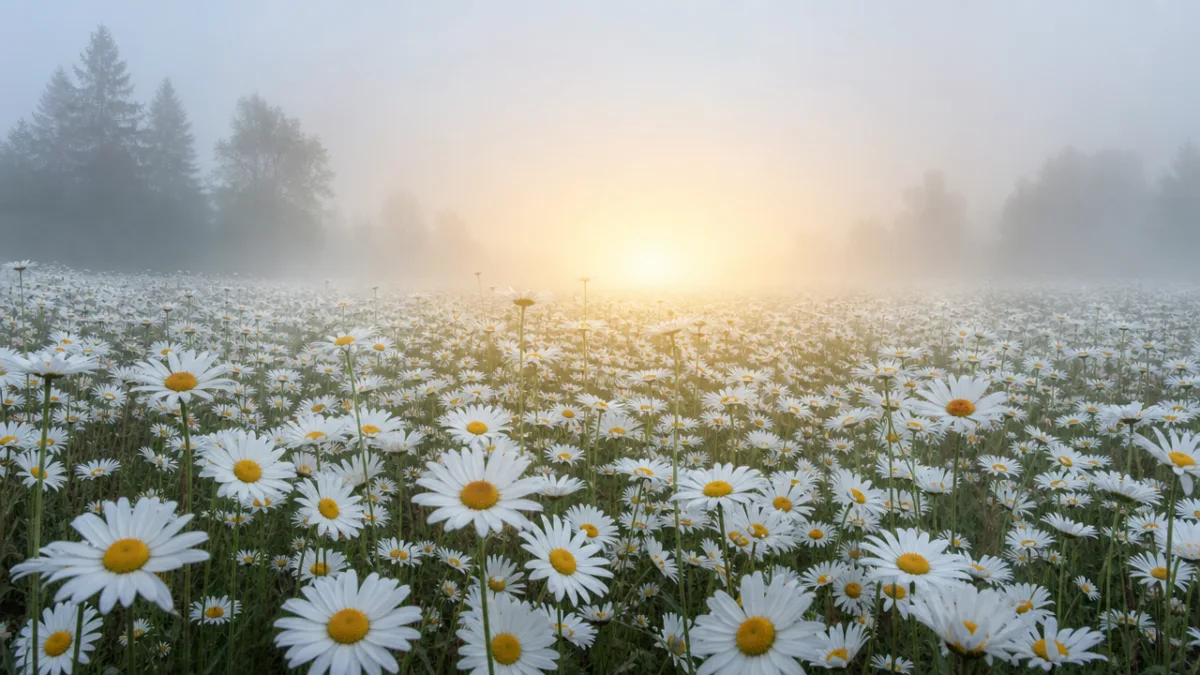
A field of white daisies emerging through morning fog is one of nature’s most quietly spectacular sights. The blossoms seem to glow against the grey backdrop, each white petal catching what little diffused light filters through the mist. Their yellow centers become warm focal points in a cool, hushed landscape, and together the thousands of individual flowers form a rippling, breathing sea of white that stretches toward the treeline in every direction. It is the kind of scene that stops you mid-step and makes you forget whatever you were rushing toward.
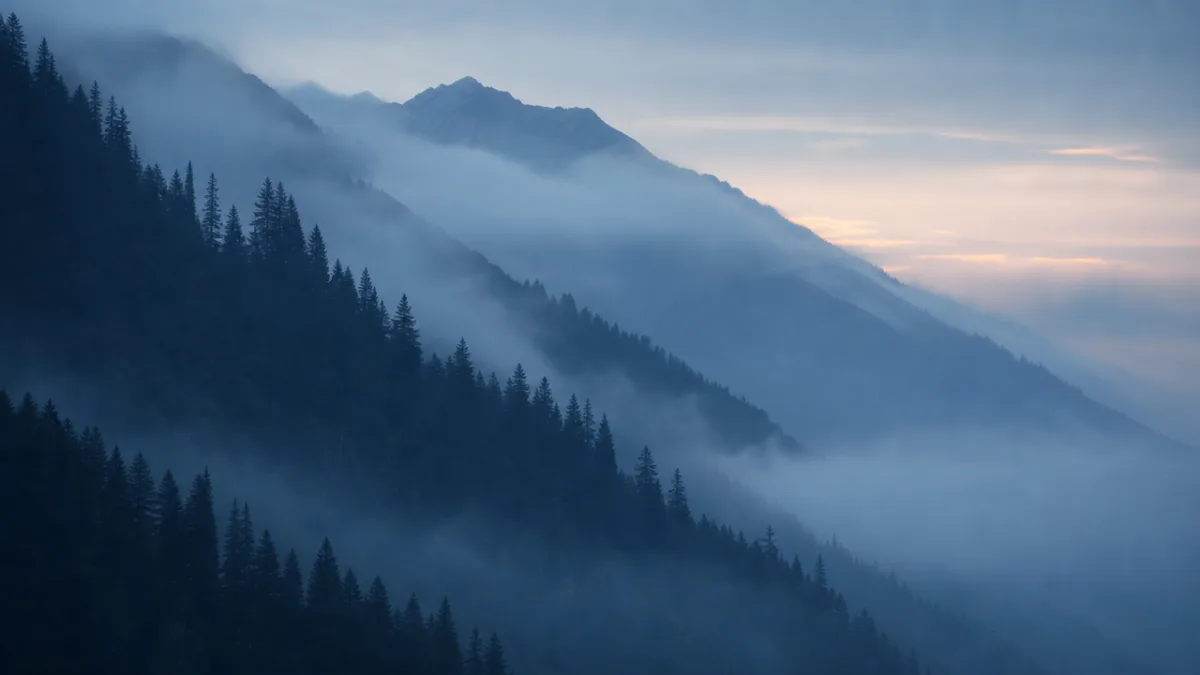
In the distance, pine-covered mountains rise through the fog like guardians of the valley below. Their dark silhouettes create a layered depth that photographers and painters have sought to capture for centuries, each ridge slightly lighter than the one before it, fading into the sky in a gradual, elegant dissolution. This interplay between solid landform and atmospheric vapor is at the heart of why foggy mountain mornings feel so emotionally resonant — they speak to something ancient and wordless inside us, a recognition of scale and impermanence that is both humbling and deeply calming.
The scent of such a morning is inseparable from its visual beauty. Pine resin mingles with damp earth and the light, clean fragrance of the daisy blooms themselves. The air is cool and carries moisture on every breath, refreshing the lungs in a way that no other environment quite replicates. Birds call distantly through the fog, their songs dampened and softened by the mist into something that sounds almost reverential. The whole landscape conspires to create an atmosphere of peaceful, sacred stillness that lingers in memory long after the fog has burned away.
White Daisies: Symbol, Science, and Splendor
The common white daisy, known scientifically as Leucanthemum vulgare or in some species as Bellis perennis, is one of the most universally recognized wildflowers on earth. Found across meadows, roadsides, mountain valleys, and hillsides throughout the Northern Hemisphere and beyond, the daisy’s simple architecture — a ring of white ray florets surrounding a dense, sunny disc of yellow — has made it a beloved symbol of innocence, cheerfulness, and new beginnings for thousands of years. Its very familiarity is part of its power; few other flowers carry such immediate emotional warmth.
A full field of white daisies is an ecological achievement as much as it is an aesthetic one. Daisies thrive in meadow environments that receive ample sunlight and moderate moisture, which makes valley floors near pine-covered mountains — where snowmelt feeds the soil and altitude keeps temperatures mild — ideal habitats. They are pioneer species in many environments, among the first wildflowers to colonize disturbed ground, and their presence signals a healthy, biodiverse ecosystem. When you look across a daisy-filled meadow, you are looking at a landscape that supports hundreds of species of insects, birds, and small mammals.
From a cultural and symbolic standpoint, white daisies appear across an extraordinary range of human traditions. In Celtic mythology, daisies were associated with the sun and were believed to have protective properties. In Victorian flower language, the daisy spoke of innocence and loyal love. Children have threaded them into crowns for millennia. Artists from Botticelli to Georgia O’Keeffe have rendered them on canvas. The practice of pulling petals — “loves me, loves me not” — has been passed from generation to generation across cultures so different in every other respect that the daisy itself seems to serve as a universal human touchstone, a shared point of tenderness in an often complicated world.
What makes a field of daisies particularly striking in morning fog is the way their white petals behave in low, diffused light. Unlike flowers that depend on direct sunlight to reveal their color — reds and oranges that can look dull in shade — white daisies actually intensify in appearance under cloudy or misty conditions. The soft, even illumination of a foggy morning eliminates harsh shadows and allows the eye to register the full roundness and texture of each bloom. Photographers refer to this kind of light as “open shade” and prize it above all other conditions for capturing flowers, because it creates a gentle luminosity that artificial studio lights can only approximate.
Butterflies: Fragile Travelers of the Meadow Morning
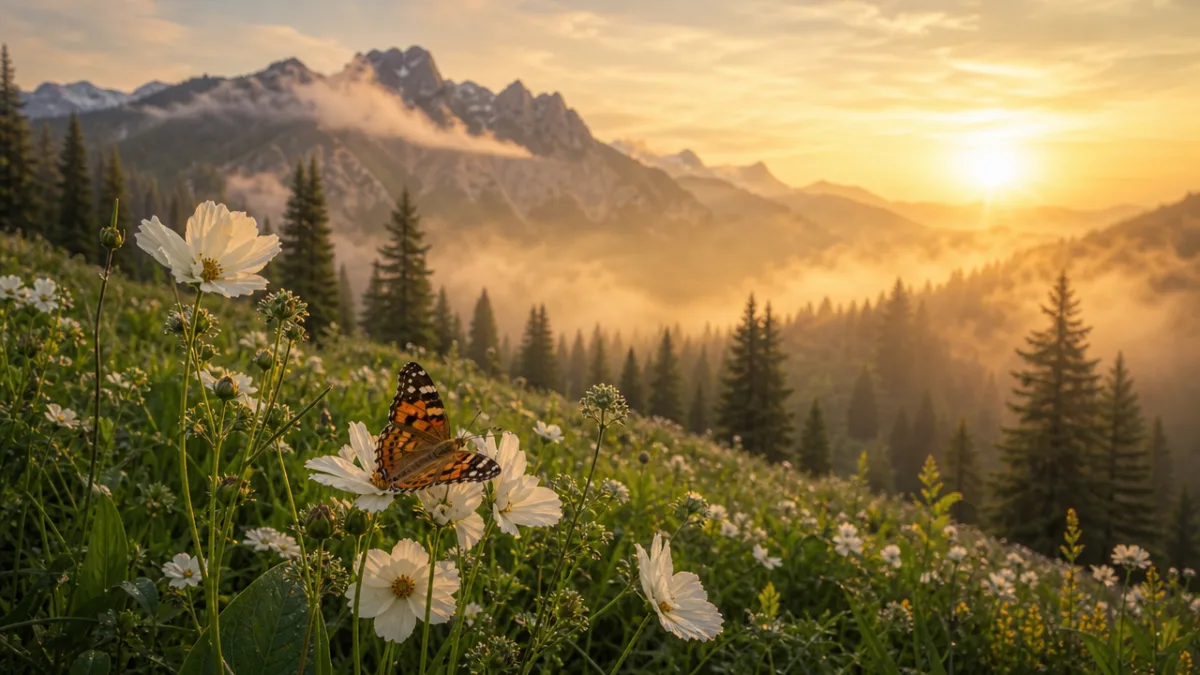
A butterfly in flight above a field of white daisies is one of those sights that seems almost deliberately composed for human delight. Butterflies in a morning meadow are not simply decorative; they are active participants in a complex biological system that sustains the landscape itself. As pollinators, they move from flower to flower transferring pollen with every visit, supporting the reproduction of not just daisies but dozens of other plant species that share the meadow. Their presence in large numbers is an indicator of ecological health — a sign that pesticide use is low, habitat is intact, and floral diversity is sufficient to sustain them through their life cycle.
The species most commonly found dancing over wildflower meadows near pine mountain environments include an impressive range of shapes, colors, and behaviors. Some of the most frequently encountered varieties in such landscapes include:
- Painted Lady (Vanessa cardui): One of the world’s most widely distributed butterflies, with orange, black, and white patterning that contrasts beautifully against white daisy petals.
- Common Blue (Polyommatus icarus): The male’s iridescent blue wings catch even the dimmest morning light and create a dazzling visual effect when many individuals take flight simultaneously.
- Cabbage White (Pieris rapae): Pale and ghostly, these butterflies seem almost to disappear against the white daisy blooms, revealing themselves only in motion.
- Meadow Brown (Maniola jurtina): A warm-toned, understated butterfly that favors grassy meadows and often perches on daisy heads to feed in the cooler morning hours.
- Swallowtails (Papilionidae family): Larger, more dramatic species that bring an almost tropical exuberance to mountain meadow scenes.
Butterflies are among the first indicators of changing ecological conditions, which is why scientists monitor their populations as proxies for overall ecosystem health. In many parts of the world, butterfly numbers have declined significantly due to habitat loss, climate change, and agricultural intensification. The image of dozens of butterflies freely navigating a fog-kissed mountain meadow is, in this context, more than just a beautiful picture — it is a vision of what healthy, intact natural systems look like, a reminder of what conservation efforts are working to protect and restore across landscapes that have been diminished.
There is also a meditative quality to watching butterflies in morning light that has been noted across cultures. Their movement is non-linear, responsive, and utterly unhurried — they cannot be anticipated or directed, only observed. Chinese philosophical tradition, most famously in Zhuangzi’s dream of being a butterfly, has used them as metaphors for the fluid, uncertain boundary between states of being. Japanese art has rendered them for centuries as symbols of transformation, joy, and the soul. In a foggy meadow at dawn, watching a butterfly navigate between daisy blooms in the still morning air, it is easy to understand why these small, fragile creatures have attracted such profound human attention throughout history.
Pine Trees on Mountains: Architecture of the High Landscape
Pine trees on mountain slopes are among the most visually powerful elements in any landscape composition. Their verticality — the way they rise in dense, dark ranks up steep gradients, their silhouettes cutting against sky and fog — creates a structural counterpoint to the soft horizontality of the daisy meadow below. The eye moves naturally between these two registers, from the delicate, low-growing flowers to the massive, ancient trees, and in that movement lies much of the aesthetic satisfaction of the scene. The pine mountain is the meadow’s backdrop, its anchor, the thing that gives the open field its sense of sheltered intimacy.
Several species of pine are commonly associated with mountain landscapes across the temperate world, and each brings its own character to the scene. The Scots Pine (Pinus sylvestris), with its distinctive orange-red upper bark and blue-green needles, is a particularly photogenic species that appears across European mountain ranges from Scotland to Siberia. In North American contexts, species like the Ponderosa Pine (Pinus ponderosa) and the Lodgepole Pine (Pinus contorta) dominate high-elevation forests. Japanese Black Pines and Korean Pines bring their own sculptural elegance to East Asian mountain scenes. What these species share is a remarkable adaptability to extreme conditions — cold, poor soil, wind exposure, and dramatic seasonal change — that makes them symbols of endurance and resilience in many cultural traditions.
In fog, pine trees transform. Their dark, densely-needled canopies absorb what little light penetrates the mist, making them appear almost black against the grey atmosphere, while their silhouettes become simplified into graphic, almost abstract shapes. Individual branches become invisible; only the overall form remains, layered in diminishing clarity as the eye moves deeper into the forest and up the mountain slope. This atmospheric perspective — the way objects become progressively lighter and less distinct with distance due to moisture in the air — is one of the fundamental visual effects that painters have used for centuries to create a sense of depth and scale in landscape art.
The ecological role of pine forests in maintaining healthy mountain meadows is significant and often underappreciated. Mature pine forests regulate water flow from snowmelt and rainfall, releasing moisture slowly into the soil system below rather than allowing it to rush away in surface runoff. This steady release keeps valley meadows watered through dry summer months, sustaining the wildflower communities — including the daisies — that depend on consistent soil moisture. Pine forests also moderate temperature extremes in adjacent meadows, providing shelter from wind and creating microclimates that extend the growing season. The meadow and the forest are not simply neighbors; they are partners in a complex, co-dependent relationship that has taken thousands of years to establish.
Fog as a Living Element: The Science and Soul of Morning Mist
Fog is not merely an atmospheric condition; in a landscape of mountains, meadows, and pine forests, it is a dynamic, living participant. Valley fog — the variety most commonly associated with the kind of scene described in this scene — forms when radiative cooling during clear nights causes the ground to lose heat rapidly. The air immediately above the ground cools to its dew point, at which temperature water vapor condenses into the tiny droplets that constitute fog. This process typically begins in the hours just before dawn and reaches its maximum density around sunrise, creating the extraordinary visual effect of a world submerged in soft, luminous vapour.
The behavior of fog in mountainous terrain is shaped by topography in fascinating ways. Cold air, being denser than warm air, flows downhill and pools in valleys and low-lying meadows — exactly where wildflower fields tend to flourish. This means that while the pine trees on the upper mountain slopes may stand in relatively clear air, the meadow below swims in a sea of fog that can be several meters deep. This temperature inversion creates a landscape of two distinct worlds: the grey, still world of the fog-bound meadow and the sunlit world above the cloud layer, visible only to those willing to climb above the treeline before the morning mist burns away.
From a purely ecological perspective, fog provides critical moisture to meadow and forest ecosystems, particularly during summer months when rainfall may be scarce. Pine trees are especially effective fog-catchers: their dense needle arrays intercept and collect fog droplets, which then coalesce and drip to the ground, a process known as fog drip. Studies have shown that in some coastal and mountain pine forests, fog drip can contribute as much rainfall-equivalent moisture to the soil system as several inches of precipitation. This mechanism is one of the reasons why pine forests can sustain healthy understory and adjacent meadow communities even in relatively arid climates.
Artists and photographers have long recognized fog as the element that most transforms an ordinary landscape into something extraordinary. The way fog creates natural vignetting — darkening and softening the edges of the visual field while leaving the immediate foreground in relative clarity — mimics the selective focus effects that photographers achieve with wide apertures. Painters from the Hudson River School in America to the landscape masters of the Chinese Song dynasty have used fog as both a compositional and emotional tool, understanding that mist in a landscape does not simply obscure but actively creates meaning. It introduces mystery, scale, and an awareness of time passing that clear-day views cannot achieve.
Capturing and Preserving the Moment: Art, Photography, and Conservation
The scene of white daisies, butterflies, pine mountains, and morning fog exists at an intersection of natural forces so specific — season, elevation, temperature, moisture, wind conditions, and the presence of healthy biological communities — that its full expression may occur only a handful of times in any given year. This ephemerality is part of what gives the image its emotional power, and it is what drives artists, photographers, and naturalists alike to wake before dawn and make the journey to high meadows in hopes of witnessing it. The transience of the moment is not incidental to its beauty; it is fundamental to it.
For photographers seeking to capture this scene effectively, a number of practical considerations can make the difference between a snapshot and a genuinely compelling image. Key techniques and approaches include:
- Arrive before sunrise: Fog is typically densest and most visually dramatic in the thirty minutes before and after sunrise, when light is softest and the mist is at its maximum extent. Arriving in darkness and setting up in advance ensures you are ready when conditions peak.
- Use a tripod without exception: Low light and the desire for sharp daisy foregrounds with creamy-smooth fog backgrounds require slow shutter speeds that make handheld shooting impractical.
- Shoot toward the light source: Positioning yourself with the diffused sunrise behind your subject creates backlit conditions that make fog luminous and give daisy petals a translucent, almost magical quality.
- Include scale elements: A lone pine tree, a butterfly in sharp focus, or a path disappearing into the mist gives the viewer’s eye a point of reference that emphasizes the vastness of the scene.
- Bracket exposures: Foggy scenes fool camera meters; shooting a range of exposures ensures you capture the precise tonal values that convey the scene’s atmospheric quality.
Beyond photography, the preservation of landscapes like this one depends on active conservation engagement. Wildflower meadows in mountain valleys face pressure from agricultural conversion, overgrazing, invasive species, and the long-term effects of climate change, which is shifting fog patterns, snowmelt timing, and temperature regimes across mountain ecosystems worldwide. Organizations dedicated to meadow restoration, pollinator habitat preservation, and pine forest conservation are working across many regions to protect and restore the ecological conditions that make scenes like this possible. Supporting these efforts — whether through donations, volunteering, or simply advocating for land protection policies — is one of the most meaningful responses a person can have to the experience of encountering such beauty.
Ultimately, the image of a fog-covered meadow filled with white daisies and butterflies, framed by pine-clad mountains in the grey-gold light of early morning, is more than a beautiful composition. It is a portrait of a living system in balance — complex, interdependent, and irreplaceable. The fog connects sky to earth. The daisies feed the butterflies. The pine forests shelter and water the meadow. The mountains hold it all in place. When we stand in such a landscape and allow ourselves to truly see it, we are reminded that beauty and ecological integrity are not separate concerns but the same thing, perceived through different faculties, pointing toward the same truth.








What do you think?
It is nice to know your opinion. Leave a comment.