










Candlelight on the Vanity: A Guide to Soft Gothic Still Life Aesthetics
The Soul of Soft Gothic: Understanding the Aesthetic
Soft gothic is not the harsh, angular darkness that many people first imagine when they hear the word “gothic.” It is something far more intimate — a aesthetic philosophy built on the quiet tension between beauty and melancholy, between warmth and shadow. At its heart, soft gothic embraces the romantic side of darkness: candlelight flickering against velvet, dried roses curling at their edges, antique glass catching a dim and golden glow. It is an aesthetic that feels lived-in and deeply personal, rooted in the sensory pleasures of texture, scent, and atmospheric light.
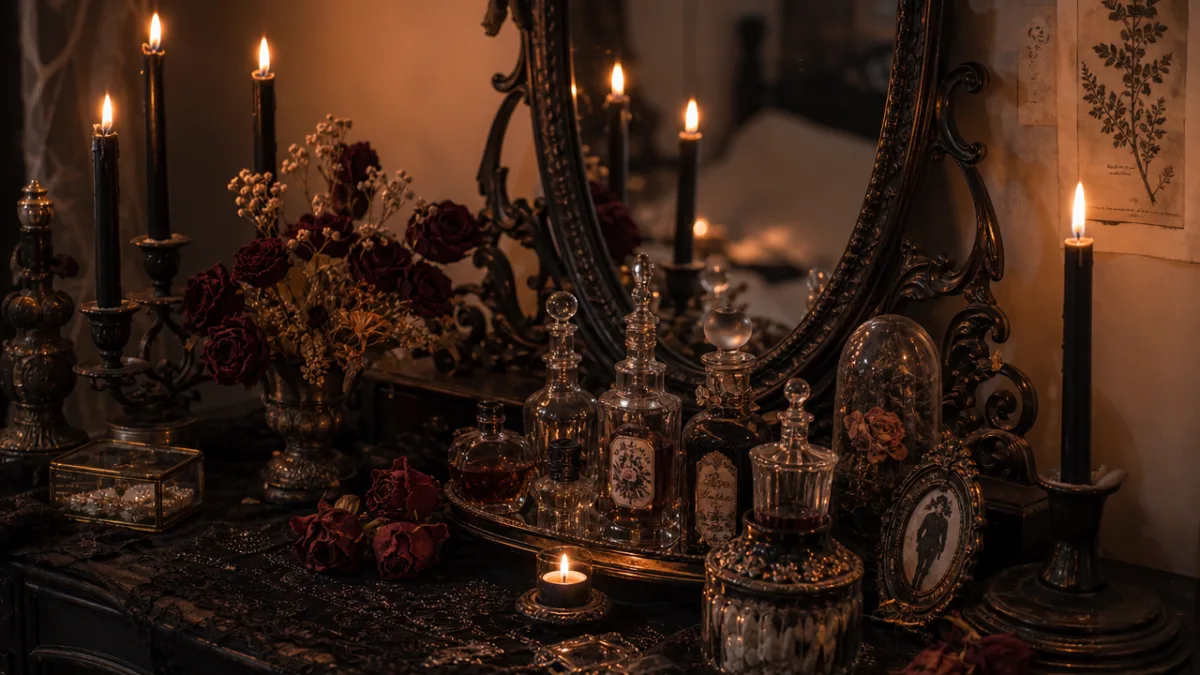
The vanity table has long been a symbolic space in gothic and romantic traditions. It is a place of transformation and self-reflection, where identity is constructed and examined. In a soft gothic still life, the vanity becomes a theatrical stage for objects that carry emotional weight — perfume bottles, tarnished hand mirrors, strands of pearls or jet beads, a half-burned taper candle in a brass holder. Each object is chosen not just for its appearance but for the story it tells and the mood it evokes. The arrangement becomes a kind of visual autobiography, a portrait without a face.
What separates soft gothic from darker gothic subcultures is its emphasis on warmth and livability. The palette leans into deep burgundies, dusty mauves, forest greens, and the amber tones of candlelight rather than harsh blacks and cold silvers. Materials feel touchable: aged wood, worn velvet, waxy candles, pressed botanical specimens behind glass. This is a world that invites you to slow down, to light a candle, and to sit quietly in the company of beautiful, slightly melancholy things. It is, at its best, a practice of mindful aestheticism.
Key Influences Behind the Style
The visual language of soft gothic still life draws from an extraordinarily rich heritage of artistic and literary traditions. Dutch Golden Age vanitas paintings, with their symbolic skulls, guttering candles, and tumbling flowers, established the foundational vocabulary of the memento mori aesthetic. Victorian mourning culture, with its elaborate rituals of remembrance and its love of keepsakes — hair art, jet jewelry, pressed flowers from a loved one’s funeral wreath — contributed a layer of deeply personal sentiment. Gothic literature from Ann Radcliffe to Edgar Allan Poe gave the aesthetic its emotional register: the haunted interior, the significant object, the charged atmosphere.
More contemporary influences include the Pre-Raphaelite Brotherhood’s obsession with lush, painterly detail and feminine interiority, as well as the work of photographers like Francesca Woodman, whose haunting self-portraits in decaying interiors remain touchstones for the aesthetic. The rise of cottagecore and dark academia in the early 2020s helped create a cultural appetite for similarly warm, literary, and tactile aesthetics that provided fertile ground for soft gothic’s growing popularity. Pinterest boards, Instagram accounts, and Tumblr archives all helped codify and spread its visual conventions.
Curating Your Vanity: Objects and Arrangements
The art of curating a soft gothic vanity still life begins with the selection of objects that carry what the Japanese call “mono no aware” — a sensitivity to impermanence and the bittersweet beauty of passing things. Look for items that show their age gracefully: a silver-backed hand mirror with a slightly foxed glass, a cut-crystal perfume bottle with a few drops remaining, a cameo brooch with a hairline crack. These imperfections are not flaws to be corrected but narratives to be honored. The patina of time is the most essential decorative element in this aesthetic.
Candles are, without question, the central object around which everything else is organized. Their light is warm, directional, and alive in a way that no electric source can replicate. For a vanity arrangement, consider layering multiple candles at different heights: a tall black taper in a wrought-iron holder, a squat ivory pillar candle on a small cake stand or stack of old books, perhaps a cluster of small votive candles in mismatched glass holders. The visual rhythm created by varying heights and the gentle dance of multiple flames creates an atmosphere of extraordinary intimacy and drama simultaneously.
Beyond candles, the following categories of objects serve as excellent building blocks for a soft gothic vanity arrangement:
- Botanical elements: dried roses, pressed ferns, eucalyptus sprigs, or a single stem of black-dyed Queen Anne’s lace in a bud vase add organic texture and a note of natural transience.
- Glass and crystal: perfume bottles, apothecary jars filled with dark bath salts or dried lavender, antique inkwells, and small decanters catch and refract candlelight in mesmerizing ways.
- Books and paper: a small stack of leather-bound or cloth-covered volumes adds height, intellectual atmosphere, and rich textural contrast against smoother objects.
- Jewelry and personal objects: long strings of dark beads, a locket left open, a single earring without its pair — these introduce intimacy and the suggestion of a story interrupted.
- Fabric and draping: a length of black velvet or aged lace laid beneath the arrangement unifies disparate objects and adds the essential softness that keeps the composition from feeling cold.
The arrangement itself should feel considered but never rigid. Study the compositional principles of classical still life painting: create a focal point with the tallest or most visually significant object, build outward and downward in layers, allow objects to overlap and touch rather than standing in neat rows. Leave a little negative space so the eye has room to travel and rest. The goal is a composition that looks as though it has been slowly accumulated over time by someone with an unerring instinct for beauty — not decorated all at once but gathered, piece by piece, with love.
Mastering the Light: Candles, Shadows, and Atmosphere
Light is the true medium of the soft gothic still life. No arrangement, however beautifully curated, will achieve its full potential without the right quality of illumination. Candlelight does something to objects that no artificial lighting can replicate: it renders them both more visible and more mysterious simultaneously. The warm orange-amber wavelengths of a flame emphasize depth and texture, making velvet look more sumptuous, making glass glow with interior life, and casting shadows that shift and breathe with the air currents of a room. This dynamic quality makes a candlelit still life feel alive in a way that static, even lighting cannot.
Understanding how to work with shadow is just as important as understanding light. In a soft gothic composition, shadow is not the absence of something beautiful — it is an active element in the scene. The deep shadow pooled behind a cluster of perfume bottles, the penumbra cast by a candle flame across the face of an old book, the way a mirror catches and redirects a small gleam of warmth across an otherwise dark surface: these are the details that create the sense of depth and mystery essential to the aesthetic. When arranging your objects, spend time observing the shadows they cast and use those shadows deliberately as compositional elements in their own right.
For photographers and digital creators seeking to capture or recreate soft gothic still life imagery, the technical challenges are significant but rewarding. Natural candlelight has a color temperature of approximately 1800K to 2000K, which is dramatically warmer than daylight or standard tungsten bulbs. Cameras will want to correct this warmth away — resist that impulse entirely. In post-processing, protect the orange and amber tones, pull down the highlights gently to prevent flame blow-out, lift the shadows only minimally to preserve the sense of mystery, and consider adding a very slight green-or-purple color cast in the deepest shadows to evoke the particular quality of old photographic processes. The goal is an image that feels like it could have been made in another century.
Choosing the Right Candles for Mood and Longevity
Not all candles are created equal, and for a soft gothic aesthetic, the choice of candle matters both visually and practically. Beeswax tapers in natural ivory or dyed black are perennial favorites: they burn cleanly, hold their shape elegantly, and have a faint honey scent that adds an olfactory dimension to the scene. Black candles are particularly useful in this aesthetic because they stand out as strong visual anchors against lighter backgrounds while also pooling their melted wax in interesting, darkly beautiful ways. Unscented candles are often preferable when multiple are used together to avoid conflicting fragrance notes.
The candleholder itself deserves as much consideration as the candle. Wrought iron, tarnished brass, pewter, or aged silver-plate holders carry the weight and antique character appropriate to the aesthetic. Ornate candelabras create theatrical grandeur; simple spike holders on a single wooden base suggest austere elegance. Crystal bobeches — the small dishes or rings designed to catch dripping wax — add both practical functionality and a glittering detail that enhances the composition. Never overlook the way pooled and dripped wax contributes to the beauty of the arrangement over time; allow it to accumulate naturally rather than cleaning it away.

Color Palette and Texture: Building the Visual Language
The color palette of soft gothic still life is one of its most immediately recognizable and emotionally resonant features. Unlike the high-contrast black and white of classic gothic imagery, soft gothic embraces a range of deep, muted, and dusty tones that feel simultaneously rich and faded. Think of the color of old velvet that has seen decades of light: once-deep burgundy softened to a dusty rose at its worn edges. Think of aged brass, not polished but pleasantly patinated, carrying green in its recesses and warm gold at its raised surfaces. This sense of color that has been lived-in and gently altered by time is central to the palette’s appeal.
The primary palette typically includes deep burgundy and wine reds, dusty mauve and faded rose, forest and sage greens, navy and midnight blues, and the full spectrum of amber, gold, and ochre introduced by candlelight. Black is used as an accent rather than a dominant tone — in a candleholder, in a ribbon, in the spine of a leather-bound book. Cream, aged ivory, and bone white provide the high notes that prevent the palette from becoming too heavy or oppressive. The overall effect should feel like looking at a watercolor that has been left in a sunlit window for many years: deep but gentle, rich but soft.
Texture is equally central to the visual language and is perhaps even more important in a physical arrangement than in a flat image. The contrast between different surface qualities creates the tactile richness that makes soft gothic still life so physically compelling. Consider the following textural pairings as compositional building blocks: rough-hewn stone or reclaimed wood against the smooth glass of a perfume bottle; heavy velvet against the thin, delicate paper of a pressed-flower specimen; the waxy, matte surface of a candle against the high shine of a silver hand mirror. Each pairing creates a visual and sensory dialogue that enriches the overall composition and rewards close looking.
Sourcing Materials: Where to Find the Perfect Objects
Part of the pleasure of building a soft gothic aesthetic is the process of sourcing and discovering objects, which should itself feel like a slow, atmospheric practice rather than a quick shopping exercise. Antique markets, estate sales, and secondhand shops are the primary hunting grounds for the kinds of aged, character-rich objects this aesthetic demands. The patina of genuine age is difficult to fake convincingly, and the thrill of discovering a perfect Victorian inkwell or a tarnished silver-backed brush at a flea market carries its own particular romantic satisfaction. Online platforms like Etsy, eBay, and specialist vintage dealers can supplement physical shopping for more specific or rare items.
Dried botanicals can be sourced commercially from dried flower specialists or created at home by hanging fresh flowers upside down in a dry, dark space for two to three weeks. Roses, peonies, strawflowers, lunaria (silver-dollar plant), and various grasses all dry beautifully and are well-suited to the aesthetic. Pressing flowers and ferns between the pages of heavy books and then framing them behind glass produces objects of great delicacy and beauty that fit perfectly within the soft gothic still life tradition. The time investment in making these objects yourself adds a layer of personal meaning that enhances their aesthetic power considerably.
Soft Gothic Still Life as a Meditative Practice
There is a dimension to the practice of creating soft gothic still life arrangements that goes beyond purely visual or decorative concerns. For many people who are drawn to this aesthetic, the deliberate, careful activity of gathering and arranging meaningful objects in beautiful relationship to one another is itself a form of meditation or ritual. In an era of relentless speed, digital stimulation, and disposable goods, the act of slowing down to light a candle, to place a dried rose at just the right angle, to observe the way a shadow falls across an open book — this is a practice of presence and attentiveness that has genuine psychological and emotional value.
The aesthetic’s engagement with themes of impermanence, transience, and the beauty of things that are passing away connects it to contemplative traditions across many cultures. The Japanese practice of wabi-sabi — finding beauty in imperfection and incompleteness — is a close philosophical cousin to soft gothic sensibility. The Buddhist concept of impermanence expressed through the Zen practice of arranging seasonal flowers with full awareness of their inevitable fading is another resonant parallel. The Western vanitas tradition in painting was explicitly designed to prompt philosophical reflection on the brevity of life and the inevitability of death, but to do so in a way that created beauty rather than despair.
Creating a soft gothic vanity still life can be understood as a contemporary version of these ancient practices: an acknowledgment that beautiful things pass, that darkness is a natural part of the cycle of existence, and that there is consolation and even joy to be found in attending carefully to the textures and lights of the present moment. The candlelight that flickers and will eventually go out, the rose that has dried but retains its form, the mirror that shows you your face in this particular moment of your particular life — these are not simply decorative elements but invitations to a richer, more conscious way of inhabiting the world.
Sharing and Photographing Your Still Life: A Creative Guide
For those who wish to share their soft gothic still life creations on platforms like Pinterest, Instagram, or a personal blog, the photography of the arrangement is itself a creative practice worthy of serious attention. The fundamental challenge is capturing candlelight accurately: modern cameras and phones default to auto-white-balance settings that will strip the warmth from candlelight and render your carefully curated amber atmosphere as a flat, grey-toned image. The first and most important technical adjustment is to lock your white balance to a tungsten or warm setting, or to shoot in RAW format and correct in post-processing while preserving the warmth of the original light.
Composition in photography follows many of the same principles as composition in the physical arrangement, with some additional considerations. The rule of thirds can be a useful starting point but should not be applied rigidly: many of the most beautiful still life photographs employ centered compositions that feel formal and slightly archaic, evoking the conventions of painted portraiture. Shooting slightly from above creates a map-like clarity in the image while maintaining intimacy; shooting at near table-level creates a more dramatic, immersive perspective. Experiment with both and observe how the apparent relationship between objects changes dramatically with viewpoint.
Editing soft gothic still life photographs is an art in its own right. The following approaches tend to produce results consistent with the aesthetic’s visual language and emotional register:
- Preserve warmth aggressively: move the temperature slider toward warm rather than cool, and protect the orange and amber tones in the hue-saturation-luminance panel.
- Reduce clarity and texture: unlike many modern editing trends that emphasize sharpness, soft gothic imagery benefits from a slightly reduced clarity that creates a gentle, hazy quality reminiscent of old photographs.
- Lift shadows minimally: preserve the depth of the darkest areas of the image rather than opening them up entirely; mystery lives in shadow.
- Add slight grain: film grain or its digital equivalent adds an analog, historical quality that is deeply congruent with the aesthetic’s temporal sensibility.
- Consider a subtle color grade: a very slight addition of green or purple in the shadows, balanced by warm amber in the highlights, creates a sophisticated tonal quality that distinguishes carefully edited soft gothic imagery from casual phone photography.
When sharing your images, the written content that accompanies them is as important as the visual itself for building community and communicating the aesthetic’s depth. Write captions that invite reflection rather than merely describe: instead of listing the objects in the frame, offer a fragment of mood, a question about memory or beauty, a line of poetry that resonates with the image’s emotional register. This approach honors the intellectual and emotional seriousness that distinguishes soft gothic still life from mere decoration and invites a quality of engagement from viewers that transforms passive scrolling into genuine encounter. The most resonant images in this genre create not just a visual experience but a small, contained world that the viewer can briefly inhabit.








What do you think?
It is nice to know your opinion. Leave a comment.