









The Ultimate Guide to Crochet Chart Symbols: Unlocking the Mystery
Crocheting is an art form that has captivated the hearts of many across the globe. It’s a creative process that allows for the transformation of simple yarn into intricate patterns and designs, showcasing the maker’s skill and imagination. While many crocheters begin by learning to read written patterns, there’s another skill that can take your crafting to the next level: understanding crochet chart symbols.
Why Learn Crochet Chart Symbols?
For many, the thought of deciphering a chart can be intimidating. However, learning to read crochet chart symbols can open up a whole new world of possibilities. Here are several reasons why you should consider diving into the world of crochet charts:
-
Universality: Unlike written patterns, which can vary dramatically between different languages, crochet charts are universal. Once you learn the symbols, you can interpret patterns from around the world without needing a translation.
-
Visual Representation: Charts provide a visual representation of the project. This can make it easier to understand the construction of a piece, especially for complex designs.
-
Quick Reference: Instead of paging through lengthy written instructions, a chart often provides a compact summary of a pattern, allowing for quicker reference and easier navigation.
-
Design Versatility: With charts, you can get a better sense of how to adjust and modify patterns, offering an opportunity for customization and personalization of your projects.
-
Simplification: For repetitive patterns, charts can simplify your project by reducing the amount of text you need to follow.
Now that we’ve established why learning to read crochet chart symbols is invaluable, let’s delve into the nitty-gritty details of the most common symbols you’ll encounter.
Basic Crochet Chart Symbols
-
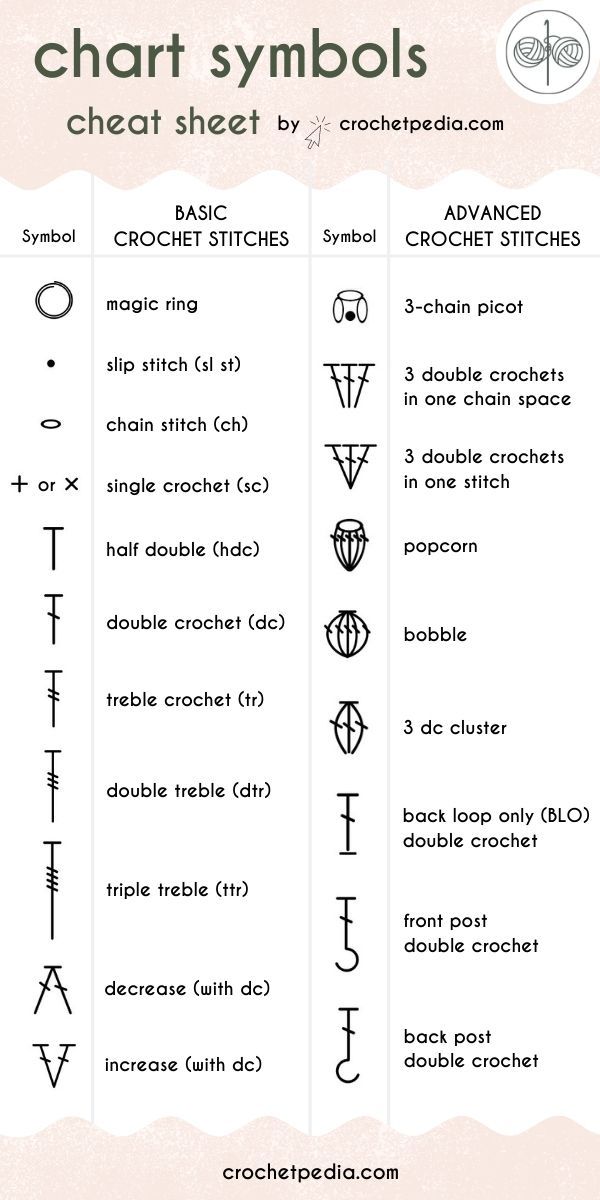
Chain (ch): This is one of the simplest stitches in crochet and often the starting point for many projects. In charts, the chain is usually represented by an oval or a small, empty circle.
-
Slip Stitch (sl st): Used to join work or move the yarn without adding height, the slip stitch is often depicted as a filled dot or a small plus sign.
-
Single Crochet (sc): This basic stitch is symbolized by an ‘X’ or a filled square. It’s one of the most frequently used stitches in amigurumi and other tight, dense fabric projects.
-
Half Double Crochet (hdc): A versatile stitch that adds a bit more height than a single crochet, the half double crochet is shown as a ‘T’ with a single slash through the stem.
-
Double Crochet (dc): This stitch, which adds considerable height, is represented by a ‘T’ with two slashes through it.
-
Treble Crochet (tr): For even more height, the treble crochet is depicted by a ‘T’ with three slashes.
-
Double Treble Crochet (dtr): Used for open and airy designs, this stitch appears as a ‘T’ with four slashes.
-
Front Post and Back Post Stitches: These stitches add texture. The front post is often shown as a standard stitch symbol with an extended vertical line in front of the stitch, while the back post has an extended vertical line behind.
-
Cluster Stitches: These involve working multiple stitches together at the top. Chart symbols for clusters often resemble an elongated ‘Y’ or a series of connected ‘T’ symbols.
-
Increase and Decrease: These techniques shape your project. An increase might not have a distinct symbol but is shown by placing multiple stitches in the same space. A decrease might be shown using angled lines connecting the stitches involved, or a line joining two stitch symbols.
Reading and Using Crochet Charts
When you first look at a crochet chart, it may appear overwhelming. However, with some patience and practice, you’ll become adept at interpreting these visual patterns. Here are some tips for effectively working with charts:
-
Identify the Start Point: Most charts will have a clear starting point, often indicated by a separate symbol or arrow. Ensure you begin your project at this point.
-
Understand the Direction: The direction of each row or round is crucial. For back-and-forth patterns, you’ll read one row right to left, then the next left to right. For worked-in-the-round projects, follow the direction of the rounds, typically marked with numbers or arrows.
-
Track Your Progress: Keeping track of which row or round you’re on can be daunting. Use a highlighter or cover sheets to help mark where you’ve been and what’s next.
-
Combine with Written Instructions: Sometimes, patterns offer both chart and written instructions. Combining these can help reinforce your understanding and ensure accuracy.
-
Practice with Simple Patterns: Begin with simple chart patterns to build confidence. Gradually, you’ll be able to tackle more intricate designs.
Advanced Crochet Chart Techniques
For seasoned crocheters looking to expand their repertoire, advanced symbols and techniques in charts can provide rewarding challenges:
-
Tapestry and Mosaic Crochet: These methods create colorful patterns using multiple shades of yarn. The charts often look like pixel art, where each square or stitch symbol corresponds to a particular color.
-
Lace and Openwork: These projects involve a lot of chains and extended stitches. Their charts may include unique symbols for picots, shells, and various lace elements.
-
Cables and Arans: While traditionally a knitting technique, crocheted cables can be achieved through front and back post stitches. These are often illustrated through crossing latticework in charts.
-
Overlay Crochet: This innovative method involves layering multiple parts of your crochet, often represented in charts by stacked stitches or overlapping paths.
-
Symbol Combinations: Advanced charts often combine multiple symbols into a single, complex symbol indicating a specific stitch pattern you’ll need to repeat.
Troubleshooting Common Chart Mistakes
Even experienced crocheters can stumble when working with charts. Here are some common errors and how to fix them:
-
Miscounted Stitches: Double-check against the chart if your stitch count is off. Errors often occur when misreading symbols or directions.
-
Wrong Direction: If you find a mismatch, you may have alternately read rows or rounds in the wrong direction. Reorient yourself by rechecking the chart.
-
Inadvertently Skipping Rows: It’s easy to miss a row on a chart. To fix this, always have a systematic way to track completed rows, such as using a row counter or sticky notes.
-
Misinterpreted Symbols: Make sure you’re familiar with the chart legend. Different patterns use varying symbols, so confirming with the legend can clarify any confusion.
Conclusion: Embrace the Power of Crochet Charts
Learning to read crochet chart symbols can initially seem like a daunting task. However, the benefits far outweigh the challenges. Not only do charts offer a universal language that connects crocheters worldwide, but they also simplify the pattern-following process with clear visual guides.
By understanding each symbol, practicing regularly, and embracing both basic and advanced techniques, you can bring new life to your crochet projects. Whether creating a simple scarf or an elaborate tapestry, remember that every stitch begins with a single yarn loop—and every new chart is just another opportunity to expand your skills and unleash your creativity.
Embrace the beauty and potential of crochet charts, and unlock a world of possibilities in your crafting journey. With each loop and stitch, you’ll find joy in the artistry of crochet, building not just projects but a profound understanding of this timeless craft.
Happy crocheting!








What do you think?
It is nice to know your opinion. Leave a comment.